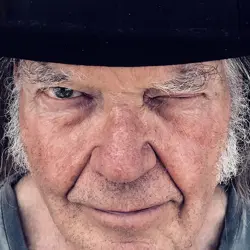
 Neil Young Profile
The killings of Renée Good and Alex Pretti by ICE agents left segments of society around the world so stunned, numb or angry that it took music godlinks to put the tragedy into words.
Almost 50 songs were written in the weeks after.
Billy Bragg’s City Of Heroes was written, recorded and released within 24 hours as “a tribute to the bravery of the people of Minneapolis,” Bragg said.
“Knowing that these trigger-happy ICE thugs operate in their midst, they are still willing to put themselves in harm’s way to defend their community.”
Dropkick Murphys, who 20 years ago wrote a mock recruitment song for the CIA, rushed out Citizen ICE, “We’ll teach them all our secrets and then we’ll walk away/We’re knee-deep in guerrillas, yeah the party never stops/United States of America, undercover cop.”
Others came with titles such as Minnesota Nazis (NOFX), Did You See What Happened In Minneapolis? (Dezi Music), Bad News (Zach Bryan), Pretend You Remember Me (Tom Morello), Tell Me What Terrorism Looks Like (Speak Now Sasha), There's Blood Upon The Snow In Minneapolis (Jodi Jones), The World's Gone Wrong (Lucinda Williams), Cold As ICE (Jax the Band), Come Out Ye Cowards ICE (Carsie Blanton), A Song for Renee Good (Odin Scott Coleman), and Who Is She to You? (Lamaar).
The most high-profile of these, Bruce Springsteen’s Streets Of Minneapolis (calling out “King Trump” and his “federal thugs”), had 2.5 million views on the first day. It went to #1 on YouTube charts in 19 countries including Australia, the US and Italy.
Here are 12 examples through the years.
Ohio – Crosby, Stills, Nash & Young (1970)
On May 4, 1970, students at Kent State University in Ohio, protested the US administration’s secret bombing of Cambodia, the Governor over-reacted.
He foolishly sent in the National Guard with live ammo and they opened fire, killing four as they ran away. Two were simply going to their next classes. Other students there included Chrissie Hynde later of The Pretenders, and Gerald Casale later of Devo.
Crosby, Stills, Nash & Young – at the time among the biggest acts in the world – were on holidays. Neil Young and David Crosby were chilling out in a log cabin in Northern California.
Young saw photos in LIFE magazine, including a student bent over a dying protestor, picked up his guitar and walked into the woods. “He came back an hour later with the song completed,” Crosby related.
Stephen Stills and Graham Nash were contacted in Los Angeles to book Record Plant Studios for that night. Ohio was finished in a few takes. In the fade out, Crosby is repeating “Four!", "How many more?" and "Why?". He cried when he heard the end result.
Also recorded that night was Stills’ Find The Cost Of Freedom, which the band would in concert perform segueing into Ohio. Atlantic Records rushed the track to radio even though CSN&Y already had Teach Your Children in the charts at the time.
With lines like “Tin soldiers and Nixon’s coming/We’re finally on our own”, many radio stations banned the track. Most Americans blamed the protestors for the tragedy, and Nixon won by a landslide in the 1972 elections, including a margin of 21% in Ohio.
Now Ohio is played on classic rock radio and inducted into the Grammy Hall of Fame in 2009.
Pure Massacre – Silverchair (1995)
Pure Massacre, the second single from Silverchair’s debut album Frogstomp reached #2 in Australia and New Zealand and charted in the US, Canada and the UK.
It was inspired by TV news of the Bosnian War, according to Daniel Johns. "It's pretty stupid, war, like that. So, it seemed the right thing to write a song about, rather than about the usual--girls or whatever. It took about a half an hour; it came straight to my head."
Eddie Mabo – Neil Murray (2000)
Warumpi Band co-founder Neil Murray (My Island Home) spent much time with First Nations artists (“because of their truth”) and issues.
Torres Strait Islander and land rights activist Eddie Mabo took on the might of Australian history and law by taking to court the lie of “terra nullius” by early lawmakers that the continent was not populated.
The High Court agreed with Mabo, officially recognising the rights of Aboriginal and Torres Strait Islander people.
Murray explained, “I wrote the song mostly from what would have been going through his mind when he began the court case.”
Lines included “When you see me in the morning going down, I’m gonna meet them. Ones with all the money and the power, I'm going to face them.”
Angel – Sarah McLachlan (1998)
Angel was directly inspired by the heroin overdose death in 1996 of Jonathan Melvoin, who’d been keyboard player with Smashing Pumpkins.
She recalled, “I was reading a Rolling Stone article OD’d on heroin in. Flood of emotion, empathy, recognition, of their feeling of isolation and desperation, I’ve never done heroin – never have – but we all have things to learn or pull from, in tough situations.”
Much of the song came together in four hours. Lines like "You're in the arms of the angel/May you find some comfort here" make it sought-after at funerals and memorial services.
Polly – Nirvana (1991)
In April 1987, a 14-year old girl returning from a punk rock show in Tacoma, Washington was kidnapped by one Gerald Friend.
He hung her upside down in his mobile home, raped her, and tortured her with a blow torch. She escaped, and Friend was caught and jailed.
Kurt Cobain that year remembered reading an article about Friend’s earlier rape in the 1960s. He kidnapped a 12-year old and her brother as they were hitchhiking in Sumner, Washington.
He threw the boy out of the truck, and subjected the girl to horrific abuse. She escaped by pretending to enjoy herself and putting him lower his guard, and jumping out when he stopped at a service station. He was jailed for 75 years but released after 20 years even though he twice tried to escape from prison.
Polly is not the name of either girl. For Cobain sexual assault was one of the "worst crimes on earth." He wrote it from the perspective of power and control. It also addresses how victims of continual assault become conditioned to obeying the aggressor in return for rewards and favour.
Even something as insignificant as a cracker. Hence the line, “Polly wants a cracker/I think I should get off her first.”
The song was titled Cracker when Cobain cut a voice/guitar demo in 1987 (this version is on Nirvana’s rarities set With The Lights Out from November 2004) but released on 1991’s breakthrough Nevermind.
In the liner notes to the 1992 compilation Incesticide, Cobain revealed, "Last year, a girl was raped by two wastes of sperm and eggs while they sang the lyrics to our song Polly. I have a hard time carrying on knowing there are plankton like that in our audience".
Blue Sky Mining – Midnight Oil (1990)
Blue Sky Mining was Midnight Oil’s response to the plight of the 20,000 men – mostly newly arrived migrants – who worked in the Wittenoom asbestos mine in Western Australia where blue asbestos was mined between 1947 and 1966. It is said 25% died of asbestos-related diseases.
The "blue" is the blue asbestos, and the "sugar refining company" refers to the Colonial Sugar Refining Company, owner of the mines. The song’s Motown feel was suggested by producer Warne Livesey.
Smoke On The Water – Deep Purple (1973)
Deep Purple arrived in Montreux, Switzerland in December 1971 to record their Machine Head album at the casino.
There was to be one more concert at its theatre before it closed for its annual winter renovations, allowing the British band to finish its sessions without disruptions.
That final concert (December 4th) was by Frank Zappa and The Mothers Of Invention. Zappa was intellectual and provocative and polarising.
During the end of the 90-minute show, someone in the audience fired a flare gun towards the rattan-covered ceiling. The heating system exploded, and a couple of people were injured,
The ensuing fire burned down the entire casino complex. From their hotel on the other side of Lake Geneva, Purple watched the building burn, casting reflections on the water.
While the band moved its recording sessions to a theatre, bassist Roger Glover woke from a dream a few days later with the image of billowing smoke reflected on the water.
As per Far Out, he recalled, "It was probably the biggest fire I'd ever seen up to that point and probably ever seen in my life. It was a huge building.
“I remember there was very little panic getting out, because it didn't seem like much of a fire at first. But, when it caught, it went up like a fireworks display.”
In the song, “some stupid with a flare gun” referred to Zdeněk Špička, a Czechoslovakian refugee living in Épalinges whom police named as a suspect, but fled the country before arrest.
"Funky Claude" was Claude Nobs, then-director of the Montreux Jazz Festival who helped audiences out of the building and found Purple a replacement space at Pavilion Theatre.
Ritchie Blackmore came up with the iconic Smoke On The Water guitar riff, which on the record was made tougher with Jon Lord repeating it on a Hammond C3 organ put through a distorted Marshall amp.
Blackmore revealed the main riff was an interpretation of the inversion of the main theme of Beethoven’s Symphony No. 5, and quipped, "I owe him a lot of money".
Smoke was the only track made at the Pavilion. The band got booted out after noise complaints, and finished Machine Head at the Grand Hôtel de Territet using its hallways and stairwells.
A plaque was set up at the back entrance of the hotel while notes from the riff was a decoration on the balustrade of the rebuilt casino.
Circles – Pierce The Veil (2016)
On November 13th, 2015, members of the Brussels cell of Islamic State attacked The Bataclan Theatre on the boulevard Voltaire in Paris armed with Zastava M70 assault rifles, Bulgarian AKKS-47 rifles, Chinese Norinco Type 56-1, TATP suicide belts and butcher knives.
It was targeted because its owners of 40 years, Pascal and Joël Laloux, were Jewish brothers who actively supported Israel and Jewish organisations.
The attack took place during an Eagles Of Death Metal show before 1,500 people. Initially many mistook gunfire for pyrotechnics.
Bloodied bodies fell on those of others, while those in the balcony dropped lifeless onto stalls below. 137 died (including seven attackers killed by police or detonated suicide bombs) and 416 were injured. 20 were taken hostage.
San Diego post-hardcore band Pierce The Veil’s lyricist Vic Fuentes wrote Circles about two (hypothetical) friends at the show trying to save each other as the massacre continued. The idea came from watching the Eagles Of Death Metal talk about it on TV.
“They said a lot of people died trying to save their friends, and that just really affected me, thinking about these kids at a rock show trying to save their friends,” he explained. “And I realized that could have been our band or any of our friends’ bands, and the whole situation really hit me hard.”
Ballad Of The Beaconsfield Miners – Foo Fighters (2007)
At Foo Fighters’ one-off show in Launceston, Tasmania in January, Dave Grohl brought out Brant Webb for an emotional reunion onstage.
In 2006, Webb and Todd Russell spent 14 days trapped a kilometre underground after a mine collapse in Beaconsfield in Tasmania's north.
During the ordeal, the pair requested Foo Fighters's music to boost their spirits.
Grohl faxed them a message, "Though I'm halfway around the world right now, my heart is with you both, and I want you to know that when you come home, there's two tickets to any Foos show, anywhere, and two cold beers waiting for you. Deal?"
He also wrote Ballad Of The Beaconsfield Miners. He told the Launceston crowd: "It was such a huge and profound moment for me… it really hits home."
Let The Franklin Flow – Gordon Franklin And The Wilderness Ensemble (1983)
In 1983, the Tasmanian Wilderness Society launched a campaign to stop the proposed damming of the state’s pure and picturesque Gordon and Franklin rivers for a hydroelectricity project, which would have destroyed a large wilderness area.
Shane Howard of Goanna, who joined the picket line, wrote Let The Franklin Flow to raise money for the project. Gordon Franklin And The Wilderness Ensemble included members of Goanna and Redgum, and their shared producer Trevor Lucas.
It peaked at #12 on the charts and raised thousands of dollars. The success of the campaign led to the formation of the Greens as a national political party.
Street Fighting Man – The Rolling Stones (1968)
1968 was the year of violent leftwing student and civil rights protests around the world, a movement that Mick Jagger was interested in.
He and Keith Richards attended an anti-war rally on March 17th at London’s Trafalgar Square, where 10,000 peacefully protested US forces in Vietnam, and demanded Britain pull its troops.
But a four-hour break-away rally outside the US embassy in Grosvenor Square turned violent. 50 cops and demonstrators were sent to hospital, and 200 arrested. Jagger was caught in the scuffles, and Street Fighting Man was born.
Jagger told Rolling Stone: “It was a direct inspiration, because by contrast, London was very quiet ... It was a very strange time in France. But not only in France but also in America, because of the Vietnam War and these endless disruptions ... I thought it was a very good thing at the time.
“There was all this violence going on. I mean, they almost toppled the government in France; de Gaulle went into this complete funk, as he had in the past, and he went and sort of locked himself in his house in the country. And so the government was almost inactive.”
The lyrics of Street Fighting Man reflected the relative calm of UK protests, using the line, “But what can a poor boy do/‘cept sing in a rock and roll band.”
But musically it remains one of the best soundtracks of violent street rallies.
With a rhythm based on police sirens, it kicked off with an acoustic guitar (with an opening tuning in front of a portable Philips cassette recorder microphone to provide rough distortion) and thundering drums and building up with piano and sitar. It was banned by many radio stations for fear it would spark more civil disobedience.
Woodstock – Joni Mitchell (1970)
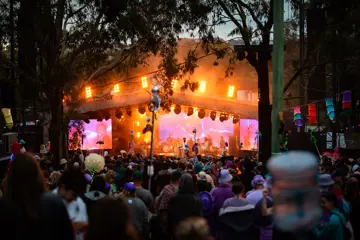
One of the greatest love songs to the turning point of the ‘60s global hippie movement was written by someone who wasn’t there but picked up the vibes watching TV footage in a hotel room.
Joni Mitchell was booked for the 1969 Woodstock festival held on Max Yasgur’s farm in Bethel in upstate New York over three days in mid-August.
The idea was she’d do her set and then hot-foot it back to New York City to appear that night on a career-boosting appearance TV’s The Dick Cavett Show.
Festival organisers expected 25,000 to 30,000 to show. But it drew 460,000 (including Marcia Hines), creating traffic jams and abandoned cars on the road.
It became a logistics nightmare for managers to find helicopters to get their acts to the site.
Mitchell’s manager, David Geffen, decided she’d cancel out because the TV appearance was too important. He and the Canadian singer songwriter watched it in the comfort (look ma! no mud!) of his hotel suite in New York.
Aside from TV footage, Mitchell also got filled in about the experience of her boyfriend Graham Nash. He’d played with Crosby, Stills, Nash & Young at their second-ever show and told the audience, “We’re scared shitless!”
"The deprivation of not being able to go provided me with an intense angle on Woodstock,” the Canadian folkie later said. Woodstock nailed the sentiment of the day, based around a person heading to the festival to join in the "song and celebration" and "Well, I came upon a child of God, he was walking along the road.”
The tone was triumphant: "By the time we got to Woodstock, we were half a million strong!" Yasgur’s farm was equated with the biblical Garden of Eden ("and we've got to get ourselves back to the garden"). Elsewhere it declared, "We are stardust, we are golden..."
While Jimi Hendrix’s closing set at Woodstock was anti-war with guitar sound effects to the US national anthem denote bombs falling on Vietnamese children and unarmed civilians, Mitchell went the spiritual route: "Bombers riding shotgun in the sky... turning into butterflies above our nation."
Mitchell’s version was on the B-side of her Big Yellow Taxi hit. But in America and Australia, the notable version was by Crosby, Stills, Nash & Young on their Déjà Vu album. In the UK the rendition by British band Matthews Southern Comfort topped the charts.
Singer songwriter Melanie’s hit Lay Down (Candles In The Rain) was also inspired by Woodstock.
The Monterey Pop festival in California a year earlier inspired Hendrix’s Little Wing relating the experience to a beautiful girl, and The Animals’ Monterey.
The Grateful Dead’s New Speedway Boogie was about the disastrous Altamont festival in 1969.
The half a dozen numbers created from the Burning Man experience include those by Inca Babies (Burning Town), Kevin Coyne (A Distant Desert), The Janitors (Both Ends Burning) and The Aardvarks (Bargain Day).
Tributes to Coachella include Lana Del Rey’sCoachella – Woodstock In My Mind, Cashmere Cat 9’s After Coachella, Gucci Mane’s Coachella,and Matoma’s more carnal Girl At Coachella.