 Bad Bunny Profile
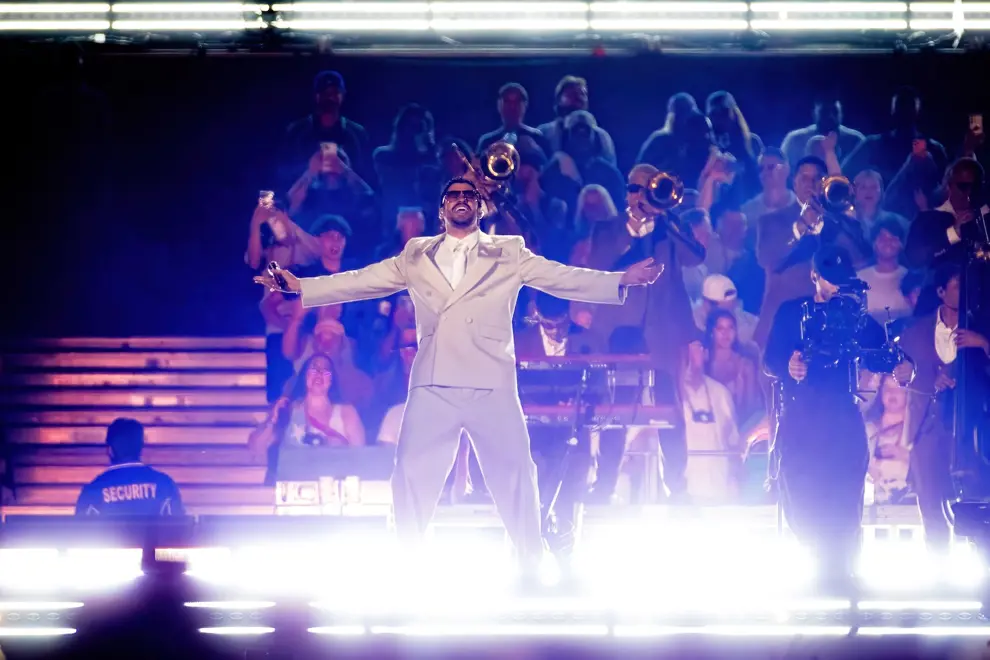
Bad Bunny’s streak of Spanish-language hits on the ARIA Chart and drawing almost 90,000 this month to Sydney’s ENGIE Stadium proved a flashpoint for growing taste of local audiences.
But this move has been coming for a while, here and overseas, and has accelerated due to the impact of streaming and TikTok.
Promoter Live Nation’s Living For Live Global Study 2025 found that almost 70% of music listeners listen to more global artists than ever, with 65% seeking music from outside their own cultures.
But non-English language songs storming local charts began 68 years ago, when Domenico Modugno’s Italian song Nel blu dipinto di blu (Volare) stayed at Number One for seven weeks from October 25, 1958.
Through the years, our mainstream and community radio charts included First Nations dialects, Korean, Japanese, French, Latin, Sanskrit, German, African Spanish, and Arabic.
SPANISH
The first Spanish-tongue track dented the Australian chart back in 1957. That was the year American Latino singer Richie Valens had a hit cover of the 1929 Mexican folk song La Bamba.
However, the song would have to wait until 1987 for Los Lobos to take it to #1 in Australia. The word “bamba” is of African origin for “wood”, and refers to dancing on a wooden floor.
Tequila (1958) was an instrumental by US band The Champs, who named themselves after singing cowboy Gene Autry’s horse. It was written by Mexican-origin saxophonist Danny Flores (“godfather of Latino rock”), based on the Cuban mambo song Como Mi Ritmo No Hay Dos. The title was spoken three times.
It was originally a throwaway B-side (recorded in three takes) for Dave Burgess’ Train To Nowhere. The single struggled until a Cleveland DJ flipped it over. In three weeks, Tequila was at #1 in America and became an international hit, winning a Grammy the year after, and was inducted into the Grammy Hall of Fame in 2001.
Another global evergreen, Guantanamera, meaning a woman from the Cuban city of Guantánamo, started life as a political poem dedicated to Cuba. There were numerous versions from the ‘30s, but the best known was by the vocal group The Sandpipers (1966).
A big explosion came in the mid-’90s with Los del Río’s Macarena. As a result of their lounge act, the duo from Spain was invited to tour South America in 1992.
At a private party in Venezuela, they were transfixed by a flamenco dancer’s routine. Right then and there, they came up with the chorus, “Give your body some joy”.
After a slow start by the original track, two dance remixes moved it to 14 million worldwide sales, fuelled by dance routines. In Australia, Macarena was #1 for nine weeks from August 31, 1996, and the biggest song of that year.
Two years later, Ricky Martin had a six-week workout at the top with Maria alongside the English language The Cup Of Life.
Also fuelled by a global dance (three weeks in October 2002 here) was The Ketchup Song (Aserejé), by Spanish pop group Las Ketchup.
In the song, young dude Diego was in a nightclub. His DJ friend spun his favourite song, The Sugarhill Gang’s Rapper's Delight. Diego responded with a song and dance routine, making up gibberish in Spanish, Aserejé, ja, de je, de jebe tu de jebere ..." in response to the US rappers’ chorus "I said a hip-hop, the hippie the hippie to the hip hip hop ...”
Despacito (2017) by Puerto Rico’s Luis Fonsi and Daddy Yankee (helped by a Justin Bieber remix) was a milestone. By last year, it had generated 2 billion streams.
Topping the charts in 47 countries, Despacito spent a record-breaking 56 weeks at the top in America, 26 in Spain, 20 in Switzerland and 13 in Australia, where it earned 5 platinum certifications for sales of 350,000.
Building the momentum sharply were two collaborations by Colombia’s Shakira, Bzrp Music Sessions, Vol. 53 with Argentine producer Bizarrap in 2022, and a year later, with Karol G on TQG (or Te Quedó Grande, translated to Too Big For You). Both were deadly aims at exes and considered self-empowerment anthems.
TQG whipped up 1.18 billion subscription streams equivalents globally.
FRENCH
Belgian-born Jeannine Deckers was The Singing Nun, whose 1963 track Dominique was about Saint Dominic, the Spanish-born founder of the Dominican Order, of which she was a member.
It topped the charts in eleven countries, including Australia. She was a celebrity. But her business naiveté about contracts saw royalties go to the producers. She went broke, lost her faith, and suicided in 1985 with her partner Annie Pécher.
The Beatles’ Michelle emerged in 1965 on the Rubber Soul album. But Paul McCartney had started work on it in 1959, using his first ever guitar, a Zenith, which he still has.
Liverpool was going through a bohemian French movement. John Lennon’s tutor at the Liverpool College of Art, Austin Mitchell, threw great all-nighters where sex and drinks were freely available (“which was what it was about at that age”, McCartney quipped) and French singers sporting black sweaters and goatees would perform French songs in the living room.
“I used to pretend I could speak French, because everyone wanted to be like Sacha Distel”, Paul recalled. The name Michelle was a nod to Austin Mitchell.
Six years later, while gathering songs for Rubber Soul, Lennon told McCartney to finish off the number, and helped him with the middle-8. It was always going to have French lyrics, so Macca asked a French teacher, the wife of a friend, to help.
She came up with "Michelle, ma belle" and changed "these are words that go together well” to French. Michelle is one of their most covered songs. A highlight for Paul was singing it to Michelle Obama when performing at the White House on June 2, 2010, after being awarded the Gershwin Prize for Popular Song by President Barack Obama in a ceremony there.
Rubber Soul had sold 15.2 million, 275,000 of that in Australia. A version by The Overlanders reached #2 here.
Belgian chappie Plastic Bertrand’s joyous new wave three chord Ça plane pour moi (1978) was roughly translated as “this works for me”. It worked in Europe and reached #2 in Australia.
A court case in 2010 disputed whether he or its writer/producer Lou Deprijck did the vocals. An audiologist testified that the accent was Deprijck’s, but a Brussels court sided with Plastic.
FIRST NATIONS LANGUAGES
There are 250 First Nations languages, including around 800 dialects. Some have reached international acclaim.
Yothu Yindi’s Treaty (1991) used a mix of English and Gumatj, a Yolngu Matha dialect of the Yolngu people of Arnhem Land in northern Australia. The Filthy Lucre remix, which reached #15 here and spent 22 weeks in the charts, made it to #6 on the Billboard US Hot Dance Play, and charted in the UK, Netherlands, Belgium, and Switzerland.
Gurrumul Yunupingu took the Gaalpu, Gumatj, or Djambarrpuynu dialects to European ears when his albums – which went Top 3 in Australia and Djarimirri (Child Of The Rainbow) from 2018 peaked at top spot – cracked charts in Belgium, France, Germany, Netherlands and Sweden.
Electric Fields took Pitjantjatjara and Yankunytjatjara to the Eurovision 2024 stage, with the phrases milkaḻi kutju “one blood” and milkaḻila “we are blood.”
ARIA-winning singer-songwriter and producer Emily Wurramurra sings in Anindilyakwa, a language spoken by 1,516 people from Groote Eylandt and Bickerton Island in the NT.
Although the toughest grammar of First Nation languages, a song like Ngarrikwujeyinama (roughly translated: The Seabed Mining Song) had a greater impact as it delivered a message about the mining on Groote Eylandt and “how we all come from the sea and how it’s our duty to protect and cherish her, and the pain we cause when we don’t.”
Similarly, on I Feel Better But I Don’t Feel Good, Alice Skye found using her Central Victorian language Wergaia on the “Yergan gumbar yerginjan, wurega djalin” (roughly translating to ‘I am searching, I am listening / I will search, to speak my tongue’) made more impact.
JAPANESE
Japanese crooner Kyu Sakamoto’s Sukiyaki (1963) started out as Ue o Muite Arukō, aka I Look Up As I Walk. The character looked up while he is walking so that his tears will not fall to the ground. The words came together after lyricist Rokusuke Ei was heading home after a protest rally against a Japan-US military agreement in 1960.
Smart marketing saw the international version retitled to the Japanese hot pot dish with cooked beef. The word “sukiyaki” did not appear in the lyrics. But it worked. It was one of the fastest-selling singles of all time. It sold 13 million at the time, and reached #1 in places like Australia (two weeks in July) and the US.
SANSKRIT
Sanskrit phrases seeped into Beatles songs after they journeyed to Rishikesh in India to study spirituality under the Maharishi.
The refrain "Jai Guru Deva Om" on Across The Universe (a mantra for the mind to move into higher consciousness) was printed on two brass bracelets that he bought at the ashram.
George Harrison’s The Inner Light, the B-side of Lady Madonna, used Chapter 47 of the Taoist Tao Te Ching, which Sanskrit scholar Juan Mascaró suggested to him after he translated the passage in his 1958 book Lamps Of Fire.
Harrison’s while-my-sitar-gently-weeps onslaught on Within You Without You took from Vedanta philosophy, particularly the concept of maya (“illusions”) and how the way you live selfishly can stop you seeing the truth in the line
"And the people who hide themselves behind a wall of illusion / Never glimpse the truth".
In 1996, UK band Kula Shaker, which used Indian influences in its rock music, issued Govinda, sung entirely in Sanskrit.
Early ‘80s UK band Monsoon, which used Indian inspirations, had a #1 club hit in Australia with debut single Ever So Lonely. On their Third Eye album (1983), their singer Sheila Chandra, with Indian parentage, did a Hindi version of the hit.
That was embraced by local community radio, which also created high profiles for Australian acts who paid tribute to their cultural backgrounds. One was The Bombay Royale, fronted by Parvyn and Shourov Bhattacharya, who sang in Hindi, Bengali and English.
Another was singer-songwriter Ashwarya, whose breakout single Biryani was delivered in Hindi.
GERMAN
At a June 1982 Rolling Stones show in West Berlin, balloons were released, changing shape, looking like UFOs as they drifted up. Nena's guitarist, Carlo Karges, wondered about the military response if the “UFOs” floated into East Berlin.
Also, an inspiration was a 1973 item in The Las Vegas Review-Journal about five high school students who released 99 balloons in tandem tied to red flares to make it look like a giant spaceship hovering near the Las Vegas Valley.
The 1984 Nena song became a Cold War anthem. The English one was titled 99 Red Balloons, the original German one was 99 Air Balloons. Australian radio went for the German language, where it was #1 for five weeks from April 2, 1984. So did the US, where the track, umm, floated up to #2.
The first German-language track to top the US charts was Austrian musician Falco’s Rock Me Amadeus in 1986, staying there for three weeks. In Australia, the track slipped down after peaking at #15 but had massive success in Europe.
It was written by Dutch music producers Bolland & Bolland, who were approached by Falco’s manager to work with him. A day later, by coincidence, Rob Bolland went to the cinema to see Amadeus, about classical composer Wolfgang Amadeus Mozart. The song, which began, “He was the first punk ever to set foot on this earth,” recounted the child prodigy’s genius, wild bohemian lifestyle and huge debts.
Falco was flown to their Holland studio. On the first day, he fell into their arms drunk and sent back to his hotel. The next day, he returned sober but hated the song and wanted to do a The Cars cover. He eventually relented.
A sax player asked to do the squiggly bit on the track, but thought it ridiculous and demanded it be pulled. They released it with it anyway. After it became a huge hit, the saxman wanted a cut of the royalties because his sax made it a hit. Falco died in a car crash in February 1998, aged 40.
AFRICAN
The joyful phrase "Mama-say, mama-sa, ma- ma-ko-ssa” (meaning “I dance”) put the Cameroon lingo on top of the charts twice. It first appeared on Soul Makossa (1972) by Cameroonian sax player Manu Dibango in the Duala dialect.
It was used on Michael Jackson’s Wanna Be Starting Somethin’ (1982) for the Thriller album, currently the biggest-selling album of all time at 125 million, with original Australian sales close to 2 million.
The phrase was also used in Rihanna’s Don’t Stop The Music (2007), about the joy of going clubbing. It reached #1 in Australia, where it was certified 8 x platinum for sales of 840,000.
Both artists were sued for millions by Dibango, who later settled out of court.
One-time Australian resident Sampa The Great used English and Bemba, her mother’s native tongue, for the song F E M A L E.
ITALIAN
Domenico Modugno’s Nel blu dipinto di blu (Volare) was massive in 1958, at #1 for seven weeks in Australia, and five weeks in the USA. It’s popularly known as Volare (To Fly).
A line about “flying to infinity” came from co-writer Franco Migliacci’s feeling that he wanted to soar in the air every time he was with his lover.
The one about painting himself blue was from a Marc Chagall painting hanging on his wall, in which Chagall had painted his face blue.
Volare was Italy’s 1958 Eurovision Song entry. It came third but is the most covered Eurovision song of all time, most notably by Dean Martin.
These covers were calculated in 2004 to have shifted 18 million copies in total. The Italian Society of Authors and Publishers recognised it as the most played Italian song in Italy and the world.
Volare was the first to win a Grammy for both Record of the Year and Song of the Year. It is also the basis for football chants.
LATIN
An astonishing amount of rock acts incorporate Latin phrases or tackled whole ancient songs.
The most successful in Australia was German project Enigma’s Sadeness Pt 1 (1990). Its video was of a dream of entering The Gates of Hell. The track featured monks chanting in Latin, as well as one of the producers’ wives whispering seductively in French. It reached #1 in 14 countries, and #2 in Australia.
The chorus of U2’s Gloria (1981), "Gloria in te Domine / Gloria exultate" translates to "Glory in You, Lord / Glory, exalt [Him]" incorporating The Bible’s Psalm 30:2. The song also references Colossians 2:9-10 ("Only in You I'm complete") and James 5:7-9 ("The door is open / You're standing there").
In the 1994 book Race Of Angels, Bono revealed he loved the lyric in the way it suggested talking in tongues. He said, “Taking this Latin thing, this hymn thing. It's so outrageous at the end, going to the full Latin whack. That still makes me smile. It's so wonderfully mad and epic and operatic.”
Gloria was one of U2’s lowest charting singles in Australia, peaking at #32. But it was one of their fist-raising highlights of their live shows.
For a full list of rock songs with Latin lyrical references, head here.
ARABIC & PERSIAN
Queen fans long debated how many languages Freddie Mercury spoke. He was born Farrokh Bulsara in Zanzibar, Africa (the main language there is Swahili), to Indian parents of the Parsi community, who descended from Persians. He most likely spoke Gujerati and Hindi to cousins.
Bulsara started studying as a child in English-language boarding schools in India and Zanzibar before the family moved to the UK. The racism he copped there saw him dilute or abandon the early languages to be accepted. It’s also said he spoke some French, German, and Japanese.
The Jazz album, which peaked at #15 in Australia, included the track Mustapha (1979). It included Persian and Arabic lines as "Allah, Allah, Allah we'll pray for you", "salaam alaykum", "alaykum salaam" and "Achtar es na sholei" meaning "His star, not his flame.”
KOREAN
Psy’s Gangnam Style (2012) – giving a finger to the nouveau riche lifestyles in the Gangnam region of Seoul – was the first to open up Australians to South Korea’s music, dance, fashion and even food, in a big way.
It debuted on the ARIA chart at #7 in September 2012, three weeks scampering to the top spot after Psy arrived in Australia to perform on The X Factor and Sunrise.
It was the first-ever Korean-language track to make it into the ARIA chart, the first non-English language track to go #1 since Las Ketchup’s The Ketchup Song in September 2002.
It sold 700,000 units here and spent 16 weeks in the Top 10. Its stay at #1 was for six weeks.
But other K-Pop hits had longer stays at the top spot. Rosé and Bruno Mars’ Apt. (October 2024) hung in for 14 weeks. Huntr/x’s Golden (August 2025) kept on keeping on for 10 weeks, riding off the hefty success of the Netflix movie KPop Demon Hunters.
The soundtrack sat at #1 for a number of weeks, and also catapulted singles Soda Pop, Your Idol, How It’s Done, What It Sounds Like, Free, and Takedown.
Takedown, which peaked at #11, was performed by Jeongyeon, Jihyo, and Chaeyoung of girl group Twice, who played four arena dates in Sydney and Melbourne in November 2025.
Blackpink’s Pink Venom (August 2022) only stayed for a week. But it at last did better than the Coldplay/BTS match-up My Universe (September 2021), which stalled at #7.
BTS, one of the biggest K-Pop live acts in Australia, have had a series of Top 30 hits, with Boy With Luv (2019) reaching #10. Band member Jimin’s Like Crazy peaked at #23 in April 2023. Their chart attack may intensify when they hit Australia in February 2027 for their first tour in ten years, with shows in Melbourne and Sydney.