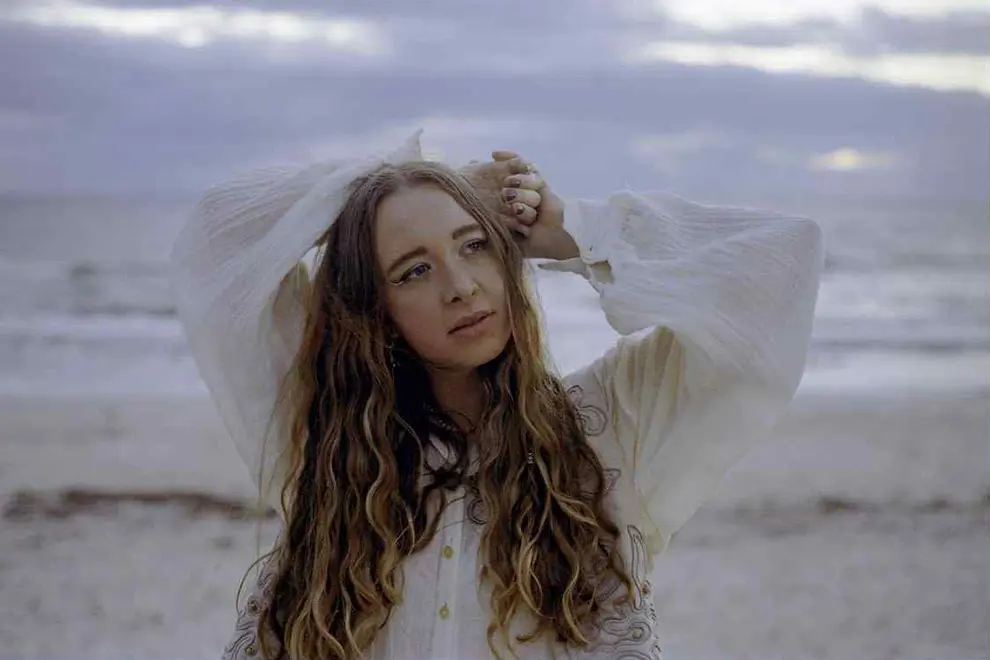
South Africa raised and Adelaide based, singer-songwriter My Chérie (aka Cherie de Klerk) has capped off the month by releasing a captivating new video for her song Box Of Pencils from her 2025 EP Life is Short & Life is Long.
The video accompanies the most vulnerable song de Klerk has ever written, and also one she nearly didn't release. It explores Chérie's lived experience as a queer woman growing up in South Africa from a Christian background while diving into the cultural pressures and generational weight that many women carry.
The song imagines what it would have been like if she "chose the other life,” with visions and lyrics of her being "somebody's wife, children all around, maybe my mother would feel so proud".
She took a number songs to director Bryce Kraehenbuehl and the team to see which would be the best one to make into a music video. The team unanimously decided Box Of Pencils was the standout song.
However, it was the song de Klerk hoped they wouldn’t choose because it was the one she was most nervous to create.
“It's a song that I think a few years ago I wouldn't have had the courage to release,” de Klerk explains over Zoom from her home in Adelaide.
“Over the last few years it was realising that the courage comes from actually doing the thing – releasing the song and putting the visual to it. So, for me, it's kind of been a process of not waiting until I feel courageous enough to talk openly about my background, but rather slowly sharing these things and then healing and getting more courage in the process of that.
“I think the song has a few different layers, the biggest thing being social pressure, when you can't give other people the life that they want for you and grieving that person that can't exist,” she adds. “When I had that song, I just had the vision of having a husband and kids. I was in my first proper queer relationship [at the time]. So it was just processing all of those social constructs that are put on us from such a young age.
“I've experienced it to a quite large degree with growing up Christian and in South Africa, which is a very different culture. What's normal there is quite different to here and just not wanting to let people down, so not sharing my life for a long time. So it felt like a very powerful and important song to release and to create a visual world that's so on the nose even with some of the topics.”
The video sees Chérie moving between eras and landscapes as she’s baptised in a river and is getting married in an old fashioned, traditional church. It follows one soul living through different times and spaces, never able to be their true self.
It conjures thoughts of people from the past who weren’t presented with the same opportunities of the modern era.
“During the church scene I was really thinking back to the women that fought for the rights that we have today, and I felt spiritually, like their energy was in me in that moment,” de Klerk remembers. “I guess that's probably what actors and stuff experience, which was really cool, when you kind of really take in what you're presenting.
“That it represents years of people going through that who didn't have the same opportunity to share that story. Just thinking of an individual person that if they felt that, they wouldn't have had the same rights that I have.”
de Klerk moved over to Australia from South Africa when she was 12 and shares that she’s very lucky to live here. She still imagines what life would have been like in this different culture if she didn’t move to Australia.
“It would be different in so many ways. I often wonder and I think even through my journey of self-acceptance, I've thought about would I have even had any queer…” she pauses. “Like would I have known? Because in some countries if you don't have any exposure you might just shove it down and just not realise that you're even allowed to have those feelings.
“I was like ‘is it just because of it socially being okay’ and all of this,” she adds. “I think that I probably just wouldn't have understood what to do with the feelings.”
The video's final image sees de Klerk as a painter representing the life she is meant to live on her own terms. In her real life, she’s able to curate her own story and is still able to hold onto the religious beliefs she grew up with.
“I think it’s taken many years to kind of accept that by not defining God and the religion to the box that I was taught that it was, actually accepting that that’s okay, rather than that being bad,” she explains.
“I think the thing that you live with once you've grown up with it is this constant awareness of the life that you're not living, which I guess is essentially what the song was about. I've slowly gotten to a place of accepting what I do believe, but I do find it difficult to know how to have access to that and that's actually what my next song [Stuck Inside My Head] is about.
“I've got ADHD, I've got a busy brain, I think just practically I had church on a Wednesday, Friday, Sunday, that's a lot of time in a space where you're practising spiritually connecting to something outside of yourself,” she adds. “I think, for me, it was just, ‘Where do I find that and when do I remember to go and find that?’ Then not feeling safe, or knowing which church I can go and find it and it having this heaviness.
“I've realised that music is one of the places where I can find it and so this project and making music and sharing music literally feels like my religion and who I'm connecting with in those spiritual moments. For me, I still define it as God and that gives me peace. But at the same time, I know that that same spiritual thing that I'm connecting with is what someone else might call the universe, or a muse, or something. I don’t feel like I can define and I don’t have the answers.”
de Klerk reveals it’s looking like a big 2026 where she hopes to tour interstate, release new tracks and keep chipping away at another body of work.
Although de Klerk is relatively fresh into her career it feels like she’s becoming one to watch in Adelaide’s live music scene. She has released three EPs, supported the likes of Lenny Kravitz and Daryl Braithwate, and scored a spot on the upcoming WOMADelaide line-up, but fans are still waiting for the debut album.
“I think it'll reveal itself, whether that's an EP or an album,” she teases. “I hate the idea of releasing an album before having a big audience behind it. That’s what I've been working towards, because I'm kind of over just releasing singles.
“Sometimes it’s like, ‘what if all 10 of these songs could be singles and you love them all?’ I hate how some of them fall off on EPs. That always makes me sad, because I'm like, if I chose that one to be the single, that would have lots more listeners.”
My Chérie performs at WOMADelaide on March 8th.
This piece of content has been assisted by the Australian Government through Music Australia and Creative Australia, its arts funding and advisory body