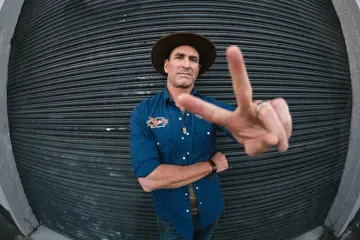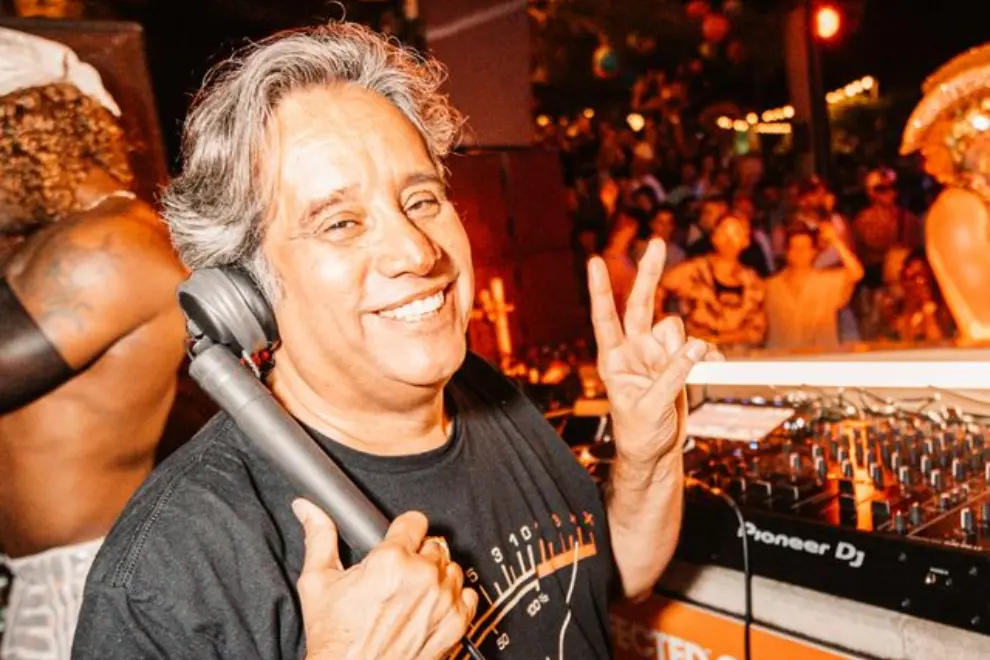
John "Jellybean" Benitez is finally playing Australia – and his myth precedes him.
Benitez was a hot DJ, producer, songwriter and remixer in the '80s, his presence felt in the nightclub scene and charts alike. The New Yorker not only broke records commercially but also popularised buzz hybrid dance music genres like freestyle in the post-disco era. He created a blueprint for the 'superstar DJ'. Benitez worked closely with Madonna in the studio when she was a rising star and produced her runaway dance-pop smash Holiday.
For years, rumours have circulated of Benitez hitting Australia. "At one point back in, wow, the mid-'80s, I was gonna go over there," he laughs. "[Countdown host] Molly Meldrum at the time was setting something up. But my schedule was so crazy. I kept having to [say] like, 'I can't go then, I can't go then.' So it ended up never happening.
“But I have a lot of Instagram followers from Australia 'cause, when I'm playing internationally, if it's Ibiza or Mykonos or somewhere people will go in the summer when it's cold wherever they are, [they go] 'Hey, I'm from Melbourne,' 'I'm from Perth.' So I'm looking forward to it – I'm super excited. I've spoken to so many DJs that have played there, and they keep telling me how much fun I'm gonna have."
Benitez is Zooming from Florida, where he lives by the beach. Youthful and possessing a warm smile, the legend is sporting a casual black V-neck T-shirt and seated in a room of vinyl in dust covers, the window curtained. He is touring nationally with Glitterbox, a spectacular disco-house party brand (and label) that Defected Records' Simon Dunmore founded in 2014, and is synonymous with the White Isle.
The DJ will co-headline with Germany's Mousse T., the line-up rounded out by French electro-boogie selector Breakbot and vocalist Irfane, and UK DJ Yasmin (repping the Aussie side is the duo Close Counters). The first stop is Naarm/Melbourne, and Benitez intends to explore the city. "Someone told me that Melbourne has more record stores per capita than any other place in the world," he asks. "Is that true?" (It is). In fact, Benitez has a solid association with Glitterbox, appearing in 2021's documentary Where Love Lives.
Coincidentally, Benitez's youngest daughter, Layla Benitez, will be in the country at the same time – the emerging DJ hanging out in his booth as a kid. She has played Coachella and is producing tracks and running her own label, Sheep At Night. Layla previously visited here last April (in Naarm/Melbourne, she was actually booked at Revolver). "She's doing amazing," Benitez enthuses. "We get to play together not as often as I would like, but we get to do it. So we played Pacha together in Ibiza, we played Space a few times in Miami, and we played in Mykonos. [But] we have yet to play NY together."
JELLYBEAN ROCKS THE HOUSE
The greatest DJs understand narrative – and Benitez has stories. "It's funny 'cause this month, on January 1st, 1976, was the first time I played in a club. Prior to that, I had done a lot of school dances and parties and little block parties – like all this stuff. But it was my first sort of paid gig in a venue. So it's been 50 years now. So I love doing it. You know, I would do it for free! The fact that someone still pays me to play records is funny."
Benitez was born into a Boricuas/Puerto Rican family in the South Bronx and raised by a single mother holding down an office role – his sister coined the nickname "Jellybean". And the DJ frequently fondly quotes his mom. She disapproved when the adolescent Benitez launched his career as a 'disc jockey', progressing from DJing at block parties to that inaugural regular slot – at the discothèque Charlie's in The Bronx.
Having discovered nightlife early, Benitez had a formative experience partying at The Sanctuary, where Francis Grasso phased in beatmatching. He hung out at record stores and partied at The Loft, David Mancuso's 'invite only' private event in the hotspot of Manhattan. "My mom used to say that to me when I was a teenager – like 'So you need to have a job.' I'm like, 'I have a job.' She's like, 'No, like a real job.' And I'm like, 'Mom, this is a real job.' 'Someone's gonna pay you to play records?' I'm like 'Yes.'"
DJ culture was in its infancy – with Benitez playing before the introduction of pitch control on turntables for beatmatching or headphones to cue songs or 45s. He'd spin a profusion of seven-inch records. The scene shifted with the advent of 12 inch vinyl, extended mixes initially a promotional vinyl format for DJs (and invented by disco pioneer Tom Moulton). "Those sounded so much better than the grooves on a seven-inch record," he says. As Benitez established his reputation, he DJed in ever more glamorous nightclubs – one the exclusive Studio 54, again in Manhattan.
But the charismatic Benitez arrived as a resident at the underground Manhattan club The Fun House in the early '80s – the booth a carnivalesque clown mouth. It was here he expanded his network over three years, leading to opportunities to produce.
"A lot of artists came there on a regular basis, and it just sort of evolved. I didn't have a plan in any way. I just in the back of my head kept hearing my mom's like, 'You need a real job.'" A tastemaker influencing radio programmers, Benitez took to the airwaves, too, with a weekend mix show on WKTU.
THE REMIX REVOLUTION
Benitez eased into production by becoming an industrious remixer, befriending Arthur Baker (he reworked Afrika Bambaataa & The Soulsonic Force's enduring Planet Rock). "A lot of DJs that I would go and listen to and respected were remixing records, and they were like, 'You should try this.' I'm like 'OK.' I felt I had nothing to lose and everything to gain."
Benitez went on to remix boombox bangers such as Irene Cara's epochal 1983 Giorgio Moroder-stamped Flashdance... What A Feeling off The Flashdance soundtrack (another flip of her Why Me? is still exhilarating). He was canvassed to remix veteran acts – among his many commissions were Paul McCartney's US chart-topping duet with Michael Jackson, Say Say Say, that serial self-reinventor David Bowie's Blue Jean and various Fleetwood Mac tunes from Tango In The Night (including a stellar Little Lies).
He helped English punk-rocker Billy Idol, a beneficiary of the MTV-backed Second British Invasion. He remixed Idol's New Wave classic Eyes Without A Face (now apparently lost) off Rebel Yell. "He came to the club to hear it played, and he was in a whole different world of what he envisioned the club was. He had never seen really an underground club where people were just dancing to soul music – and he liked it."
HOLIDAY: WORKING WITH MADONNA
In 1983, Benitez had met Madonna at The Fun House – the future Queen of Pop herself, the product of a working-class, Catholic, Italian-American family. Moving to NY from Detroit, Madonna premiered with Everybody, produced by Danceteria DJ Mark Kamins. Benitez secured an advance copy from his cohort and championed what became a crowd fave.
Madonna was labouring on her self-titled debut album for Sire Records with hired gun Reggie Lucas, yet wasn't vibing. In Benitez, she intuited a more streetwise collaborator for her soulful dance style – and they'd be an 'It' romantic couple. Was he conscious that he was part of something so iconic?
"I knew it was different; I knew it was special. I had started remixing records, and she was introduced to me by Bobby Shaw from Warner Bros. She asked if I would mix her next single – it was gonna be a double A-side with Physical Attraction and Burning Up – and I said, 'I gotta hear it.' So we got together, and I listened to the songs, and I was like, 'Yeah, I can do this.'"
Benitez tested the reel-to-reel tape recording at The Fun House. "Saturday, I started at 10 pm, and I went to 12 noon or 1 pm the next day straight through, so it allowed me to really spread my wings and play all kinds of stuff, even what they now call 'hip hop' and early New Wave – but it was all really soulful-based."
Benitez remixed other Madonna songs, tweaking Lucky Star. But, most significantly, he produced Holiday (composed by members of the disco ensemble Pure Energy) – Madonna's international breakout, with her supplying cowbell.
Music was changing – and Benitez was programming the novel LinnDrum machine. "I hummed all the parts to all the musicians, and I tapped out the groove – and that's how I made records. I knew what people would dance to, what would make them wanna get up to the dancefloor and then I also knew what made them stop dancing. So I tried to make a record that made people wanna get up and dance. And, for those five minutes, they were just lost in that moment."
The contemporary freestyle music was hip in Hispanic and Italian-American communities – and Benitez' Latin freestyle heritage could be heard on the sublime ballad Borderline, which he co-produced.
The success of Madonna's album ushered in New Wave dance-pop. She connected with Nile Rodgers for her second LP, Like A Virgin, but Benitez remixed the #1 title-track. He helmed Madonna's US #1 serenade Crazy For You (for which she received her first Grammy nomination) and Gambler – both from 1985's Vision Quest soundtrack, the famous "wannabe" sensation cameoing in the film as a dive bar performer.
Benitez had to adjust to celebrity. "With Madonna, our careers were taking off simultaneously, and it was really amazing to be part of it. And, yes, I was aware that, 'This is very different.' You know, walking down the street and being recognised was an alien concept to me. It [already] happened in record stores. When I did a record store, I was definitely gonna be recognised. But, to be just walking down the street or boarding a plane or something, that was all very new to both of us. We would just look at each other like, 'Wow, this is strange.'
"I recall one day walking down the street with her, and there's this woman in front of us singing Holiday to herself. We just looked at each other and, at the time, we're like, 'This is weird, is someone filming this?' – like trying to not be what is now known as being 'punk'd'. But that's what we thought – like, 'This is weird, what's going on?'
"But it was an incredible time in music, especially in NY. There were so many different evolving and burgeoning genres at the time that it all seemed fine. I was used to being around a lot of, I guess you would call them, 'very famous artists,' so it wasn't so unusual. It was just that, when I became part of that, it was, 'Wow, this is strange,' you know? But it all came from the love of the music and wanting to create."
LOVE WILL SAVE THE DAY: IN THE STUDIO WITH WHITNEY HOUSTON
Ironically, as his production accelerated, Benitez had less time for DJing – although, while Crazy For You was blowing up, he accepted a residency at The Palladium, a new club from the team behind Studio 54, alongside Larry Levan. Meanwhile, Benitez liaised with other pop stars – overseeing Debbie Harry's blithe Feel The Spin off the 1985 Krush Groove OST.
The DIY musician produced Whitney Houston's celebrated hit Love Will Save The Day, from 1987's blockbuster second album, Whitney (nominated for 'Album Of The Year' at the Grammys), after remixing How Will I Know off her eponymous debut (he similarly recast I Wanna Dance With Somebody (Who Loves Me) and So Emotional).
"She's my favourite artist that I ever worked with," Benitez recollects. Houston gave him instructions – "'I want a record that you would play in a club, that's what I really want.'"
He continues, "[Arista boss] Clive Davis took me to see her [premiere] at Carnegie Hall. We went backstage and met her, and we talked, and then she was like, 'I need your phone number, we need to talk – I really wanna do this.' She had only done really ballads. [But she said] 'I have this song, How Will I Know – will you listen to it and tell me what you think?' And I was like, 'Yeah, it's like a pop/R&B tune, but I could make it more accessible.'"
Benitez recounts in detail recording Love Will Save The Day and witnessing Houston's perfectionism. "The thing about her was that her voice was amazing. And that was a little over six minutes, the song. She came in and laid down the vocal, and then she laid another one and another one… But the first one was perfect. I still have it. I said, 'OK, I'm gonna create a composite of all the different things I like on these performances' – and it's what I did. It took me two hours.
“She was in the lounge, and I said, 'OK, I'm ready for you to hear this.' She came in, and I played it for her, and she said, 'It's great – is that what you want?' I said 'Yes.' [She goes], 'Would you mind if I sing it one more time?' And I was like, 'Yeah, OK.' She went in, and she had only heard it that first time – and that performance you hear on the record was one take. She'd listened to the composite I had done and matched it perfectly – all the breaths and everything.
"The song ends cold – and, if you listen to the record, you will hear Whitney laughing. The reason she's laughing is 'cause she was laughing at the look on my face, that I couldn't believe that she had nailed it. I just was like, 'How is that even possible?' I've worked with so many singers – no one's been able to do that ever, in one take done. I said, 'That's it – we're gonna finish the record around this performance.'
"That's a genuine moment – I remember it as clear as day. She was laughing at me, like 'You didn't think I could do it, you really didn't think I could do it.' 'You're right! You're right.'"
Benitez also proved himself as an artist – debuting on EMI Records with 1984's EP Wotupski!?! entailing a cult electro cover of Babe Ruth's groovy prog-rock The Mexican (recruiting the band's Jenny Haan) and the boogie Sidewalk Talk (featuring mystery vocalist Catharine Buchanan, but penned and partly sung by Madonna), both #1 on the Billboard Dance Club Songs chart and the latter among the earliest crossover hits for a DJ. He followed with the 1987 album Just Visiting This Planet – home to another classic in the hooky, sax-laden Who Found Who, showcasing later Prince protégée (and Savage Garden backing singer) Elisa Fiorillo. The LP was certified Gold in the UK.
LAST NIGHT JELLYBEAN SAVED MY LIFE
In 1991, Benitez married Canadian model Carolyn Effer and realised an unexpected appreciation for domestic life. After Spillin' The Beans (with the single What's It Gonna Be, performed by Niki Haris), Benitez pulled away from producing as well as DJing – though he transformed Duran Duran's Too Much Information, off their '90s eponymous comeback, into piano house.
"I stopped [DJing] in like '91, '92. I had two daughters, and I was just a dad. And, during that time, I had transitioned from producing records to producing films and writing scores for motion pictures, writing theme songs for television shows and working as a music supervisor."
In the '80s, Benitez was already involved in films – and he'd consolidate a profile in Hollywood, selecting the music for Brian De Palma's 1993 crime drama Carlito's Way, starring Sean Penn. He served as executive producer of HBO's acclaimed 2000 biographical movie For Love Or Country: The Arturo Sandoval Story, about the brilliant Cuban defector, which won Sandoval an Emmy.
Benitez' credits on IMDb are impressive, even encompassing Stranger Things. As supervisor, he honed the same instincts as a DJ, leaning into the emotion. "That was a great thing for me to be able to do when I wasn't DJing."
Benitez did miss playing out, however. "I would still go buy vinyl until it disappeared completely. So I would buy two copies, and my wife would say, 'Why are you still buying two copies of everything?' I said, 'You just never know – one could get warped, I may feel creative and want to extend it…' She was like, 'OK.' But I love playing records for an audience. I haven't found anything else that replaces that connection."
In the early 2000s, Benitez returned to DJing – Mancuso inviting him to guest at a Loft party. And, in 2011, he revived his radio sideline, hosting a show, In The Mix, on Studio 54 Radio for SiriusXM satellite radio – and is the channel's executive producer.
"There had never been a radio station in the US where you heard the entire 12-inch version of a song," he explains. "And, on Studio 54 Radio, I program the longest versions that we can find… But, for people that love disco in that era, it's really special to hear things… I get to play a lot of deep disco cuts that usually don't get played." Benitez has recorded sets live to broadcast. "If the venue co-operates and hangs microphones, you can hear people singing along or responding to the songs and the mixes and the breaks in the songs – it's fun."
Though DJing for decades, Benitez has lost none of his fervour. "I just love that connection. I really focus on being present and in the moment. I find, when I play music and people are dancing, I'm so in that moment. And it just feels good to me to be present and in the moment and really aware. It has a really special place in my heart." He adds later, "I always do my best to live every day to the fullest and enjoy myself."
FEEL THE SPIN: NEW TECHNOLOGIES, NEW DJS
Even as a vinyl collector, Benitez is intrigued by innovation – and the latest tools – in DJing. "I embrace technology," he stresses. The DJ transitioned from vinyl to CDs upon abandoning retirement. ("So every CD player that came out along the way that had pitch control, I bought two of.") He's experimented with software. "I learned how to play with Serato and the other technology – I just didn't like it. The thought of staring at a computer screen, I just couldn't connect to it. I've seen a lot of amazing sets with people doing it, and I said, 'Oh, I could do that with a computer,' 'Oh, that's cool.' But it wasn't something that I was like, 'I have to do that.'"
Layla uses rekordbox and so does Benitez when they play back-to-back. Typically, he totes USBs. "I would never, ever know what I'm gonna play. I have a sense that there's about 10 records that I feel like of the moment are happening, and people wanna hear them. I don't play anything I don't like, so it's a very limited list." But, he admits, "I still like playing vinyl."
Benitez checks out new DJs – and, though it's "challenging" to identify individuals, he cites South African superstar Black Coffee ("the first time I heard [him], I thought there was something incredibly amazing about it") and The Martinez Brothers from The Bronx, knowing their father Steve Martinez Sr, a mainstay at the Paradise Garage. "They were like 15 – it reminded me of me when I started. But, I mean, they blew my mind when I first heard them play 'cause I wasn't expecting it – you know, someone that young to work a room the way they did."
That curiosity extends to his exposing himself to fresh music, Benitez noting the proliferation of subgenres on Traxsource or Beatport. "I'm like, 'What genre is this?,'" he relates. "I'll go in, and I'll buy every #1 record in every genre just to listen to it." Benitez randomly listens to tracks in the car in order to have no "preconceived notion." Occasionally, he's surprised. "Some of it is not anything I could play or would probably ever listen to again. But there are things I found, and I was like, 'Oh, this could be good.'
"And, since I knew I'd be coming to Australia to play, I've been picking songs that I would like to play and putting them in a separate folder – I have no idea if I'll end up playing any of them. But, once I get there and I get a sense of what the room is, it'll talk to me in a way that things don't and I believe I'll connect… So I just love music. I believe that's where it starts for me. You know, music speaks to me in a way that nothing else does."
Benitez praises the current wave of Australian DJ/producers – "It's crazy how many there are."
SIDEWALK TALK: DANCE MUSIC HISTORY
For Benitez, studying the history of dance music is key, as it's an intergenerational movement. He posits that 1973's proto-disco Love Is The Message, cut by MFSB, Philadelphia International Records' house band, was "the blueprint for house records."
He laughs, "I love learning. I just received the new James Hamilton book [James Hamilton's Disco Pages, published by Greg Wilson] – it's like 700, 800 pages. I think it's a good reference point for people to learn stuff. Vince Aletti's book [Vince Aletti's The Disco Files 1973-1978] is amazing to me – 'cause at the time he was talking about music as it was being released, right?
"So I think history is important, especially in dance music. I mean, it's only 50 years. I'm curious what it's gonna look like 50 years from now."
"If you take the time to learn about the history, starting from like '75, early disco was around – what they now call 'disco', 'cause it wasn't called 'disco' then... '72 to '74 is really the sweet spot for sort of obscure records. But a lot of those hooks and string arrangements, horn arrangements, grooves are still present in house music today."
PAINT A RUMOUR: JELLYBEAN'S RETURN TO THE STUDIO
Benitez rarely makes music now. "I don't produce. I get asked all the time to do things. At least every 10 days, someone will say, 'Hey, you wanna hear this song…' I'm like, 'Nope, I don't want any deadlines' – 'cause everyone needs it like yesterday. I'm like, 'Yeah, I don't wanna do that anymore.'
"But I have recently been playing around with a bunch of stuff. My daughter had asked me, 'Dad, we should make a record together – something that I could play and something that you could play.' And I was like, 'How are we gonna do that?' But 'OK, I'm open to the idea.' I mentioned that to another DJ who was like, 'Oh, we have to collaborate, we have to do something!'
"Then, at ADE [the Amsterdam Dance Event], someone said, 'I heard you're collaborating with so-and-so' and, before I could finish [explaining], like 'We have to do something – I wanna be on that album.' And then I thought, 'Well, maybe I could do an album of just collaborative efforts with different DJs, that's very different from maybe stuff I would play and experiment with that.'
"So I guess that I'm not producing, but I am collecting grooves and ideas and creating things that potentially could become a song. But I'm more of a song person – you know, I like lyrics and melody, and I like soul.
"There are certain things I hear, and I'm like, 'This is awful, to me – I could never play this.' Then I go see someone play in front of 10,000 people, and they put the song on, and they're going completely crazy. I'm like, 'Well, what do I know?' It's just something I wouldn't play, but obviously they like it."
JELLYBEAN'S FUNHOUSE RECORD SHOP
Currently, Benitez is immersed in a new passion project. He's opening, and "curating", a record store or "a vinyl music experience," Jellybean's Funhouse Record Shop, in Fort Lauderdale, Florida – a tourist hub described as 'The Venice Of America'. Aside from listening nooks, the store will have a DJ platform, indoor and roof decks, "speakeasy", kava bar and provision for gelato and coffee, Benitez rattles off.
"So we have been really in the last few months just acquiring catalogues and listening and coming up with sections and playing 'record store'." The venture will launch in May, once authorities approve everything. "But I don't foresee any problems," Benitez says. "I'm ready to go now, so… It'll be fun – I'll get to play records in my store, and I'll have so many international, renowned as well as new DJs that wanna play."
"My mom used to say, 'You find a job you love, you'll never work another day in your life.' I'm like, 'I followed your advice, Mom!'"
WHO FOUND WHO: TELLING STORIES
Benitez' career might be coming full circle. Madonna has promised a sequel to 2005's Grammy-winning Confessions On A Dance Floor – guided by Brit dance-type Stuart Price. Indeed, club anthems like Holiday remain the template for her discography. Benitez is receptive to a studio reunion.
"I believe it would really have to be organic for that to happen. But, yeah, of course, we had a lot of fun making records. You know, we had a romantic relationship, we lived together for two years, and we saw so much change in our lives over the course of that period. It is phenomenal. Even people tell me stories today about that time, and I'm like, 'I do remember that, but how do you remember all those details?' 'Cause I was in it, I wasn't thinking of it that way. But it was really special. And, yeah, I would work with her."
Reportedly, Madonna is likewise developing a bio-pic series with Julia Garner attached – and there's surely scope for Benitez to pen his memoirs. "Yeah, I've been asked multiple times; I've been asked multiple times not to. I have a lot of stories!
“It was funny, 'cause on the way to the studio today, I was like, 'I have so many stories to tell.' 'Cause, as I'm working on the record store, I've been cleaning records and listening to them and remembering when I met that artist, those moments we shared together, and they escaped me. But then, when that happens, it takes me right to that moment. It's amazing how the brain works in that way."
Benitez has accounts. "I have a lot of stuff written, but for my journals – 'cause I kept a lot of journals during this whole thing." He's thought about how to structure a chronicle almost cinematically, its opening sequence set amid a crucial two-year stretch – "'cause during I think it was like a 19-month period, I had 35 #1 records in the United States on the pop chart."
He is reminded of a gift to Layla. "I recently gave her a copy of every 12-inch record I ever worked on – hundreds of records – and she was like, 'I gotta get a turntable', and I'm like [drolly], 'OK, do whatever you want.' The next day, she had a turntable, speakers, and she's just been listening to records. She's like, 'Dad, I never knew that this song is in this song and in this song.' And I'm like, 'Yeah, it was sampled a lot.'"
Conceivably, Benitez could have more than one book. He chuckles, "That's why people are telling me not to write it!"
John “Jellybean” Benitez will perform in Australia this weekend as part of this year’s Glitterbox series. Tickets are available here.