TOMB RAIDER

It sounds like pure trash: the Tomb Raider remake that no one was asking for. Instead, the latest adaptation of the famed video-game franchise lands in a multiplex middle-ground that neither demands it be seen, nor allows it to be celebrated as riotous camp. It’s a competently-made action flick with a fine lead turn from Alicia Vikander, a handful of memorable action sequences, and some desperate attempts to gin up emotion by making nearly every character dealing with some variation of daddy-issues. It succeeds, but only in scaling the very low bar it’s set for itself.
Whether an adaptation of Tomb Raider that shelves the game’s silliness is a good idea is up for debate. As is whether a moderately-enjoyable-but-ultimately-forgettable action movie is worth your time. Your mileage may vary, either way. Though it’s far ‘better’ than the great car-crash of Tom Cruise’s reboot of The Mummy, for example, your old pal Film Carew wished, often, that Tomb Raider was trashier, more of a disaster. Instead, it’s the movie equivalent of ‘meh’: perfectly mediocre, forever just-fine.
After an opening spouting mystical mumbo-jumbo about a malevolent Japanese spirit over an animated map, Tomb Raider introduces us to the new Lara Croft: Alicia Vikander playing her as slumming toff, a to-the-manor-born heiress with a posh voice but a penchant for MMA training and fixie racing, holding down a day-job as a takeaway delivery-kid rather than selling off her piece of the vast corporate holdings and ivy-covered mansion left behind by her ever-adventuring dad. Though he disappeared years ago, and has had his missing-persons case closed, daddy dear clearly isn’t actually dead. Dominic West’s absent father lives on not just in copious flashbacks, but elusively just out-of-the-frame, verily beckoning Vikander to undertake an action-filled, puzzle-festooned adventure to come find him.
The daddy-issues keep on when Vikander recruits Daniel Wu’s drunken, wife-beater-wearin’, totally-buff Hong Kong captain to sail her into the Devil’s Sea, and it turns out Wu’s pops was the one who took West there years ago; duelling disappeared-dads now looming on the horizon. When the film finally gets a villain, Walton Goggins, he’s lugging his own daddy-issues around: sure, he’s a merciless companyman exploiting a host of enslaved coolies in search of finding an evil power than could destroy the planet, but he really just wants to get home to his wife and kids, tired of being some long-distance dad, earning a thankless crust on a hellish atoll in the nuclear Pacific.
The plot to find the resting place of this malevolent-Japanese-spirit — to verily raid her tomb — bustles along with a generic familiarity: even the sight of Vikander rappelling into a dark crypt, flares illuminating a subterranean temple, and torch beams cutting through the black failing to elicit a real frisson. Eventually, there’s devilish booby-traps to pick off the musclebound, machine-gun-toting henchmen one by one, puzzles to solve, sarcophagi to prise open, mummified remains to ransack, ancient curses to unleash and then snuff.
What works in Tomb Raider comes before we ever find this temple of doom and do the raiding of the tomb, back when Vikander first arrives on the island, and has to escape the clutches of the shadowy corp that takes her hostage. Director Roar Uthaug, fresh off making the Norwegian disaster-movie The Wave, excels in an extended sequence in which Vikander falls into a river, momentarily rescues herself on the collapsing carcass of a crashed plane, then has to keep rescuing herself, over and over, forever hanging on by her fingertips, her perilous plight growing more ridiculous all the while. Finally, she crashes, clutching a parachute, into a canopy; Uthaug making all of this visceral and physical, summoning real feelings of terror, then dealing with real trauma. Watching the heroine crash, cringe, tumble, and suffer, there’s a strange momentary effect of humanising this character; an unexpected, unlikely event in a video-game adaptation about a billionaire’s daughter going on a global puzzle-solving action-adventure.
MARY MAGDALENE

“Faith-based” movies are the artless pabulum of cinema’s worst genre; better, always, are crisis-of-faith-based movies. Garth Davis’s Lion follow-up, Mary Magdalene, is a biblical film for those who find organised religion a horror, not a solace; who want to see characters wrestling with the unknowable, receiving no rewards for their faith. Here, Rooney Mara plays the titular character, in a script — by English playwrights Helen Edmundson and Philippa Goslett — out to reappraise the tainted name of the bible’s supposed harlot; her place in history seen with the fresh light of feminist eyes. Occasionally, these themes can feel heavy-handed — “we’re women, our lives are not our own!” laments Lubna Azabal — but, mostly, they’re stitched within a story about a restless young girl who skives off an arranged marriage to go join a cult. Mara’s Mary is living a life of ascetic simplicity pulling fishing nets amongst her big family, only to bring shame upon them when, wavering with her faith, she heads to the temple to pray outside of females-allowed hours. Rather than submit to the glowering familial Frenchmen (Denis Menochet and Tchéky Karyo) who submit her to exorcism and father-knows-best condescension, she follows the wandering preacher who blows through town, charming all with his magnanimous grace. That he’s played by Joaquin Phoenix is all too perfect: this Jesus not some ray of fey divinity, but a guy who looks like he just rolled out of bed after a bender, wandering through life half-detached from reality, existing in a realm beyond the ken of others.
Those others include Chiwetel Ejiofor, who plays the apostle Peter as a kind of uptight dick, and, more amazingly, Tahar Rahim. Rahim is a naturally sweet man, and an actor of bountiful charms; when he shows up, here, he’s the first one to take this girl who’s glommed onto the disciples’ sausage party under his wing, to offer a friendly face and a disarming smile. The great reveal comes, soon after, that Rahim is playing Judas; the bible’s villainous turncoat recast as a giddy kid so excited at the imminent arrival of the kingdom of God that his great betrayal is, really, just giving Jesus a friendly hurry-up.
Mary Magdalene plays pretty loose with biblical lore, but does so in search of characterisation, psychological motivation, and something approximating an art-movie’s quasi-realism: miracles underplayed, speeches few, crucifixion not the climax, atmospheric environmental shots aplenty. Davis and DOP Greig Fraser make everything moody, arty, tasteful: shooting in natural light, drawn time and again to watery imagery, setting visual poetry against the scraping strings and compositional ascension of a score by Hildur Guðnadóttir and the late, great Jóhann Jóhannsson.
Davis is not religious, nor interested in making a religious film, and that gives Mary Magdalene a sense of purpose beyond preaching to the choir, pandering to the deep-pocketed yokels of the bible belt. It ends with, essentially, a theological discussion between Ejiofor and Mara in which the former takes teachings literally, whilst the latter argues for a more metaphorical understanding of gospel, and a selfless approach to acts of faith, kindness, divinity. “I will not stay and be silent!” she says, defiantly, in a closing speech; the script seeking to return the voice of someone long maligned by the patriarchal keepers of religious institutions.
HUMAN FLOW

Human Flow is long and slow, but with a purpose. Ai Weiwei’s portrait of the global refugee crisis seeks to make audiences feel the gravity of the situation; for the suffering of the untold masses to slowly weigh on viewers, the cumulative effect essentially 140 minutes of mounting, permeating guilt. Where many documentaries about the troubled state of the world end with a cheery final-reel that gives handy tips as to ‘how you can help’, here the feeling is of helplessness: human suffering on an incomprehensible scale, inhumane bureaucracy written into law.
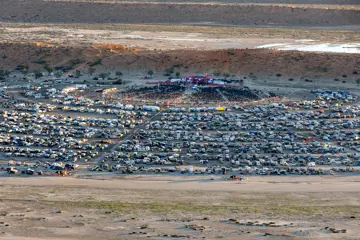
Weiwei’s directorial choices suggest the themes: scale is evoked by use of drone-shot eye-of-god overheads, which gaze down upon refugee tent-cities erected, ad-hoc, alongside closed borders, in (vain) hope of imminent passage. Movement is evoked as he — and the camera — moves amongst the surging column of modern-day pilgrims, walking northward through Greece, hoping to find safe harbour in Europe. And humanity comes in those moments in which Weiwei shoots people in close-ups, talks to them, hears their stories. The effect is observational and experiential, with little score, and a scant few eye-popping facts (and newspaper headlines) typed, silently, on screen.
Human Flow bounces around through 23 countries, from burning Iraqi oilfields to bombed-out Kurdish towns to Gaza’s Palestinian to Berlin airport-hangars turned camps for newly-admitted refugees. But the feeling, and the narratives, remain the same: people, fleeing from persecution, poverty, and war, end up having their hopes for better lives thwarted by the fences — figurative and literal — erected by increasingly-xenophobic countries. As an Australian, you expect that, at some point, we’ll land on Manus Island, but, this never happens; local audiences spared, I guess, another reminder of our complicity in that human-rights tragedy. Instead, the complicity, and the guilt, is on a global, human level: a singular species living on one planet finding increasingly elaborate ways to divide itself.
KANGAROO: A LOVE-HATE STORY
Warning: This review mentions acts of animal cruelty shown in the film.
Human Flow may not provide Australia with its moment of great cultural shame, but Kangaroo: A Love-Hate Story serves up 100 minutes of it. Amongst the sights you see herein: a child on a roo-shoot grab a joey out of its dead mother’s pouch, walk over to a ute, and smash the joey’s head against the bullbar 'til its dead; a paddock littered with dismembered kangaroo carcasses, severed heads glaring dead-eyed at the camera; a hairless newborn joey left hanging on blackberry thorns to die of exposure. Kate McIntyre Clere and Michael McIntyre’s documentary opens with on-the-ground nocturnal video of roo-shooting that evokes the visuals and mood of a found-footage horror-movie; and, from then on, the film is most effective as a horror show, due dread found in the runamok butchery of an All-Australian symbol.
Kangaroo isn’t much as a piece of cinema, but as an impassioned polemic, it has real power. There’s a time and place for nuanced debate of the kangaroo-meat industry and population sustainability, but it’s probably not at a time in which they’re misclassified as a “pest”, cruelly killed without any tally or measure, and harvested in such unhygienic fashion that most foreign countries have banned the import of kangaroo meat due to its high levels of salmonella and e.coli bacteria. The film isn’t out to engage in sensible discussion, but to reframe the parameters of the debate, wondering why our national totem is treated with such contempt and hatred. This, in turn, suggests a greater theme of colonialisation: this yet another example of the horrifying treatment of native ecology, and of local populations, that dates back 230 years.