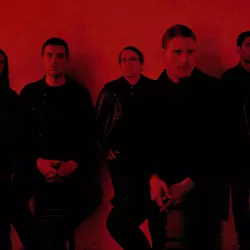
 Deafheaven Profile
"You're always going to be a little bit insecure," admits George Clarke, frontman of Californian combo Deafheaven. He's talking about the attention lavished upon his band, which has been overwhelmingly positive, but at times negative. Their most recent LPs — 2013's Sunbather and 2015's New Bermuda — have been widely hailed for mixing black-metal with the atmospherics of shoegaze and post-rock, but, in doing so (and in having short hair!), Deafheaven have also earned the ire of 'true' metal devotees. And this divide has been the definitive press angle.
"I don't need other people telling me what our band is or isn't. I know what I like, and I don't feel awkward about my tastes, and I don't feel like I don't belong."
"That narrative worked, both for people who didn't like us and for the people who did," says Clarke. "It's something writers use to entice a reader. You're made to look controversial, you're made to look divisive, you're made to look unorthodox. But that was never a part of our experience. We're just people who write music that we like. I don't need other people telling me what our band is or isn't. I know what I like, and I don't feel awkward about my tastes, and I don't feel like I don't belong. That's just media. And people that believe the media, that allow things written by other people to form their own opinions. It's more funny to watch than anything else: to see how the narrative evolves, and how the general consensus about us evolves."
On New Bermuda, Deafheaven sought to veer away from the sound of its predecessor. "We'd been playing Sunbather songs for years, at that point," Clarke says, "[so] you naturally want to write something that's different. And, the past few years, there's been such a focus on this thing called 'blackgaze', and on the whole shoegaze revival, these bands that are all sounding kind of the same; doing a good job, but blending together. I thought the best move for us was to explore other territory."
"This time," continues Clarke, "we wanted a more riff-oriented record. We wanted to take away a little bit of the shoegazeyness, a little bit of the spaciousness. And replace it with tighter songwriting, heavier guitar parts, real hooks, and strong melodies that didn't need a lot of over-effecting."
The band — built around the creative core of Clarke and guitarist Kerry McCoy — are obsessive music listeners, taking in so much musical input that it bleeds into their output, or, as Clarke says, getting to where "writing and listening become synonymous". Making New Bermuda, they "were listening to a lot of things we grew up with, like early thrash and death metal. But, at the same time, a lot of Low and Red House Painters, on top of the things that have always directly influenced [us]: bands like Mogwai and Coldworld".
Clarke is unafraid to both openly cite influences and —as his awareness of the 'divisive' narrative suggests — to read his own press. He's drawn, he says, to the discrepancy and dissonance between his own experience of making the music, and other people's ideas of his experience making the music. "People," Clarke says, "are going to get, to a degree, what you're doing, but they're also going to try and figure out what you're thinking along the way, and try and imagine your creative process and figure out your motivation. And those kind of people will be wrong, always, because they're not you."