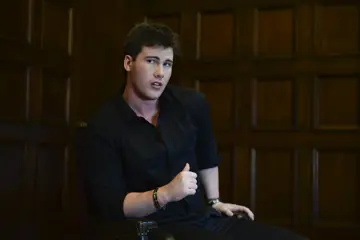
"You've caught me at crunch time,” says Mark Leonard Winter, on the phone from Brisbane where, in three days time, previews commence for Lucy Prebble's The Effect. “It's at that moment where the piece is just trying to find its feet and emerge fully. It's been a joyously challenging experience trying to get it together.”
“Mental health is a huge issue currently in a world and I'm interested in ways of dealing with it, and ways of talking about it, and ways to medicate it. To combine that with how love can exist in our contemporary world thematically creates very rich, interesting themes.”
Were it another actor, the sentiment could appear to rest on some vague faith, especially given the short time remaining before audiences fill seats. Winter, however, has a history of letting works find their feet on the floor; he made his start in theatre working in collaborative teams putting on devised and often co-written works as part of The Hayloft Project (with Simon Stone) and The Black Lung. This time around he's discovering how to allow a work to find its feet while learning, not writing, the script.
There are worse scripts one could be required to strictly adhere to. Prebble (author of the West End hit ENRON and TV's Secret Diary Of A Call Girl) premiered The Effect in late 2012 at London's National Theatre and it received the UK Critic's Circle Award for Best New Play.
Love is far from clinical, but that doesn't mean it can't blossom in such an environment, which is exactly how things play out for Winter's character of Tristan (an unemployed drifter) and psychology student Connie (Anna McGahan) – under the scientific eyes of psychiatrist Lorna (Angie Milliken) and her supervisor Toby (Eugene Gilfedder) – in a drug trial for antidepressants. Though distinguishing between the natural chemistry of love and the engineered chemistry of its manufactured doppelganger isn't simple.
“Mental health is a huge issue currently in a world and I'm interested in ways of dealing with it, and ways of talking about it, and ways to medicate it. To combine that with how love can exist in our contemporary world thematically creates very rich, interesting themes,” explains Winter. “There's four characters, all who have very different and specific opinions on the themes of the show, and essentially you lock them in a sealed ward, feed them drugs, and watch and see what happens – so it becomes a really active, exciting engagement in the ideas and the feelings behind that.
“I literally don't think I've ever done a straight piece of writing, so I was a bit confronted at first, I was like, 'I actually have to say the actual words?' And that was really strange. But I could recognise that this was a work that had been made in a room with actors working together to make it work, so I could see the organic process that had gone into the original work.”