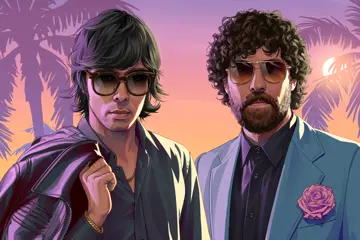
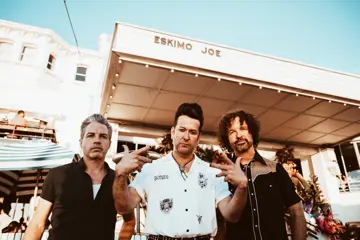
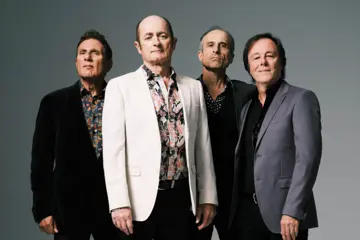
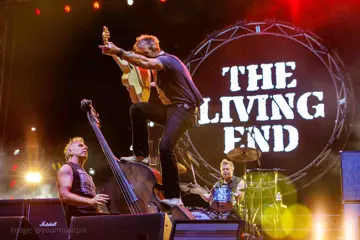
Before we get stuck into things, here’s a little about the above talent and their nominated works…
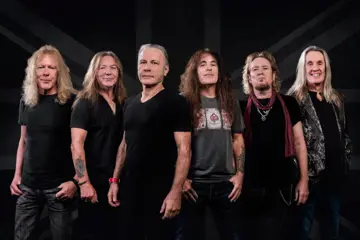
Jed Kurzel is nominated for Feature Film Score of the Year (True History of the Kelly Gang) and Most Performed Screen Composer – Overseas.
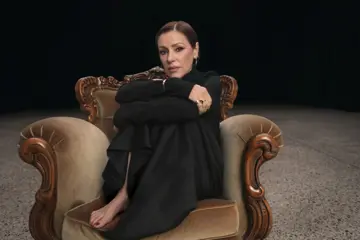
Amanda Brown is nominated for Best Music for a Documentary for Quilty: Painting the Shadows (with co-composer Damien Lane) and Best Music for a Television Series or Serial for The Secrets She Keeps.
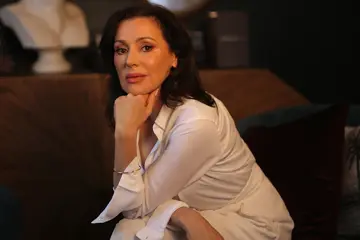
Sally Seltmann and Darren Seltmann are nominated for Best Soundtrack Album for The Letdown.
Roger Mason is nominated for Best Television Theme for The Commons.
What film or television score has had the biggest impact on you?
Amanda Brown: I saw the film Koyaanisqatsi at the Valhalla in Glebe and the music short-circuited my teenage brain. People were writing NEW, contemporary classical music? And it could have a rhythmic, hypnotic pulse? And not only that, it could accompany the moving image so well they enmeshed and became part and parcel of one incredible artistic and political statement? Mind officially blown.
Sally Seltmann: I really love the score for the Paul Thomas Anderson film Punch-Drunk Love, by Jon Brion. Every piece has an odd, warped, strangeness that compliments the beautifully awkward nature of the film. And then there are fantastic moments of lullaby and quaint classical melodies mixed with video game beats and lazy strings. It's a great soundtrack!
Jed Kurzel: I'd say Jaws. It's an obvious answer, but the music saved the film. For the first two-thirds of the film, the music plays the role of the shark. I don't think I've ever seen another movie where the music, effortlessly, does so much of the heavy lifting. Best television score would be Twin Peaks.
Darren Seltmann: Rosemary's Baby, score by Polish jazz musician Christopher Komeda. Unbelievably spooky, primal and beautiful. It sounds like medieval acapella My Bloody Valentine.
Roger Mason: That is a tough one. There have been many, many film scores I thought “I wish I’d written that.” There have been many wonderful scores that I grew to resent having been used as temp and being asked to emulate them. Churlish perhaps, but kind of like hearing David Bowie’s Heroes being used in a McDonald's commercial. It’s forever tainted and cemented in your memory. You cannot completely disassociate one from the other. Another good reason as to why I don’t watch commercial television (oops – did I say that out aloud…?)
There are so many styles and genres it’s difficult to select - so I’ll simply go with the first time I ever became aware of film music and its power. In 1960 Exodus was released. I cannot remember the exact year it was broadcast but I saw it on television when I was about eight or nine years old - and it haunted me for years. Though I had no real understanding of the story beneath, that theme seemed to encapsulate all the struggle and passion of the film within one dynamic and beautiful rendering without having to have heard one line of dialogue.
What is a film or television score that you wish you’d written and why?
Amanda Brown: I believe we’re currently in an era of television that will be viewed as something of a Golden Age, with the streamer's insatiable demand for new content and free to air networks all competing for audiences. Ergo the standard of production has lifted astronomically. There is so much high end and inventive music being composed for television right now. A couple of my favourites are Trent Reznor and Atticus Ross’ music for Watchmen and Martin Phipps' music for The Crown.
The film score I wish I wrote is The Piano. It was such a successful film on every level - critically and popularly acclaimed - and Michael Nyman’s music is inextricably tied to that success. It embodied the world of the film in such a comprehensive way - ultimately what all great film music does. The film would be a lesser work of art without the music. Nyman’s adaptation of Scottish folk tunes was a genius idea and the music just lifts the film.
Sally: I wish I'd written the score to The Piano, directed by Jane Campion. Those piano compositions by Michael Nyman are so timeless and evocative. Whenever I hear them I'm taken back to the film and the vast New Zealand landscape, the image of the grand piano on the beach, and the underwater scene. I think that Michael Nyman's score for The Piano is a classic example of when the composer really gets it right.
Jed: I wish I'd written the score for Predator. I watched it again not long ago and was truly blown away. I took me all these years to notice how brilliantly that score was put together.
Darren: Morning Of The Earth. It's unreal. Produced by G Wayne Thomas with a collective of major Australian talent in 1972. It's a spiritual journey into Australian surfing counter-culture. The music is the narrative and sucks you into the water and landscapes with its wild and slippery arrangements. When I first saw it I thought - right, I'm moving to the beach and learning how to surf!
Roger: This is the toughest question of all! Simple answer - all of them.
At least, all my favourite films. The old adage “you can’t write a good score for a bad movie,” is mostly true, but not entirely. Don’t get me wrong - most of my favourite films have great scores that have been inspiring and I probably would not have topped most of them.
Johann Johannson’s scores for Arrival and Sicario. A composer I admired. I loved both scores. I loved The Ice Storm - and the score by Michael Danna.
Under Her Skin - scored by Mica Levi was particularly creepy and reptilian rent from her tortured cello work. Road To Perdition is one of my favourites by Thomas Newman. A powerful film and a deeply resonant score that immerses the viewer in not only the mood of the period, but in the desperation of a father trying to protect his son from the people who employed him. Newman has the ability to also switch styles within the space of one score - specifically the perfectly fashioned schizoid motif for Jude Law’s character - without seeming incongruous. There are many films I have wanted to throw something at the screen because I felt they were missed opportunities where the composer held back – or as is often the case, was held back. Probably physically restrained if personal experience is not totally isolated to my experience. Don’t worry - no producer was ever harmed during the making of any score. Bruised ego’s - perhaps – but mostly mine.
I love to write melodic scores and started out writing sweeping orchestral scores as was the style that John Williams had brought back into fashion via Jaws, Raiders and Star Wars. But experimental dissonant music was always an element to a degree within my music.
What’s the film I wish I had scored? Dunno. But ask me next week and I’d have a different answer anyway.
How is writing a song or composition for screen different to writing a ‘regular’ song?
Amanda: I think of screen composers almost as the classical composers of the contemporary era. By that I mean we don’t necessarily write classical music, but we work on commission in much the same way Bach and Mozart were employed by the church or the court. We compose music to a specific brief - the music serves a particular purpose within a broader context. In our case we work synchronously with sound design, dialogue or voiceover to support the story being told. At the end of the day the music is subservient to a number of factors whilst retaining the power to enhance the film emotionally and aesthetically.
Some may argue that songwriters are subject to commercial demands but in my opinion the great songs are written from the heart, with no particular purpose other than self-expression in mind. It’s almost the opposite - if there was a winning formula for success anyone could write a hit song. Production techniques change with developments in technology and fashion, but no one can explain an incredible song that seems to come from nowhere. Most film music is instrumental and with songs you have the added layer of lyrics - an art in themselves.
Jed: Lyrics.
Sally: When I write a 'regular' song, I feel like I'm the director, I'm the character, I'm the cinematographer and I'm the screenwriter - and the whole creative process is driven by me. This means I have a lot of freedom, and I do enjoy this. However, when I write for screen it challenges me, and I'm often out of my comfort zone, which I also enjoy.
Roger: Songwriting is a completely different beast. Though it may be commissioned for a specific film it is still a little microcosm in and of itself. There is a kind of purity in that it has a life of its own outside the film. A score is mostly welded to the images and dominated by its adherence to plot lines and picture cuts. Its function is not only to underline the story but occasionally play the subtext - indeed juxtapose at times when needed. A song’s requirement is that - in a sense not unlike Ernest Gold’s theme for Exodus ideally encapsulates the spirit of the story or characters. It’s not often I get to write songs specifically for film but I did for Michael Howe. Unsolicited, I wrote a song The Harvest & The Glory for an earlier portion of the film because it just felt like it was a good opportunity and was entirely appropriate as a reflective moment between the main characters. I wrote something hymn-like and folky with a slight Irish influence - something that would not have been out of place sung in a community or church hall at that time.
The last scene of the film finishes as Howe’s head is delivered in a bag providing evidence the matter has been dealt with. The producer mentioned that he would have liked the sound of a town choir at that point but had neither the time of the money. So I took the chorus of the song that I laid in earlier and wrote out some parts so that I could record a local community choir. Shape singing was a big thing in the Southern states of the US at about the same time in the 1800s so I used the harmonies of that to emulate the style adopted by the travelling preachers and their specialised songbooks. While the opening hook played by both plucking and bowing a bowed dulcimer appears at various points throughout the film, the song plays out over the end credits and I think is a good example of something that embodies the spirit of the film while also capable of being interesting in isolation.
Similarly, the song I wrote Zephyr for the film Zelos was another plaintive song based on a couple who are deeply in love but find it difficult to overcome the challenge of jealousy. It can be hard finding the tone, but if you can, it can pay off big time in the emotional stakes.
What are the rewards of composing for the screen?
Amanda: It feels somewhat masochistic to say, but every screen composing project is different and I am frequently pushed outside my comfort zone in terms of genre and what the director or showrunners demand. I worry I won’t be able to deliver but schedules mean that there is no room for doubt or deliberation. You simply have to show up and do the work and sometimes you can surprise yourself with what you’re capable of. I love the collaborative nature of both film making and music. Recently I’ve been working with other composers like Damien Lane and that shared sense of responsibility, but also creative decision making is wonderful.
------------------------------------------
You can tune into the 2020 Screen Music Awards tonight from 7:00pm AEDT via the below video.