The music industry has long been rife with barriers and biases. It teems with institutionalised sexism and gender disparity.
Indeed, according to a systematic review run by Kimbely Riddle, PhD, and Karen Heaton, PhD, as of 2023 it was found that merely 21.8% of those who work in the music industry are women. A statistic that is, without mincing words, a travesty.
WOMP has long been committed to challenging this rigid status quo.
In 2017, Elise Reitze-Swensen and Rosie Taylor – both musicians, producers, and members of the electronic duo Feels – cofounded Women Of Music Production: the Western Australian not-for-profit and registered charity dedicated to supporting women in music production, technology, and contemporary music.
Reitze-Swensen explains of the organisation, “It started as a response to the lack of support for women in music technology and production.”
Though the music industry as a whole is statistically male-domintated, the world of music technology and production are particularly dire. The Grammys, for example, have never bestowed the award of Best Producer of the Year upon a woman. Across the expanse of its 67-year history, a mere ten women have been nominated for the prize.
“As a music producer myself, when I started I didn't have many women role models or peers to turn to–that's how WOMP came about,” Reitze-Swensen continues. “We started with community meetings focused on skills sharing and platforming women in music production and technology.
“Women would come to our events and be able to see a pathway for themselves and therefore be more likely to pursue skills and careers in the area.”
One of the charity’s most celebrated and significant endeavours is the WOMP Writing Camp.
Since its inception in 2022, the camp has brought emerging and established music-makers together with some of Australia’s leading artists and industry professionals. Previous mentors have included the likes of Stella Donnelly and Jaguar Jonze.
Indeed, the program has also resulted in numerous commercial releases, including Jaguar Jonze’s Nothing Left.
“We always had plans to run our own songwriting camp, and post COVID it felt even more necessary to get the idea up and running as we have always had the biggest impact in person,” Reitze-Swensen says.
“WOMP Writers Camp is very unique because it brings together songwriters and producers in collaboration where women are upskilling each other simply through being generous with their knowledge. The songwriters come away converted to self-production and the producers come away with better songwriting skills and more interest in collaboration.”
The writers camp, which is proudly sponsored by SAE, Department of Creative Industries, Technology and Sport, APRA AMCOS, Ableton, Telepathic Instruments, and Neumann.Berlin, is returning this year.
Each participant will leave the camp having collaborated on three new works while developing new creative relationships with artists from across Australia.
Crucially, the WOMP Writers Camp is provided at no cost to participants: all nine artists will receive a daily stipend and catering, as well as fully-funded flights, accommodation, and additional per diems for the two interstate participants, removing geographic and financial barriers to participation.
As if that wasn’t enough to pique excitement, a Telepathic Instruments Orchid giveaway will take place, and one of the nine selected artists will also receive the WOMP Ableton Scholarship, which includes an Ableton Live 12 Suite licence valued at $1,099 AUD, supporting the recipient to continue developing their independent production practice beyond the camp.
WOMP will be taking place this year from December 9th to December 11th, at the SAE University College in Boorloo/Perth, as is tradition.
“WOMP started in Perth and it only feels right for our annual songwriting event to be in our hometown,” explains Reitze-Swensen. “Australia has numerous songwriting and music production opportunities, but they are rarely in Perth. For Perth artists, these opportunities are also expensive to attend and we often miss out because of our geographical location.
“It's become an annual cornerstone of the Perth scene and the demand is high.” This year, in fact, the camp received over 100 applications.
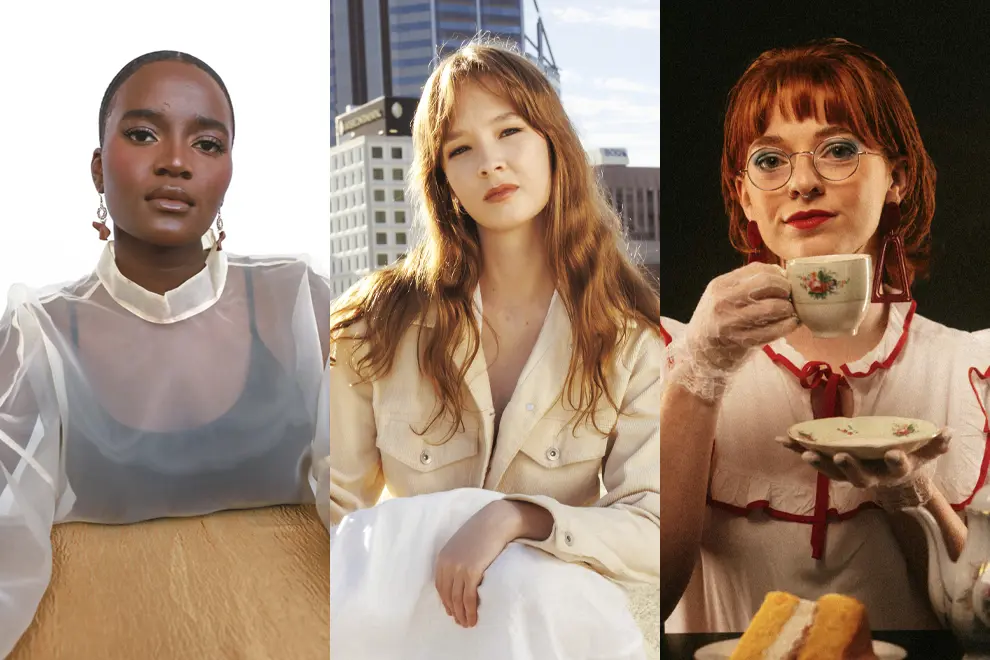
WOMP has only just announced the nine artist-participants selected for the 2026 iteration of the camp, who will be mentored by and work alongside acclaimed Australian songwriters, producers, and artists Tia Gostelow, Becki Whitton (Aphir), and Helen Shanahan.
The lucky 2026 artist-participants include Veronica Zurzolo, Stacey Ann, Lucinda Poy, ABRYNZ, Missy, Sophie Lilah, Matalja, Mo•Louie, and AGUM.
Perth-based indie pop artist and producer Lucinda Poy gushes, “I'm super excited to be participating. My friends Anna Dabbs and Drea participated a few years ago, and seeing the enjoyment and development through their experiences was deeply inspiring! I can't wait to connect with like-minded women and GNC artists through the WOMP Songwriter's Camp. WOMP is such a supportive community, and I feel that I can really further my artistry and songwriting with this crew.”
Poy, however, isn’t without a slight twinge of – healthy – anxiety. “Trying to flesh out the truth behind the intention of your song and musical choices with others in the room can be pretty daunting. Especially if that song comes from a vulnerable place,” she explains.
“A big part of the songwriting process, for me, is trying to frame your perspective on your feelings and experiences through lyrics, melodies and instrumental choices. Opening up to other artists on what the song is about can be a very raw experience, but it is also where you can receive very meaningful input on how to tell your story.”
The past year has seen Poy explore using more production in her live performances – something which has pushed her to learn more about digital audio workstations (or DAWs for short). “I've really found joy in this space. I can't wait to collaborate with other artists using more music production in my songwriting.”
Poy’s hope is to meaningfully connect with the other artists and mentors present. “I love comparing songwriting processes with other artists, and adapting different techniques to my own original songs and collaborative works, and WOMP is a huge facilitator for this.
“We'll be working on a song for each day throughout the camp, so we will not only gain works that we can further collaborate on and release afterwards, but also learn how we can further our songs and adapt these frameworks for the future.”
“To me and my team at WOMP, having skills in producing and recording gives you the power to have more control over your music and creative vision,” Reitze-Swensen adds. “We live in a patriarchal society and it is more important than ever for women to have power and autonomy over their own music–we need to hear women's voices exactly as they intended. WOMP writers camp addresses this by giving women the safe space to try new skills and encourage each other.
“Many women come away from our event challenged, but more confident as an artist. We want to see more women producing and for some artist-participants, this is the first time they have called themselves a producer, even though they have been producing for years. So, this event also encourages women to acknowledge their skill set and claim that title.”
Three straight days of supported creativity is a blessing, and a rarity.
“It is difficult to find the time to write, let alone collaborate with like minded women and GNC artists!” Poy admits. “Also, being able to work with a different group of artists involved in the camp each day is fantastic, and so great to collate more ideas and approaches to each project. I'm currently working towards my debut EP, so learning some more tools will be super helpful leading into a big recording project.”
It is particularly exciting, Poy adds, to be able to access these resources in Perth, a city which, due to its geographic isolation, can sometimes suffer from a sense of disenfranchisement, and is often skipped on the international touring roster.
She points to the recent announcement that the travelling music festival Laneway axed Perth (as well as Adelaide) from its 2027 circuit line-up.
“Sometimes it feels isolating, not only geographically, but also in accessing opportunities to connect with internationally established artists. I'm so excited to collaborate with interstate artists throughout the camp, and gain insight to how their industry experiences may differ from ours in Western Australia.”
The camp will thus facilitate advantageous cross-national connections. “I can't wait to make more friends with artists who are based outside of WA. I think your community and where you're situated deeply inspires your music sonically, particularly based on the local scene. It'll be great to collaborate with artists who are from a different scene!”
Poy underscores the value of the way that WOMP allows women and GNC artists to gain both knowledge and confidence in professional arenas that have been historically prohibitive.
“In my experience, men have dominated the recording and production spaces whenever I've worked on my original music. I've had positive experiences with my collaborators, but I've also felt hesitancy in contributing to the music production process, and a lack of confidence in voicing my ideas. I think many musicians experience doubt or fear when initially collaborating with someone, but perhaps men are more likely to try something and take a risk regardless of experience.”
“This is a big question,” Reitze-Swensen admits when asked how she feels the Australian music industry could better support the creativity of women and GNC artists. “I think it's about changing the way we think on an individual level, which in turn impacts the industry at large.
“If we consider the barriers women might face in any given scenario in the music industry, then we can consider how to adjust and support to allow for equal opportunity.”
Then, she explains, the idea needs to be applied further. “What about women of colour or mothers or women with disabilities and so on… What are their unique barriers to entry? We can't assume equal access and we are currently far from it even though on face value you might think we all have the same opportunity to even have a go. I can't speak from all women's perspectives, but I can talk to them and ask them what they need.
“The industry and individuals in the industry need to talk to more women and find out what is missing, then it actually needs to be addressed. If the reported percentage of music producers who are women is somewhere from 5%-10% then what do women need to make this role more accessible? These are the questions we are asking our community and adjusting constantly based on feedback we receive.”
Poy concludes, “It's important that everyone has the opportunity to collaborate, learn and contribute meaningfully to the process, and Australian music industry leaders could certainly continue supporting programs like WOMP to encourage women and GNC artists to increase their confidence in this space.”
For more information about WOMP and all the work they do, visit their official website here.
This piece of content has been assisted by the Australian Government through Music Australia and Creative Australia, its arts funding and advisory body