“WOMADelaide truly is the world’s festival, so it’s our duty to care for the world we celebrate,” observes the Adelaide festival’s Director, Ian Scobie AM.
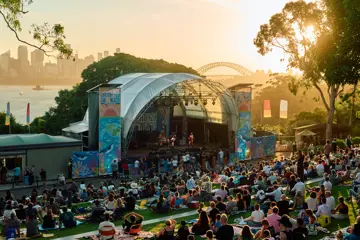
In 2026, when the World Of Music, Art And Dance plays on the traditional lands of the Kaurna people in the 34-hectare Botanic Park/Tainmuntilla from March 6-9, it will mark a new milestone for South Australian festivals.
All eight stages will be powered using 100% renewable energy as the primary source of electricity.
This is achieved through a mix of B100 fuel – a biodiesel made entirely from organic matter and trialled at the festival since 2021 – and the latest addition, HVO fuel.
HVO (hydrotreated vegetable oil) is made from used cooking oil and animal fat waste. It produces approximately 90% less greenhouse gas than diesel and can directly replace it in the same machinery as diesel (for example, drivers can run a diesel-powered car on HVO).
The festival had this as a target since 2021, but it’s had its bumps, Scobie relates.
“In terms of alternative fuels, we are about one year behind our strategic plan, which was a five-year plan developed in 2020.
“COVID was very disruptive, but the market has matured a lot since then, meaning that there are more options to help WOMADelaide reach its renewable energy target – specifically, HVO is now available and is a much more ‘flexible’ fuel than B100.”
Lead The Way
WOMADelaide has long led the way in sustainability innovation, and not only to reduce, but to actively offset its carbon footprint.
Many of its achievements, it says, have become standard use in the festival sector.
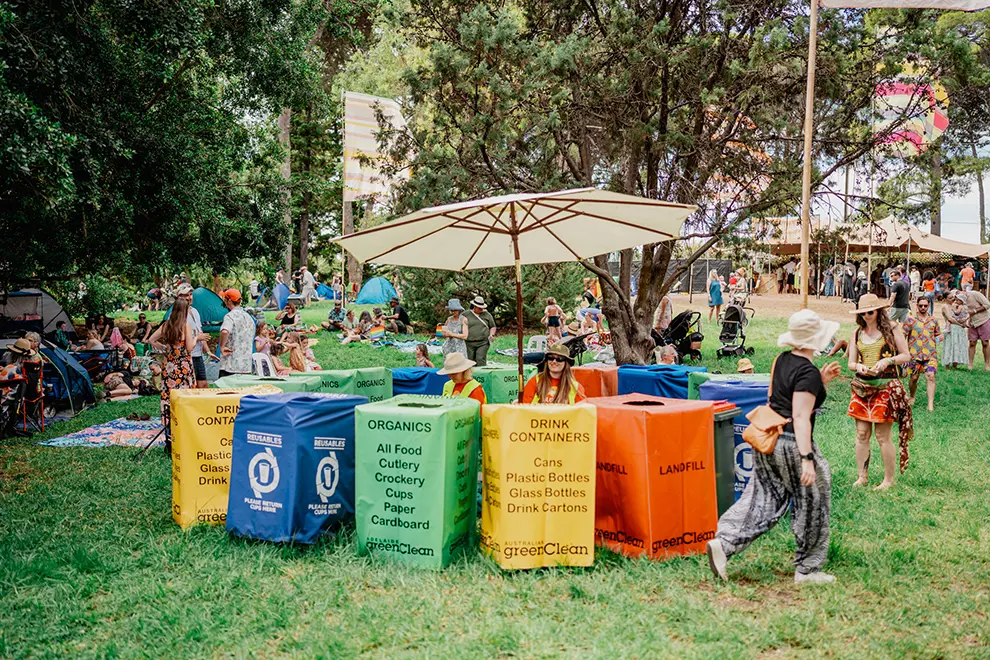
25 years ago, WOMADelaide was the first major event to introduce the ‘three bin recycling’ system – now common to all households.
Also that year, in 2001, it was the first Australian festival to instruct bar operators to use only reusable cups and food vendors to utilise compostable plates, bowls, and cutlery.
Last year, over 160,000 single use cups, representing over 870kg of plastic waste, were prevented from entering the waste system.
Segmented recycling and organic waste bins across the festival site, divert over 98% of the waste generated by the festival away from landfill through its ‘zero waste to landfill’ strategy with a four-bin system waste management program, which has been in effect since 2009.
In 2007, through its Greening Australia collaboration, $3 of each of the 80,000 tickets sold went back into planting trees in regional South Australia. The result has been about 149 hectares of “WOMADelaide forests” to date on Kaurna, Ngarrindjeri, Peramangk, and Nauo Country.
For its most recent restoration project, Greening Australia collaborated with a private landholder to restore 40 hectares of the endangered Drooping Sheoak Grassy Woodland on the Eyre Peninsula. About 95% of this ecological community has been lost on Eyre Peninsula.
Between 2022 and 2024, Greening Australia partnered with the Hills and Fleurieu Landscape Board, National Parks and Wildlife Services SA (NPWSSA) and the Friends of Newland Head Conservation Park to plant 3,500 seedlings at Newland Head Conservation Park.
The festival also supported the Hills and Fleurieu Landscape Board Back from the Brink Project by planting 17 hectares of woodland at Deep Creek to help the endangered Mount Lofty Ranges Chestnut-rumped Heathwren and the critically endangered Beautiful Firetail Finch.
Bird species are returning in growing numbers as well as increasing insect and plant diversity.
The largest planting site of 50 hectares is located near Langhorne Creek between the Ferries-McDonald Conservation Park and the Bremer River. At last count it was supporting 70 bird species, including rare and threatened Hooded Robin and Diamond Firetail.
Partners
Aside from its partnership with Greening Australia, WOMADelaide also works with a number of associations.
Melbourne based reusable cup manufacturers Bettercup came on board to assist with the rollout and development of the reusable cup system. It has a lot of experience in managing large scale reusable systems at major events.
The nation-wide RFS with international supply chain connections is the festival’s fuel supplier for B100 and now HVO.
Jeffries composts all the food ware packaging at the event. In 2025, WOMADelaide composted nearly nine tonnes, which made up 39.5% of all its waste.
A significant advance came in 2020/21 with the setting up of the role of Sustainability Officer, taken up by Hugh Scobie, and the five year plan to lower its total carbon emissions and bring it closer to a fossil fuel-free event.
Ian Scobie relates: “2021 was the first year WOMADelaide used any biofuels and was intended as a small-scale, proof of concept rollout.
“Following its successful implementation, the festival followed up in 2022 with the use of B100 to fully power the Frome Park Pavilion stage at this event.
He goes on to reveal, “Both of these ‘test-run’ years had no technical issues with the rollout of biofuels, so there was not really a noticeable impact, aside from a slightly lower carbon footprint from each event.
“While the immediate impact on the festival was not huge, it served to demonstrate to the festival, stakeholders and industry that going fossil-fuel free at major events is achievable.”
Sustainability decisions are made by a small cross-functional group alongside the Sustainability Officer.
“As a small business, we are all very hands-on and collaborative, with ideas and decision making shared across the team, though ultimately Hugh really is the driving force behind activating these practices and reducing the festival’s carbon footprint.
“Each year we conduct a rigorous debrief process – looking back to look forward – which ensures our sustainability efforts continue to evolve and strengthen over time.”
As for the next step(s), “Our goal is to run our entire festival on 100 per cent renewable energy, and after this announcement, we are one big step closer.
“In addition, we will continue to implement and improve best-practice strategies to manage, reduce, and offset the environmental impact of staging the festival in considered and holistic ways, which can also provide demonstrable examples that can be adopted across the industry and community.”
WOMADelaide’s flagship three-day forum The Planet Talks brings together international and local thinkers, trailblazing activists, pioneering scientists and visionary change-makers to discuss the issues, concerns and possible solutions to sustainability for the planet.
This year’s program features 18 speakers, including Walkley-winning journalist and author Marian Wilkinson; environmental scientist and advocate and 2024 SA Australian of the Year; Tim Jarvis AM; leading Maori earth systems scientist Dan Hikuroa; and UNICEF Pacific Ambassador Moemoana Schwenke.
Asked by The Music if it is important to keep things simple when the festival draws 80,000 people from totally different cultures, Scobie’s response is: “Not necessarily simple, but intentional.
“We aim to create a shared experience that is inclusive and welcoming. We celebrate everyone coming together, united by music, art and dance.
“Seeing people of all different ages and backgrounds in the park – family and friends and community – is one of the most beautiful and unique aspects of the festival.”
This piece of content has been assisted by the Australian Government through Music Australia and Creative Australia, its arts funding and advisory body