 John Farnham Profile
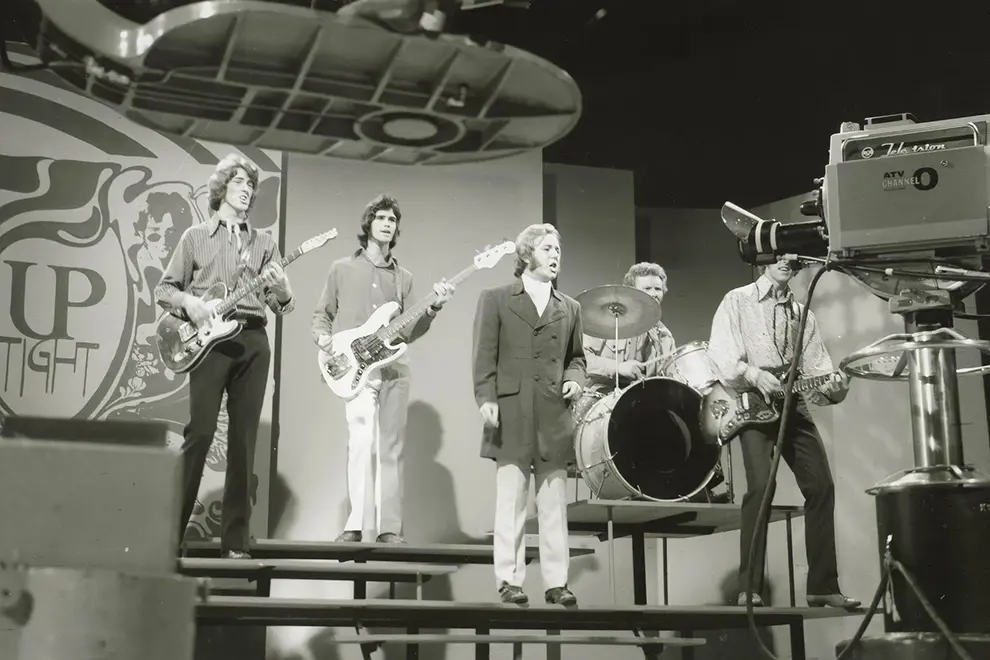
A new 396-page coffee table book Uptight/Happening 70/71/72 by Milton Hammon and Brett Leslie looks back at Australian music TV shows between 1967 and 1972.
They were filmed in Melbourne and broadcast on ATV-0 (now Ten Network).
Uptight was filmed live during the unearthly rock and roll hours of 8am to noon on Saturdays, with acts and cast expected earlier for makeup.
“That whole period between 1967 and 1972 was one of the best in Australian pop,” says Leslie.
“The Beatles had just toured, and there was a local explosion after that.
“It was the time of Normie Rowe, Johnny Farnham, Billy Thorpe, The Masters Apprentices, Ronnie Burns, The Groop, Russell Morris, Bobby & Laurie, and Johnny Young, among many others.
“There were so many nightclubs and discotheques, as they were known then. It was very vibey, a very healthy music scene.
“People would perform or club all night, and then head to the taping of the shows at 6 in the morning. They’d sleep in the back of their cars in the parking lot at Channel 0’s studios in Nunawading.”
Like Leslie and Hammon’s earlier books on The Go!! Show/Kommotion and Countdown, the new book evokes the period with impressive detail and colour. Or “groovy” as was the slang word at the time, as was “gas” and “trucking”.
This is through archival photographs, a run-down of each episode, a comprehensive look at the acts that played the shows, articles from music and TV magazines like Go-Set and TV Week, and recollections of the hosts, cast and crew, fans and fan club presidents.
Many photos from the shows were actually saved from the dumpster.
ATV-0 had space and fire-risk concerns storing photos, negatives, and film. As the book reveals, out of 123 Uptight shows, only 4 hours and 20 minutes survive. Of 139 Happening shows, just 8 hours and 20 minutes are still around.
ATV-0 employee Allan Williamson was given the task of taking photos and films to the local tip.
Instead he saved them. After his death, they went to Milton Hammon, who in turn donated it to NFSA (National Film And Sound Archive) for permanent preservation.
Footage saved by the station’s lighting manager Stuart De Young was also donated to the NFSA.
Tapped
Australian TV tapped into teen obsession with rock music from the 1950s. ATV-0’s The Go!! Show arrived in August 1964, and immediately extended its original 13 weeks to 39 weeks. At its peak it was drawing 400,000 viewers a week.
Kommotion, aimed at a younger crowd, with a fast paced Top 40 format, with local singers miming to, or cast members go-go dancing to, international hits and a strong presence of mod fashion. The 25-minute series broadcast at 5.30 pm on weekdays.
When both shows finished in 1967, Kommotion co-producer and co-director Ron Joseph put together Uptight, using the Kommotion cast.
These were part of Melbourne’s in-crowd, including Go-Set writers as Ian Meldrum (still not “Molly” yet), Liz Brett and Tony Healey, David Bland who worked in dances as The Scene and King Rat, dancer-entertainer Denise Drysdale, singers Carmel Chayne, Yvonne Barrett, and Allison Durbin, and influential radio jock Stan Rofe.
Coming in on October that year with the first act being The Iguana with California My Way, Uptight took a different route.
In those days, the major TV stations didn't start broadcasting on Saturdays until the afternoon. The premise was that families were too busy with sports or shopping to be watching TV.
ATV-0 beamed the test pattern on Saturday mornings.
Uptight filled the spot, running from 8am to noon, 100% live with no script or autocues and good natured chaos. There were no rehearsals, just an eight page time sheet which was constantly red-inked as artists (and cast members) turned up late or plain forgot to show.
“There was no other show in the world like it, not with that length,” recalls Leslie. “Four hours is a lot of time to fill, and it was more than just a pop show. The length allowed them to cover everything like country, country ‘n’ western, and soul.”
There were panel discussions on everything from dating to makeup, record reviews, tour dates and fashion spots.
No viewing figures are available but it was generally seen as being embraced by audiences, and the music industry as a promotional vehicle.
Cast members were paid $10 each (about $165 today) while the hosts Ross D. Wyllie and Jeff Philips got $60 a show (about $1,000 today).
The acts were not paid except in airtime and plugs for their latest records and tours.
Find Their Way
They were expected to find their way to the studio. Those without cars caught a train to the nearest station and walked the long distance, even as their records were high on the charts.
The Party Machine – featuring future icons Ross Wilson, Ross Hannaford, and Mike Rudd – solved the early morning problem by playing in their pyjamas.
Cast member Grant Rule, who was living with Tony Healy and his family in North Melbourne, borrowed his Ford station wagon and was clocked speeding at 85 mp/h to the studio. Rule was unlicensed.
In those days drivers licences were just pieces of paper, with no photo ID.
“You look familiar,” said the cop. Rule claimed he was Healy. He was told to present his licence at the North Melbourne police station. The duty officer glanced at Healy’s licence.
“You must be one of Myra’s (Tony’s mum) kids,” he said, letting him off. As Rule was about to bolt out the door, the cop said. “You’re the fourth ‘Tony Healey’ that I’ve had in here this week, now piss off!”
In 1970, a change in the show’s production company saw a name change to Happening ‘70 (updated to Happening ‘71 and Happening ‘72) although with the same cast and Wyllie hosting.
Wyllie had been a total risk for producers. He was totally unknown outside Brisbane, where he’d made some unmemorable records. But the show’s popularity allowed him to have two hits.
One was a cover of American singer and comedian Ray Stevens’ Funny Man, and the Johnny Young-penned chart topper The Star was covered in England by Herman’s Hermits.
When he quit in March 1971 he was replaced by Phillips who’d cut his teeth on Perth TV.
Happening had more focus on music, and the new progressive acts as Daddy Cool, Spectrum, Billy Thorpe & The Aztecs, Blackfeather, and The La De Das got their shot.
Unlike Uptight’s live broadcast over four hours, the Happening franchise was taped on the Monday between 7pm and 11pm before screening on its Saturday morning slot. But it was filmed in one session, with no chance to correct mistakes.
Footage of Wyllie stumbling over the word “loot” with “root” was brought out on the blooper list at staff Christmas parties. Stage managers accidentally walked in front of acts. Tracks would scratch and slip.
Pre-AC/DC Bon Scott was on a panel discussion about tattoos and he burst out, “You should see the one on my arse!” He was told he’d be banned if he ever used that word on TV again.
When Colleen Hewitt was performing the Carpenters’ Superstar, she was going through a real-life breakup. When it came to singing the lines “Don't you remember, you told me you loved me, baby?/You said you'd be comin' back this way again, baby”, she tearfully walked off the stage mid-song.
Faced with an empty space, the cameras swung back to a startled Phillips who explained, “It’s an emotional song!” while the crew raced around to hunt up the next act.
Billy Thorpe & The Aztecs were one of the few allowed to play live, with amps and speakers. When their three minutes were up, the lights were dimmed. But Thorpe turned up the amps and they kept playing… even through an ad break.
Carmel Chayne had to keep a straight face while delivering an ad spiel about a shoe brand, while Meldrum and Healy were tickling her bare feet under the table.
Fun Stopped
The fun soon stopped. In 1972 the Musicians Union got miming banned, insisting musicians should play for real and get paid. It was instantly over for Happening, which aired its last episode on November 11, 1972.
Jeff Phillips is quoted in the book: “That was the end of the Happening show. That was the end of promotion of all these artists. And there was nothing else for another four years or so until Countdown came along.”
Grant Rule went on to be executive producer of Countdown. Ian Meldrum became a household name. Executive producer Lesley Shaw was a major figure in international music and theatrical tours with Paul Dainty.
David Bland set up one of Melbourne’s great record stores, Pet Sounds. As a record company executive he contributed handclaps on Daddy Cool’s Eagle Rock and backup vocals on Rick Springfield’s Speak To The Sky.
Denise Drysdale became a prominent TV identity. Liz Brett transformed into an award winning novelist and poet. Tony Healy took to travel writing and died last year. David Joseph died of a heart operation in 2012. Meldrum is now in 24-hour home care.
Jeff Phillips resuscitated his singing career and moved into property. Ross D. Wyllie went into public relations but is now in a nursing home with his wife Eileen (a producer of Uptight). After getting polio as a child which left him with a limp as an adult, he is confined to a wheel chair.
“It was essential to do this book now,” Leslie sums up. “It was a great time in Australian music, and it needed to be documented. None of us are getting younger and some of the major players are no longer with us any more.”
Uptight/Happening 70/71/72 by Milton Hammon and Brett Leslie is a limited edition of 400 copies with information and copies available via email correspondence with Leslie.
This piece of content has been assisted by the Australian Government through Music Australia and Creative Australia, its arts funding and advisory body