 Taylor Swift Profile
For as long as music has existed, so too have countless ways in which to enjoy it. Sure, we could get granular and look at the evolution over millennia, ranging from vocalisation, to the introduction of instruments, performances, and so on, but for those who enjoy the modern musical landscape, 1877 is the year to look back to.
That's when Thomas Edison invented the phonograph, a physical device which allowed for the physical reproduction of sound.
How did it work? Well it can get technical, but for all intents and purposes, it comes down to sounds being physically impressed into the surface of a rotating disc which, when traced via a playback stylus, create vibrations which reproduce the sound impressed sounds.
Technology would drastically improve in the ensuing years and decades, but these rotating discs were the earliest forms of the records that we know and love today.
These technological advancements would allow popular music to be immortalised, commercialised, and ultimately find its way into the homes of consumers.
No longer was it necessary to hear your favourite songs solely by live performances, learning the music yourself, or hearing it via the radio. Now, these performances could be mass produced and offered to fans around the world.
As time went on, so too did the recording industry expand, so too did more and more artists find their music released physically, and so too did technology continue to advance.
As vinyl record sales found a peak in the '70s, magnetic tape technology would offer a more compact method of sound reproduction as it began to present itself as a viable rival to the technology, but it was in the late '70s that the world would welcome the compact disc.
The successor to the larger, video-based LaserDisc, the compact disc was created by Phillips and Sony and ultimately works as a digital data storage format. Put simply in the context of music, it's a way in which you can store your favourite music, and a CD player is the device which decodes and broadcasts that music.
The story of the compact disc is actually quite fascinating, including how its length was agreed upon and how artists have played with its limitations, but it was officially launched to market in Japan in 1982, and in North America and Europe in early 1983.
The compact disc was launched at a boom time for the music world, and there's a lot of interesting firsts associated with it. For example, the first CD released was a reissue of Billy Joel's 52nd Street from 1978, while Dire Straits' 1985 record Brothers In Arms was the first to sell a million on the format.
The CD ultimately became the "fastest-growing home entertainment product in history", and by 1988, its sales had overtaken vinyl, and cassette just three years later.
In 1986, sales in the US had hit 100 million, doubling by 1989. In 1999, sales exceeded 900 million for the first time, and the format hit its peak in 2000 – just in time for the digital age to start taking over.
As the years would go on, CD sales were on an almost constant decline from 2000 until 2020 (the only exception was a slight rise in 2004).
Utilising Google Trends data, we can actually see how this decline in the CD market occurred in real time.
In a graph of search interest over a specific time period, Google Trends shows the data on a relative scale from 0 to 100: zero suggests insufficient data, 50 indicates half the popularity, and 100 signifies the peak interest during a time period.
Google Trends' data goes back to 2004, which was the last time there was a rise in CD sales before the decline began. Indeed, December 2004 shows searches for the format reaching a peak of 100, before some years of falling resulted in a gradual rise to 66 in December 2008.
However, it has been in almost constant decline since then. That is, until it began to level out around the end of 2019, with a recent peak of 41 in December 2021 seeing a rise of 24 points from the previous month. Since then, it's been a gradual increase, with May of 2026 bringing with it a high of 27.
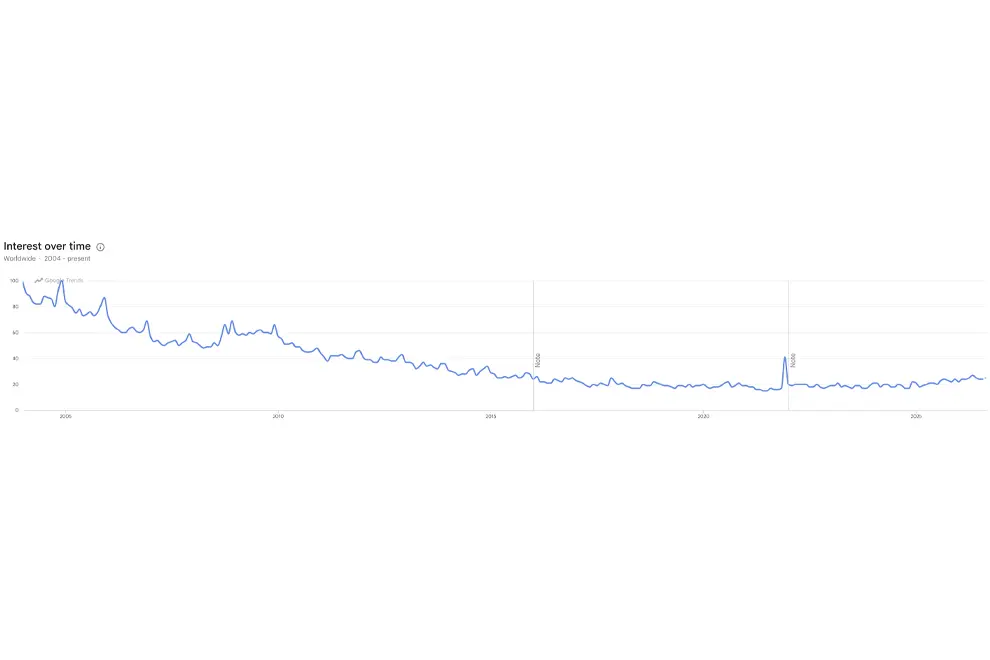
Google Trends searches for "CDs” between 2004 and 2026.
However, while mp3s began to become the prevalent format for consumption – aligning with the rise of internet speeds, devices such as the iPod, and legal and illegal distribution services such as the iTunes Music Store and Napster, respectively – so too was there a rise in music lovers turning their back on bits and bytes and embracing the physical format.
That preference for the physical was slow to take off, however. For many years, music fans found themselves co-existing with digital. Some might – legally or illegally – download an album instead of buying, some may download first and buy a physical copy later, or some may do both so as to have options in their listening.
While CDs continued to fall, vinyl sales remained low alongside their prices. In time, however, the idea of vinyl became 'cool' again, and the superseded format began to rise once again.
In 1978, vinyl had hit a peak of 62.4% of the market share, bringing in a total of USD $1.5 billion dollars (adjusted to roughly USD $7.4 billion these days), it would hit an all time low of just 0.1% of the market share in 2005 and 2006.
In 2005, it brought in just USD $8.6 million (USD $14.2 million these days). Since then, however, the numbers have been almost continuously rising.
In 2022, the Recording Industry Association of America (RIAA) announced that the previous year had seen vinyl ultimately equate to 71% of all physical format revenue and was the first time that vinyl records had outsold CDs since 1987 (41 million compared to 33 million).
Looking at vinyl sales, we can see that they've had a relative inverse of searches for CDs. In fact, after falling from a moderate high of 45 in August 2004, the format wouldn't reach that same peak until February 2016.
Since then, it's been a constant and gradual rise, having recently peaked at 100 in April 2026.
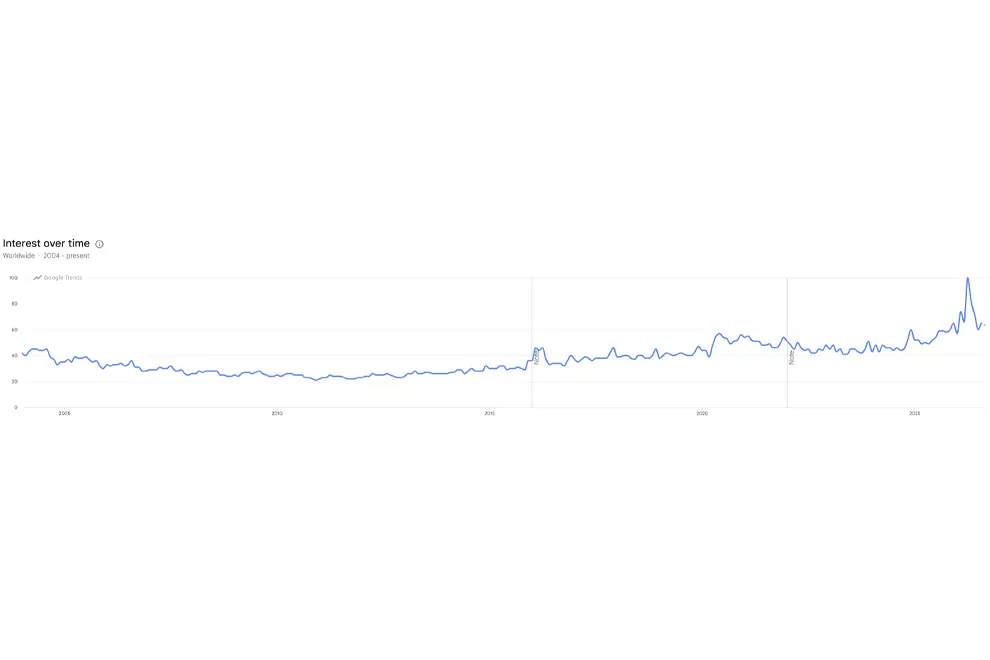
Google Trends searches for "vinyl” between 2004 and 2026.
So, there we have it, right? Vinyl was king, then CDs hit the scene as the shiny new kid on the block and took the crowd, before the ol' liquorice pizza made a comeback. Game over; the status quo has returned.
Well, not quite.
While the 'vinyl revival' made headlines over the past 15 years, now, attention has turned back to the CD revival, wherein the compact disc is the one leading the sales charge.
Overlaying search interest for both CDs and vinyl, we can see that there was a moderate decline in both until August 2008, when they were both at relative parity. CDs would overtake briefly, but since December 2011, it's been the vinyl show.
In April 2016, vinyl showed a search popularity of 46 to CDs' 11, and by December 2021, this had narrowed slightly to 54 to 21. Since then, vinyl has still managed to corner the market, having hit a peak of 100 in April 2016 to CDs' 13.
However, interest for vinyl has dwindled since, and CDs have continued to rise.
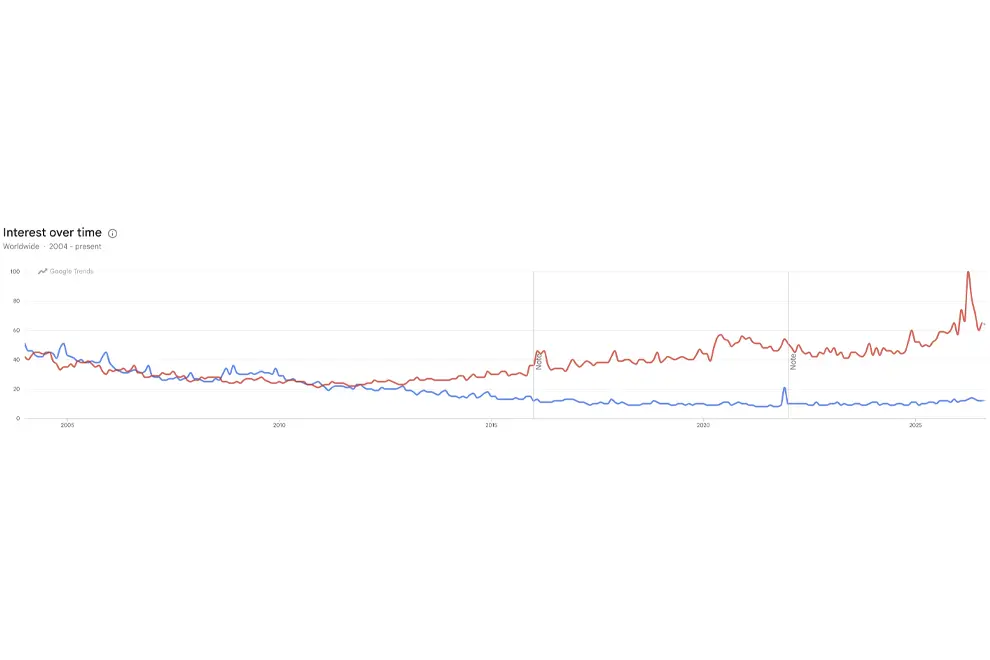
Google Trends searches for "CDs” (blue) and “vinyl” (red) between 2004 and 2026.
According to Luminate's 2026 Midyear Report, the first half of the year saw CD sales surge by 16% to 16.3 million in the US – outpacing vinyl's 2.4% growth. The reason for this growth was largely thanks to the K-pop sector, the report claimed.
Of those 16.3 million sales, three albums accounted for roughly 14%. The report notes that BTS' ARIRANG had US sales of 567,000, ENHYPEN's THE SIN : VANISH made up 286,400, and ATEEZ's GOLDEN HOUR: Part.4 were responsible for sales of 263,000.
Most interestingly, one of the biggest findings from the report is the fact that despite this massive rise in sales, the majority of Gen Z and millennials have purchased a CD despite not owning a CD player.
Roughly 50% of all Gen Zs have purchased CDs without a player, and millennials rank slightly higher. That's true for roughly 30% of Gen X, and just over 10% for boomers.
Interestingly, searches for CD players understandably fell gradually over the years, peaking at 100 in December 2004, and continuously falling ever since (though annual Christmas spikes have always occurred. The searches have undeniably flattened over the past decade, while searches for record players have risen in a similar fashion.
The two search terms would reach parity in May 2020, and while vinyl currently sits above searches for CD players, searches for the latter have been trending upwards since. This month, searches for record players are at 18 as compared to CD players' 16.
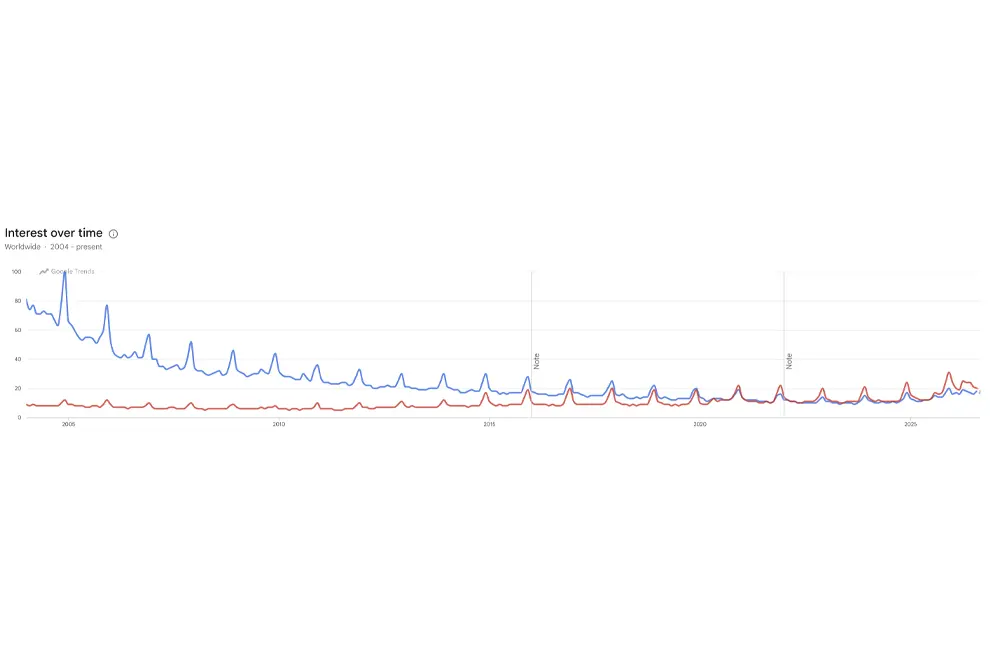
Google Trends searches for "CD player” (blue) and “record player” (red) between 2004 and 2026.
So what's to account for this? Why do we have CDs making a comeback? And why are these purchases being made even without a device on which to play them?
For one thing, the physical aspect of media has long been a driving force. After all, when music began to go digital towards the late '90s and the trend ramped up in the early '00s, fans who had grown up with a tangible product to hold in their hands resisted.
The rallying cry would be centred around claims that you can't hold an mp3 and that the ability to sit with an album and look through the booklet, liner notes, and artwork was slowly being lost to time.
That's one of the main reasons why music-lovers claimed they preferred vinyl (that, and a preference for higher audio fidelity), and it appears as though that's definitely a factor that's been driving the sales for CDs this time around too.
Given that streaming is the ubiquitous format for consumption and that music lovers are slowly feeling less and less as though they have a connection to the music they love, the ability to actively buy and keep their favourite tunes is something crucial. In an era in which music feels like an intangible commodity, a sense of ownership is key.
Even if they don't have a means to play the CD itself, it's the same as owning a piece of merchandise – a souvenir of their favourite artist which they can treasure while consuming the music on streaming.
Merchandise sales themselves have skyrocketed in recent years, even with rising prices and a high cost of living. Artists like Taylor Swift have helped (or hindered, depending on your point of view) promote physical formats as they release myriad variants of their records with collectible covers, bonus songs being available on certain editions, and other exclusive teasers.
Add in the voracious fanbase of K-pop artists – which explains why the top three CDs for 2026 so far are all of the genre – and it's becoming increasingly clear that the compact disc is in the midst of a massive spotlighting process by major artists.
Similarly, platforms like TikTok are also big proponents of this popularity.
Whether it's users (such as this author themselves) taking to the platform to showcase unique and interesting pieces of a music collection, providing historical lessons about the format, or simply promoting a sense of nostalgia for an age apparently gone by, younger TikTok users have found themselves resonating with the format as well.
Simon Homer, of Brisbane's Sonic Sherpa record store, explains that they've always sold CDs but there's been a noted influx in recent years. While he points towards the likes of convenience as one big factor, the comparative price to the format's older sibling is another.
"I think a lot of kids are probably getting secondhand cars with CD players since none of the new ones have them," he muses. "But I think it's a price point more than anything.
"Vinyl is getting pretty expensive – new stuff, new reissues. They're retailing anywhere between $80 to $120 for a new one depending on the release. As retailers, we get looked at with people thinking 'What are you doing? You're ripping us off.' But it's not us."
Indeed, while manufacturers and distributors do find themselves increasing prices along the way, so too does Homer point to the fact that as a merchandise product, it's far more convenient for fans to purchase a more durable CD rather than a comparatively fragile record while at, say, an outdoor festival.
"People still want to buy new product though," he notes. "Around the same time when vinyl started to get a little bit busier, I kind of felt record labels were pushing towards digital.
"They just pushed CDs completely out of the picture, and I think it's taking them a few years to realise that there's still a market for CDs."
Frog Harris, at Canberra's Songland Records, takes a somewhat opposing view to the whole notion of a CD revival. "The problem isn't with demand, the problem is with supply," he explains, referring to all physical formats.
As he points out, there are countless albums out in the world – specifically Australian acts of decades gone by – which are no longer in print and are therefore inaccessible.
Therefore, the record companies which own the rights to these releases aren't committing to a physical product and are simply "making a fortune sitting on their hands, raking in the money from streaming and digital".
As an example of this, imagine being a fan of an Australian artist whose peak occurred in the early '80s. Likely, this artist's work has been out of print for years, and there may even be a reticence to bring the material to streaming.
As a result, the only way which fans can consume the material is by paying exorbitant prices on the secondary market.
Sure, they can buy new CDs, but these new CDs that are available might only be the likes of K-pop artists of Taylor Swift, meaning that if the product is available for fans who want it, we might be seeing a far more representative picture of how the demand for CDs and vinyl have grown over the years.
Harris and Songland have been leading the charge for physical products for some time. Most recently, John Swan (better known as Swanee), released his album Believe last year. You won't find it on digital services, with physical CD and vinyl releases issued via Songland.
Other releases by the label include albums by the likes of v.Spy v.Spy and the late Rob Hirst. These older artists also align with the ages of fans who grew up alongside CDs.
"There is definitely a correlation between the aged demographic that always gravitate towards physical products," he explains. "The people that are aged that are buying the John Schumann album, Swanee's album, etc. they're all of that demographic.
"The kids, without wanting to sound patronising, who are being introduced or reintroduced to physical products, they're the ones that as the years progress, they will be building up their physical collection as well. They're already starting that. Things like Record Store Day have gone a long way to creating or filling that vacuum."
Indeed, the annual Record Store Day – which offers up exclusives, collectibles, and limited edition incentives as a way to bring fans into their local record store – has helped boost vinyl sales over the past two decades. But while these special editions have helped boost desire, it's also rekindled a flame in regard to the communal experience of the record store.
"A very important part of this equation that is nearly unique to record stores is that it's actually a bonding experience between parents – and to a lesser extent grandparents – and their kids," Harris explains.
"It's a cool place to go into a record store where mum and dad, particularly dads, can actually talk about the music that they grew up on and actually hold it in their hand and have that tangible experience of pointing out the songs, the way they were presented, the artwork, etc.
"For the younger generation that for the last 20 years have grown up in the cold, digital world, now that they're actually part of that world where they can enjoy and experience the tangibility of physical products, they're enjoying that experience."
That experience also relates to the idea of taking time out of one's day to live with an album for a period of time. It's not a simple case of pressing shuffle on your streaming service of choice and letting the algorithm soundtrack your day, but rather, sitting back as an artist's magnum opus is presented in a way that aligns with their artistic and creative choices.
"When they put a CD or a record on, they're making a commitment in time, and they're actually experiencing something they never did before," Harris reasons.
"The experience of listening to ELO's A New World Record or Radiohead's OK Computer or whatever the case is, they're hearing those album cuts. As we all know, anyone that's spent any time listening to albums, it's those album cuts that really make the experience so special and generally become your favourite tracks."
Harris' mention of OK Computer is a rather prescient one, actually. Thanks in part to a resurgence on TikTok, famous album cut Let Down has now become the second most-popular song by Radiohead on Spotify alone, fast closing in on being only their third track to hit a billion streams.
It not only hit the US charts, but it trails behind the same album's No Surprises on Spotify, which was the record's fourth and final single. Let Down has never been issued as a standalone commercial release, meaning that if fans want to hear it outside of a streaming environment, they'll need to grab a copy of the album – perhaps on CD?