The job of an artistic director is a lot like an iceberg, according to Sydney Festival's Wesley Enoch. "The audience never sees what isn't programmed. What makes it into the brochure is a relatively small proportion of the initial ideas," he explains. "There are all kinds of ambitions that never quite make it through the process, and in the end, you have to defer certain things and work around those defeats. You have to be able to say, 'Oh bugger, I can't do it in '18 like I wanted to. It'll have to wait till '19.' But of course, no one knows this. They only see what ends up in front of them."
After helming the first season of his four-year tenure last January, 2018's festival - which he refers to as his "difficult second album" - has prompted some objective contemplation from the celebrated Indigenous theatre-maker. "The first time programming a festival on this scale, you don't know what you don't know," Enoch admits. "It's such a whirlwind, you just stumble your way through and make the best program that you can. So, the second festival is definitely harder, because you can see the things that you missed first time around. To be honest, in my first festival I wanted to test things out; how would a large Indigenous program work; how would an extensive circus program in Parramatta work? So that was more about big gestures. This year, it's less about the broad brushstrokes, and more about the fine detail."
And as those fine details of 2018's selection were revealed in late October, it seemed clear that, like many artists this past year, the creep of conservative 'alt-right' politics into the mainstream had been a strong influence on Enoch's curatorial vision. For those familiar with his past work, this will not have come as a surprise. Enoch has long been vocal about various political issues close to his heart, speaking passionately on the record about the arts funding crisis, Indigenous rights, and same-sex marriage equality. But the Sydney Festival chief could best be described as a playful polemic, and his abundantly intelligent wit and attraction to subversive satire is certainly writ large in the work he is showcasing in his latest festival offering, although Enoch insists this is more reflexive than strategic.
"Surely the point of art is to look at a situation and ask, 'Where is the conflict? Where is the drama? Where is catharsis?'"
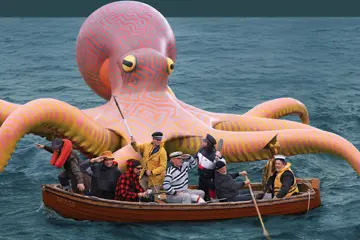
"As an artist, I have an osmotic relationship to the society that I'm living in. I sometimes just follow my gut and my sense of values. It's a process of conceptual evolution in a way," he suggests. "For example, early on in the process of putting together 2018's festival, there was a conversation about constitutional recognition for Aboriginal communities, which morphed into a discussion about sovereignty and colonialism, which then morphed into, 'What the fuck has Captain Cook got to do with us anyway?' There's also a very strong female presence in the program, but I didn't set out thinking, 'Oh, we've got to create a feminist treaty in this year's work.' It came from this sense that the appalling behaviour of Donald Trump, and all the pussy grabbing stuff, had to manifest in different ways. So you ask the question: 'How is it manifesting in the imaginations of artists?'
"These ideas are constantly changing, but if you have a strong sense of your values, and you trust your instincts, you can feel ideas shifting within you before they shift in the outside world. Artists are the canaries in the coal mine; we often have to stay sensitive and champion different thinking before it becomes normalised in the broader discussion."
However, not everyone shares Enoch's point of view. The way the arts and politics cross-pollinate has become a point of contention in Australia, as the country has fixed its political gaze on the divisive same-sex marriage survey. As the 'No' campaign scrawled their ire across the sky and filled the airwaves with dog whistle TV ads, many arts organisations responded with displays of solidarity for the LGBTQIA+ community, particularly on social media. For some arts punters, who duly expressed their displeasure in the comments section, this was an unacceptable affront, claiming that art should be about escapism rather than activism. Similar sentiments were also echoed by some of the nation's most senior politicians.
However, for Enoch, the two are not mutually exclusive. "Just because a piece of art is fun or distracting or takes you to somewhere else, doesn't mean that if you scratch the surface you won't find something politically provocative. Surely the point of art is to look at a situation and ask, 'Where is the conflict? Where is the drama? Where is the catharsis?'" Enoch insists. "I challenge the idea that you can have an apolitical, disengaged piece of art because I think every action or inaction is political. You can have a show that is full of laughter and music and joy that is still concerned with deconstructing the status quo. And personally, I'm far more interested in work that poses those questions."
True to his word, there are many shows on Sydney Festival's 2018 billing that reflect this subversive spirit. But work in this vein isn't just about defiance or injustice. As Enoch points out, this is a program that celebrates diversity, inclusivity, and community, as much as it tries to stare down the challenges our society faces: "I hope these productions show the audience that we are not alone, and personally, as an artist, my instinct is to create meaning for a community — that's the role of the artist in the tribe. Through that sense of community, through that sense of coming together and belonging, we are uplifted."
Full details of the 2018 Sydney Festival program are available now.