There is a healthy debate on which year was the healthiest for Australian rock.
1982 when INXS. Midnight Oil, Cold Chisel, Icehouse, Richard Clapton, Australian Crawl, and Men At Work came up with blockbusters?
2007 when Australian festivals as Big Day Out, Good Vibrations, Laneway, and Falls had their most inspiring line-ups?
1995 when Silverchair kicked open the door for record labels to widen their A&R instincts past the Sydney/Melbourne axis for the likes of Regurgitator, Spiderbait, and Tumbleweed?
1971 when radio embracing of Daddy Cool extended to Billy Thorpe & The Aztecs, Spectrum, Carson, and Madder Lake?
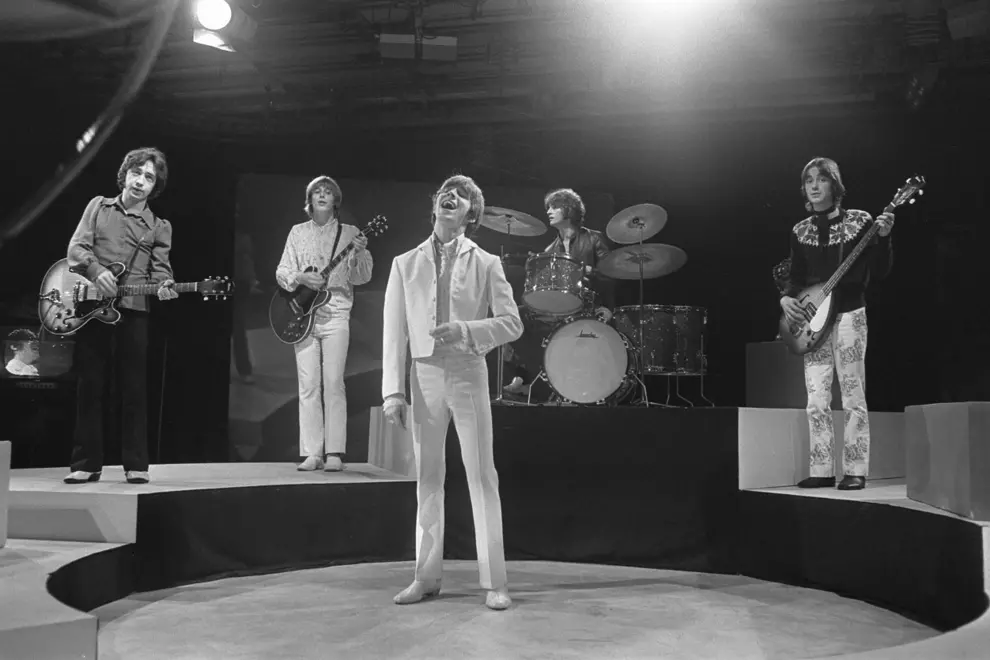
In 1966, acts created soundtracks to the lives of Australian lives and at the same time made a bid for global success. Here are ten examples.
The Easybeats – Friday On My Mind
Month of Release: October
In 2001 when APRA did a poll on the 30 best Australian songs of all time as part of its 75th anniversary, 100 music executives picked Friday On My Mind. At an ARIA Hall of Fame, You Am I played the song with Easybeats guitarist Harry Vanda who co-wrote it with George Young.
The 2:43 slab of working class/immigrant anger was covered hundreds of times, notably by David Bowie, Peter Frampton, Blue Öyster Cult, Kursaal Flyers, Richard Thompson, and Gary Moore.
Long before Bruce Springsteen played it on his 2014 tour, he told Molly Meldrum in April 1995 that when he wrote Out In The Street, “I was trying to copy one of my all time favourite songs, Friday On My Mind. I have always loved that song. The structure on that is just incredible, and it had that unbelievable exhilaration when they broke into the chorus.”
Paul McCartney was driving around London when it came on the radio. He immediately pulled over to ring the BBC to spin it again.
When The Easybeats arrived in London in 1966, they were put in the studio with Shel Talmy, the producer of The Who and The Kinks. He liked their sound but not the songs.
He told them to go home and write new songs, and come back to him each week with the results. It took seven weeks before Friday On My Mind. He said, “That’s the one we’ll go with.”
It reached #1 in Australia and the Netherlands, #16 in the US, #6 in the UK and charted in nine European territories. But the Harry Vanda/George Young writing team failed to follow up with another international hit with similar impact although they continued to come up with gems.
Trivia: Vanda ‘fessed up to Dutch radio how the opening guitar riff was nicked from the unlikely source of French vocal group The Swingle Singers who were featured in a film they’d seen.
"It went tudutudutudu, which made us all laugh. In the train back from the gig, we were imitating them and suddenly it sounded good. They became the first notes of Friday On My Mind.”
The Loved Ones – The Loved One
Month of Release: May
They formed in Melbourne in October 1965 from the remnants of The Red Onion Jazz Band and The Wild Cherries. This jazz influence and use of unorthodox chords saw The Loved Ones regarded by the likes of Ed Kuepper and Nick Cave as the most distinctive in that R&B era.
They were exciting, but moody and erratic as well, led by UK-born swamp blues growler and harmonica player Gerry Humphreys. They were in demand at clubs, one of the first locals to play electric piano and used unorthodox chords.
First single The Loved One was written by pianist Ian Clyne, Humphrey, and guitarist Rob Lovett.
It reflected Humphreys’ fascination with literature, including the use of the Shakespearean (“Younder she’s walking, she kerumms my way”) and naming the song after British novelist Evelyn Waugh 1948 book on the lengths Hollywood film studios went to woo him to get the rights to his Brideshead Revisited.
The song had a double rhythm so mod audiences could feel involved with handclaps. It reached #2 in Sydney and #15 in Melbourne.
In their two years span, they released five singles (including other classics Everlastin’ Man and Sad Dark Eyes) while the album Magic Box remains in print today.
The band broke up, primarily because they made the mistake of sacking Clyn, their main songwriter. Humphreys formed Gerry & The Joy Band (Ongo Bongo Man, Rave On). But to save his marriage he returned to London in 1972, leaving music to work as a hospital porter. He died from a heart attack in December 2005.
"He had a radiating influence on the Melbourne music scene in the '60s, more than anybody else," said Nigel Buesst, director of the documentary Gerry Humphreys — The Loved One, which screened at the 2000 Melbourne International Film Festival.
In 2001, The Loved One scored #6 APRA’s list of Top 30 Australian songs of all time.
Trivia: INXS did two versions. The first was their second single in 1988. The second was for Kick, where Michael Hutchence replaced the desperation of the original with something dark and forbidding. The worldwide success of Kick swelled the bank accounts of the three writers, and led to a reformation tour in September 1987.
Johnny Young & Kompany – Step Back/Cara-Lyn
Month of Release: May
Sixties pop star Johnny Young (John Benjamin Arthur de Jong) toured Australia with The Easybeats in 1966.
After the Perth show at 1 am, George Young and Stevie Wright wrote Step Back in their room in the Savoy Hotel in Hay Street, as Johnny watched on.
Wright claimed he wrote the lyrics while in the hotel sauna surrounded by female company.
It peaked at #1 on the Go-Set magazine National Top 40 in November.
Cara-Lyn was a cover of Cara-Lin by New York band The Strangeloves who claimed they formed in outback Australia.
Trivia: Young went on to become a radio DJ, TV presenter and writer of hits such as Russell Morris’ The Real Thing, Ronnie Burns’ Smiley, Lionel Rose’s I Thank You, and Ross D. Wylie’s Here Comes The Star which became a British hit when covered by Herman’s Hermits.
Bobby And Laurie – Hitch Hiker
Month of Release: March
Bobby & Laurie were vocalist and guitarist Bobby Bright and singer, guitarist and keyboard player Laurie Allen.
The Melbourne pop duo put out no less than eight singles and three LPs in 1965 and 1966.
The Allen-penned I Belong With You was a chart topper which broke them on TV, and had them mobbed even on trams. Hitch Hiker was at the top spot for five weeks, and was the biggest local hit of 1966.
Allen, who had a huge record collection, found Hitch Hiker on the B-side of a single by US country singer Roger Miller. It had been written about serial killer Billy Cook who killed six people by pretending to be a hitch hiker.
The single’s success gave the duo their own TV teen show on the ABC. It’s A Gas, later re-branded as Dig We Must for an adult market.
The move misfired, and friction between the two saw them split in 1967 after three years. They briefly reformed from 1969 to 1971 and had two further hits The Carroll County Accident (1969) and Through The Eyes Of Love (1970).
Trivia: Hitch Hiker was, according to Allen, the first Australian single to feature a fuzz box. Miller’s version had saxophones. Bobby And Laurie’s used the distortion effect to imitate the sound of cars approaching the hitchhiker.
The effect was brought back to Adelaide from London by The Twilights’ Terry Britten. During the recording session, their guitarist Wayne Treble found it difficult to play the note and operate the fuzzbox with his foot. So Bright lay on the floor and operated it with his hand.
The track’s drummer Gary Young, and bassist Wayne Duncan, would in four years have their own #1 as part of Daddy Cool and Eagle Rock.
The Throb – Fortune Teller
Month of Release: February
The Throb were a short-lived brash leather-clad Sydney garage R&B band with a mod and surfer following. They recalled, “Some guy was trying to put us down, saying ‘You just sound like a big throb!’ But we loved it, and we adopted it immediately.”
The Throb were similar to The Easybeats, and not just because they were wild onstage and signed to Albert Productions. They were also made up of English and Dutch immigrants, some who stayed in the Villawood Migrant Hostel where Harry Vanda and George Young met.
Their first single Fortune Teller was written by US producer Allen Toussaint under the name Naomi Neville. It was fairly obscure, appearing on the B-side of singles by Louisiana singer Benny Spellman (1962) and The Merseybeats (1963), and an album track by The Hollies and EP track by The Rolling Stones in 1965.
Albert Productions chose the song. In the session, the producer played The Stones version repeatedly for inspiration, although The Throb rendition was more raucous.
It went to #4 nationally, going top spot in Brisbane, #2 in Melbourne, and #4 in Sydney.
It ramped up their gig schedule to 30 shows in a week, doing half-hour sets back-to-back in discos. They burned out four vans as a result, one bursting into flames on a Sydney street, with scenes of these latest pop stars covered in wet blankets trying to save their equipment.
Trivia: their first TV appearance, on Saturday Date, was a disaster, reported Milesago. “The band got lost on their way to the set, emerging with the opening bars of Fortune Teller blaring out, to find that no drum kit had been set up onstage.”
Bee Gees – Spicks And Specks
Month of Release: September
By 1966, Festival Records was about to drop the Bee Gees from its Leedon label. Over three years all their eleven singles had flopped.
By this stage the Gibbs family had moved from the Gold Coast to Sydney (171 Bunnerong Road, Maroubra). So broke they couldn’t afford guitar strings, they had already decided privately to return to the UK to find success there.
Then things took a turn. US-born songwriter, producer, and entrepreneur Nat Kipner was made A&R manager at new independent label, Spin Records. He briefly took over management of the brothers, and moved them to Spin.
He put them in touch with engineer and producer Ossie Byrne who had his own small St Clair Studio at 56 Queen’s Road in Hurstville. He built it in a storeroom behind a butcher’s shop. It was basic with two mono recorders and cheap, and used by emerging R&B and beat groups.
Aged in his 40s, Byrne believed the Bee Gees were the most original band in Australia. He allowed them free unlimited time in the studio. It was a turning point. The brothers learned studio techniques, Maurice and Robin started to write, and Maurice developed as a musician.
One of their newies was Spicks And Specks, written by Barry, with the piano riff by Maurice. The trumpet was played by Geoff Grant (Geoffrey Streeter). There were no charts: Barry sang what he wanted, and Geoff copied it.
Arriving in London with no contacts or money, they met Aussie expatriate, entrepreneur Robert Stigwood, who was a partner in Beatles manager Brian Epstein’s company NEMS. He had clout and the Gibbs’ fortunes changed.
Spicks And Specks became their first hit outside Australia, charting in the Netherlands (#2), Germany (#28), New Zealand (#1) and Japan (#56). To Love Somebody and Massachusetts followed, and they never looked back.
Trivia: Spicks And Specks entered the Sydney charts at the end of September and stayed in the Top 40 for 19 weeks. The national charts by Go-Set had the track in its Top 40 for 16 weeks, finally reaching #4 in November. It also declared it best Australian single of 1966.
By January 1967, the Bee Gees were already on a boat to England. “We were on the boat in the middle of the Indian Ocean when we heard Spicks And Specks was a hit,” Barry would say.
The Masters Apprentices – Undecided
Month of Release: October
Starting out as an instrumental surf band in Adelaide called The Mustangs, the Beatles’ Australian tour changed their focus to the R&B boom. They brought in a singer called Jim Keays who’d just arrived from Scotland.
At a gig by The Overs, the singer would introduce the songs as “Here’s another one from the masters’ apprentices.” The Masters were inspired by blues giants such as Muddy Waters, Jimmy Reed, Elmore James. Robert Johnson, and Howlin’ Wolf. The new band decided to adopt the moniker but without the apostrophe.
The Masters quickly found a following among other immigrant kids, who liked their music, rock star fashion sense and “bad boy” menace.
In Adelaide after a tour with Bobby And Laurie, Bobby Bright recommended them to his record label Astor. Astor requested a four-track demo tape. The band trooped into Max Pepper's two-track studio in Moger Lane.
They immediately had a problem. They thought only three songs wort of recoding. Guitarists Mick Bower and Rick Morrison slipped away for 15 minutes and came back with a new song. It took another 15 minutes for it to be recorded.
It had a fuzz tone that gave the track its extra verve. It was due to a malfunctioning valve in Bower’s amp. They liked the sound so they didn’t fix it until after the recording.
According to Keays in his memoirs, Pepper asked for the song’s title so he could document it. The singer replied he was “undecided”, and Pepper took it as the title.
Undecided went to #8 nationally, with another Bower song Dead And Buried a follow up hit. Visits to Melbourne found immediate support from influencers as Molly Meldrum, Go-Set, the Kommotion TV show, and they moved there permanently.
By this stage, their workload was relentless. In one town they found Bower had suffered a nervous breakdown in his room. The show’s promoter threatened to dock their pay if the full band didn't play. Nervous they’d be stranded in the town, they dressed up the ill guitarist and had him stand up onstage, motionless.
He left the business but in 2020, rejoined the original lineup for an Adelaide hall of fame performance. The chemistry was still there, so they’ve continued to gig together.
Trivia: the B-side of Undecided was Wars Or Hands Of Time, regarded as the first Australian rock song to address the Vietnam war.
Ironically Keays was one 8,400 Australians conscripted to the armed forces in 1966 when his birthday (September 9) was one of those chosen. But he got out of signing on instead to the Citizens' Military Force, hiding his long hair under his slouch hat during their meet-ups!
Normie Rowe – Ooh La La
Month of Release: December
As Australian solo acts went, Normie Rowe owned the ‘60s, with eight Top 10 hits by his 20th birthday, after dropping out of school five years before.
A self-confessed “natural showoff” on stage, he had boundless enthusiasm and charisma. He was championed by the powerful Stan Rofe, top rating Melbourne DJ and Go-Set columnist.
Rofe’s radio show was essential listening. He got Qantas flight attendants to return from the US with the latest issues of trade publications Billboard and Cashbox, and copies of the latest hits which were not yet available locally.
Rowe and his backing band The Playboys arrived on the scene when town halls and ballrooms were jam-packed, enthusiastic Aussies in each city would make up different dances to the beat stompers, new labels like Sunshine whom he signed to were scooping up new talent, and new TV shows The Go! Show and Teen Scene were being made in Melbourne.
At Rofe’s suggestion, his first single in April 1965 was a rocked-up rendition of George Gershwin's It Ain't Necessarily So (from the musical Porgy & Bess) which went #1 in Melbourne and Top 10 nationally. Sydney radio station 2SM at the time owned by the Catholic Church banned the record because of its line “Things you read in the Bible ain’t necessarily so” but it became the first Melbourne-made record to break the Sydney Top 5.
A version of Ben E. King’s I (Who Have Nothing) (also found in Rofe’s collection) went Top 10.
A double-A side single, covers of Doris Day’s Que Sera Sera and Johnny Kidd & The Pirates’ Shakin' All Over was #1, selling up to 100,000 copies, and regarded as the best selling Australian single of the decade. In October he had three singles in the Melbourne Top 40.
Riding on this wave, he ventured to London in November 1966 to try the English market. He toured with Jools Driscoll, Gene Pitney, The Troggs, and the Spencer Davis Group, and hung out with The Small Faces as they recorded Tin Soldier in the studio next door.
A couple of tracks were cut in London, with the production team of Terry Kennedy and John Carter. Ooh La La was written for Rowe by Robin Shaw and Mickey Keen, “reflecting my love for Ray Charles”.
Among the session players on the record were Jimmy Page and John Paul Jones, who at that time were starting to plan a new venture called Led Zeppelin. Ooh La La was a #1 in Australia and a hit in the UK.
But by 1968 Rowe was drafted and shipped off to Vietnam as a Corporal. By the time he returned in May 1970, the audience had moved on and his pop career was over. He successfully widened to theatre and acting.
Trivia: Rowe discovered that his time in the Army had been a publicity gimmick by the Australian Government to soften public opinion of an unpopular war. He met others who shared his birthday but had not been conscripted.
The Seekers – Georgy Girl
Month of Release: December
Georgy Girl was Melbourne folk-pop group The Seekers’ biggest worldwide hit. But it was not planned as a single. It was on the soundtrack to the English movie of that name. US radio discovered it, and it was rushed out worldwide.
They weren't the first choice either. The producers had a crooner-type song, and asked Frank Sinatra. He wanted changes they didn’t agree with.
One of the producers was a Seekers fan. After shown a preview in a small cinema in Soho, London, the Aussies rejected the Sinatra-style song, and wanted a new one written by English writer Tom Springfield.
A former member of vocal band The Springfields (with his sister Dusty) whose Silver Threads And Golden Needles topped the Australian charts, Tom had earlier written The Seekers’ first #1, I'll Never Find Another You.
The movie was a rom-com about a dowdy girl who had to choose between a sour older man who was her father’s boss and the boyfriend of her glamorous and promiscuous flatmate.
It starred Lynn Redgrave as Georgy, James Mason, Alan Bates, Charlotte Rampling, and Lynn's own mother, Rachel Kempson.
It was a different song for The Seekers, with complex chords. The lyrics by actor Jim Dale (now known for his Harry Potter association) perfectly captured its Swinging London setting, evoking mini skirts and Mini cars, Carnaby Street boutiques, go-go-girls and dark discos.
For Judith Durham, who faced self-esteem and weight problem issues, “It's always been the perfect lyric for me to sing":
Hey there, Georgy Girl
Swingin' down the street so fancy-free
Nobody you meet could ever see
The loneliness there
Inside you...
You're always window shopping
But never stopping to buy
So shed those dowdy feathers and fly
A little bit...
Georgy Girl went to #1 in Australia, the US (where it sold a million), New Zealand and Canada, #3 in the UK, and Top 10 in Ireland and South Africa. At the Oscars 1967, it was sung by Mitzi Gaynor as a nominee for Song of the Year (losing to Born Free).
One review called it “the perfect pop song.” A generation of baby girls was called Georgy.
When The Seekers returned to Melbourne from London in March 1967, a welcome home show at Myer Music Bowl drew 200,000. Police had to stop traffic 4km away. It made The Guinness Book Of World Records as the biggest attendance at a concert in the Southern Hemisphere.
More recently it was spoofed on The Simpsons while in Men Behaving Badly a character recalled he and his wife being devastated when they heard The Seekers had split.
Trivia: the song initially was to start with the chorus. But during the sessions at Abbey Road, it was decided to use the sound of whistling. Reports through the years suggested it was a piccolo or flute. But Durham told this writer, “It was a professional whistler. He came to Abbey Road, did his bit and went.”
The Twilights – Needle In A Haystack
Month of Release: August
Adelaide was arguably the city which reacted most to The Beatles’ visit to Australia in mid-1964, due to the high population of English and European teenage immigrants.
The Twilights came together after two bands entered a Beatles soundalike competition and palled up. They even played live the Sgt. Pepper album in its entirety – something which the Fab Four themselves never did.
They went on to have nine hits over a two year period. Acclaimed for their songwriting, musicianship and on-stage humour, The Twilights became a major live attraction in South Australia.
They did four successful trips to Melbourne, taking a bus over on Friday night and back on early Monday mornings in time for their day jobs.
In Melbourne, they caught the eye of promoter Gary Spry who became their manager and recommended a permanent move to Melbourne in late 1965. They did a three-month residency at his discotheque, Pinocchio's, and they slowly took over their new city.
For their next single, he wanted them to do a cover of Needle In A Haystack, a minor US hit in 1964 for Motown group The Velvelettes, co-written and co-produced by Norman Whitfield.
The Twilights initially resisted recording it, but Spry insisted. Needle In A Haystack was their biggest hit to date. They were on the passenger liner Castel Felice en-route to England when they got a telegram in October telling them it had just hit #1 on the Go-Set charts.
The UK trip was the result of winning the inaugural Hoadley’s Battle of The Bands in June. The prize was $1,000 ($16,500 in today’s money), an English trip from Sitmar cruise lines, 26), gigs and recording.
They recorded at Abbey Road Studios with The Beatles’ engineer Norman Smith. The Fab Four, also recording there at the time, invited them to watch the Penny Lane sessions.
The UK trip didn't work. But they recorded What’s Wrong With The Way I Live and Cathy Come Home which were hits at home in 1967.
A plan to star in their own TV series for the Seven Network fell through after a sponsor pulled out. By 1968 when The Twilights went through their "psychedelic" period, the hits dried up and they broke up a year later.
Trivia: two members went on to have global success. Singer Glenn Shorrock would be part of multi-million selling Little River Band penning Emma, Help Is on Its Way and Cool Change.
Guitarist Terry Britten became a hit writer and producer. Among his long list were Carrie and Devil Woman for Cliff Richard, We Don’t Need Another Hero and What's Love Got To Do With It for Tina Turner, Just Good Friends for Michael Jackson's Bad album, and Circus for Lenny Kravitz.
This piece of content has been assisted by the Australian Government through Music Australia and Creative Australia, its arts funding and advisory body