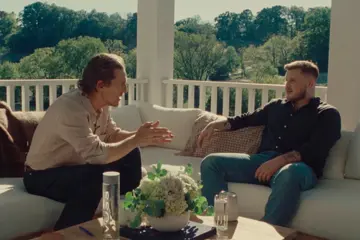
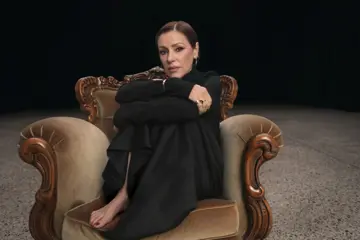
"It's exactly what attracts press and exhibitors: the celebrity component," admits Monson. "If you talk to people who haven't seen the film, all they want to ask about is these celebrity narrators. But, after they've seen the film — after we've had screenings of it — no one is talking about that anymore, but the content of the film."
The content is, essentially, an overview of humanity as a species, contrasting our capacity for empathy and art with our history of war and oppression. "Even though we know we are on a planet that contains multitudes, we can't stop creating these binaries, and seeing opposites in one another. What will it take for humans to stop being at odds with one another, to stop this constant fighting amongst ourselves? There's a statistic we use in the film, that mankind has been at war for 95 per cent of recorded civilisation. Even today, in our modern era, with all our increased knowledge and understanding of other cultures and the world around us, we can't get to the point where we can just tolerate each other's differences. We still feel the need to use force to exert our position. We drop bombs on each other. It's incredible that we still do that today. Yet, we're so accustomed to life being that way, that the idea of a civilisation without war is truly alien to us."
Conceived as a companion-piece to Monson's 2005 documentary, Earthlings, an animal rights documentary featuring footage shot covertly inside slaughterhouses, puppy mills and pet stores, Unity begins with footage of a cow awaiting slaughter, frantically trying to escape, and part of its look at humanity is our belief we have 'dominion' over all creatures for our own use.
Earthlings was narrated by Joaquin Phoenix, the first person Monson contacted about narrating Unity. Both are vegan, as are a host of the other narrators: Jessica Chastain, Casey Affleck, Moby, Olivia Wilde, Carrie-Anne Moss. After initially thinking Phoenix would serve as the sole narrator, "in the spirit of unity" Monson soon imagined his film as some We Are The World collection of narrators. At first there were going to be 25, then 35 and, after going all out, they arrived at 85. By that point, the concept crystalised: 100 narrators for a 100-minute film.
"Some of my investors thought it sounded silly," Monson admits. "'Is this just a gimmick? Is this egocentric? Is having celebrities read the dialogue contrary to the message and the spirit of the film?' And I would've been happy to have a janitor or a school-teacher or a policeman read for the film, but the truth of the matter is that actors and performers are just very, very good at delivering dialogue. And, of course, I also knew that having actors in it would increase the chance of the film being seen."