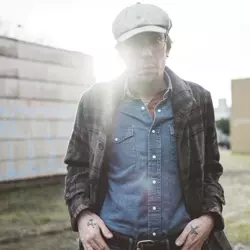
 Justin Townes Earle Profile
Swiss author and dramatist Friedrich Durrenmatt once sagely opined, "resistance at all cost is the most senseless act there is", a tenet that US singer-songwriter Justin Townes Earle can readily attest to following the birth of his recent seventh album Kids In The Street.
For a full decade the rising star had been crafting his authentic, heartfelt Americana in his native Nashville - under his own supervision - with requisitely strong results. Yet suddenly for Kids In The Street Earle decamped to the Omaha studio of producer Mike Mogis (Bright Eyes, Cursive, First Aid Kit) - the first time he'd allowed outside assistance in the studio - and recorded using hitherto-unknown local musicians, a move he attributes to his brand new label New West Records.
"It was time to try something different, or just somewhere different," Earle reflects. "But I can't claim credit for the wanting to go there, it was something that my record label brought to me and then I fought it a bit at first. I do actually trust the people who work at my record label and admire the work that they've done in the past, so I decided that maybe it was time to listen and take a little bit of direction from an outside source, which I hadn't done at any point in my career.
"I ended up liking it, although it felt strange doing it. It's my seventh full-length and eighth release altogether and I'm going somewhere other than where I've always made records that have done well for me - it kinda goes against everything that we would normally think."
Fortunately, Kids In The Street survived the new process unscathed, the album assured and upbeat and dripping with soul. "I knew what I wanted feeling-wise, but I really went into this record not knowing what to expect," the singer continues. "And a big part of the making of this record was that I relinquished a lot of control, and the fact that Mike Mogis plays a lot on the record and I allowed him to do all his parts on his own and then send them in.
"Usually when I make records I'm there for the mixing process and the mastering process - I'm there the whole time. I wasn't there for the mixing of this record, so I genuinely in a lot of ways did not know what to expect with this record and I won't say that I was surprised that I liked it, but I was surprised that I loved it.
"[Relinquishing control] is definitely one thing that singer-songwriters especially are kinda heady about, we like to think that our way of looking at our songs and the way that we first envisioned our songs is the way that they have to be sometimes, and I'm guilty of that. I do write songs where I know my part but I definitely have ideas for instrumentation and things by the time I've done writing a song. So it was interesting doing it, the nerve-wracking part was waiting for the mixes but it worked out great. It's good to be nervous every once in a while."
Lyrically Kids In The Street finds Earle getting nostalgic, regularly touching upon childhood memories and the gentrification of his old neighbourhoods through the prism of third-party perspectives. "I think in all my records there's some kind of loose thread that runs through them all," he offers, "and this record is definitely looking at the fact that I'm 35 and I'm old enough to look at a troubled life with something other than anger now and to look at it more from an outward perspective as opposed to an inward perspective.
"[It's a different challenge], especially when you're looking and trying to understand how it all projects onto everybody around you. I think it's a lot more difficult than say sorting through my own thoughts of it and my own opinions, and looking at it from a stance other than your own. Trying to speak for other people is a definite challenge."
Kids In The Street also finds Earle dusting off timeworn narratives in If I Was The Devil and Same Old Stagolee, his tip of the cap to the ongoing folk tradition and lineage.
"Absolutely," he concedes. "I think that it's the same reason that I did They Killed John Henry [on 2009's Midnight At The Movies]: I see where I gained the most important bits of what I do from generation after generation of artists re-working the same songs and making sure that these storylines didn't die. So I do think that because I took from that tradition so much that I have an obligation to try and continue that tradition."