 Jebediah Profile
There's a moment near the start of the recently-premiered documentary, Jebediah: Are We OK?, in which guitarist and vocalist Kevin Mitchell describes the eponymous group as a "very functional band surrounded by so much dysfunction".
From an outsider's point of view, this almost feels like a bizarre statement to make. For over 30 years now, the Western Australian rockers have felt the archetype of the '90s alternative rock band.
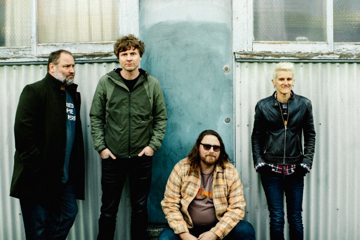
Forming as scrappy teenagers, the band – comprising Mitchell and his drummer brother Brett, alongside bassist Vanessa Thornton and guitarist Chris Daymond – managed to impress the right people, make music which equally impressed the punters, and over the coming decades, they appeared to avoid the trap of salacious headlines and public in-fighting – all while winning awards, generating airplay, and playing well-attended shows on a consistent basis.
For the average fan, this lack of outward dysfunction is indeed what the majority of the Arlo Dean Cook-directed documentary feature portrays. However, as time passes, so too does the darkness seep in at times.
When Cook first picked up the camera 11 years ago with the intent of capturing the group's story, Jebediah were in the process of celebrating their 20th anniversary. At the time, no one had any idea of what the end result would be.
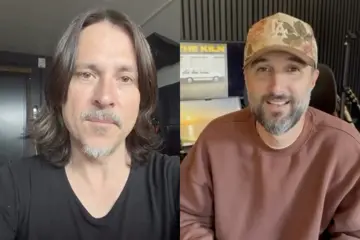
"I think we quickly decided it was really important that if there was going to be a documentary made about us it had to be more than just a movie for fans that was just all about how fucking great Jebediah are," Mitchell says over a Zoom call from his house.
"That's such a narrow, boring way to do things, and it's not really offering much to the world."
By his own admission, Mitchell pointed to the release of Sacha Gervasi's 2008 documentary on Canadian metal outfit Anvil – helpfully titled Anvil! The Story Of Anvil.
While that particular film viewed Anvil as also-rans in the metal world (albeit with a redemptive arc), Mitchell explains that the approach of the documentary was one he could foresee Jebediah's taking.
"It was a fairly low budget kind of festival-type film, but it had this broad appeal," he explains. "I mean, this is a band from another country that I'd never heard of before, their music is kind of not really in my wheelhouse, but I enjoyed the doco; I found it really entertaining.
"I figured if we were going to be in a documentary, it had to have that broad appeal, and it's got to offer something to somebody who knows nothing about the band. Or if they have heard of the band, maybe it's not even their kind of cup of tea, but it's got to give something to more than just fans of Australian '90 pop punk."
However, while that's the idea now, that wasn't necessarily the plan when Cook began filming. In fact, there was no set plan.
Sure, fans of Jebediah have probably seen Cook's name mentioned frequently over the past decade, and he's been a frequent presence at their live shows, events, and even behind the scenes, but just why he was filming wasn't apparent for quite some time.
At first, his filming was for the purpose of generating 'content' – perhaps to have later been shared as a DVD addition to an album. Soon enough, the footage piled up and talks of a documentary emerged.
But even then, there was no set 'narrative' at play – more a case of Cook keeping the camera rolling in hopes something cohesive would become present. "A whole different thing started to reveal itself," Mitchell explains.
"If ten years ago, Arlo had sat us down and said, 'Hey, I want to make a documentary about your lives, this is what it's going to be about, and this is what it's going to cover,' we probably would've said no. We'd probably been like, 'Ah, that's way too scary.'
"And we were all pretty nervous and anxious about it coming out."
One of the more endearing aspects of the documentary is seeing a young, fresh-faced version of Jebediah in their formative years.
While countless fans around Australia effectively grew up alongside the band, it's sweet to go back and see this group of musicians, creating purely for the love of the craft, unaware of the future acclaim and accolades that would come their way.
While everyone has that same sense of cringing embarrassment whenever they look back on old photos of themselves as teenagers, seeing it on the big screen in a format such as this didn't leave the members of Jebediah (or at least Mitchell) lamenting their past fashion or facial hair decisions predominantly.
Instead, it was an opportunity to do so alongside providing a sense of sympathy for their younger selves.
"There are so many things that I look back and go, 'Oh God, why did I think that was cool?'" he laughs. "I don't know if all people in bands would go through that, but I just think we were so young and so naïve, and we weren't very cool.
"I made all sorts of stupid decisions on stage and with my appearance that, look, I don't regret – I don't live with regrets – but there's lots of stuff there that makes me kind of wince a little bit."
However, at the age of 48 and with teenagers of his own, Mitchell does admit that he's managed to reach a point in life where he can employ a sense of perspective, forgive himself for past embarrassments, and not let those questionable decisions come back to haunt him.
"It's being able to separate myself a little bit and go, 'Look at that person. He's a kid, he's got no idea what he's doing, and he's done some pretty dumb shit, but he was having a good time,'" Mitchell explains. "'I like him, even though he does some dumb shit.'
"There's nothing I regret. Things that I would do differently? Sure, absolutely. Who wouldn't? Knowing what I do as a middle-aged person, I'd love to go back and just make some tweaks, but there's nothing that I look back on with regrets."
Given that Mitchell didn't want to simply release an ego-stroking film about how great Jebediah are, a documentary such as this is one that needs to pair the crunchy with the smooth. And indeed, that's where the darkness of the film's focus lies.
Notably, internal struggles come to a head across the band's past decade, specifically centring around the topic of methamphetamine addiction and the band's response to it.
In the film, this addiction is something that the band and the audience learn about in real time.
When the cameras began rolling 11 years ago, none of this was apparent. However, by the time of the film's release, one can only imagine there may have been internal conversations about whether this information should in fact be broadcast in such a public manner.
"There was a lot of apprehension," Mitchell admits, explaining the level of anxiety he felt was nothing in comparison to what his bandmate was experiencing.
"I think once we started to realise what was happening, and Arlo was there capturing it all because that's what he had been doing for years, I guess we had to ask ourselves, 'This is happening and we can't shy away from it, so I guess this is what Jebediah is at the moment?'
"And fuck, I mean, that's life. Who gets to nearly 50 or thereabouts – middle age – without experiencing some kind of crisis? Whether it's losing a family member or a partner, a bad relationship breakup, or just some big disruption in their lives.
"We just felt like if we shy away from it, then what's the point of doing this?" he asks. "What kind of story are we trying to tell?"
Indeed, it wouldn't feel like an honest examination of the band if the focus was little more than a highlight reel of the group's achievements.
Early in the film, however, there's a moment in which Mitchell talks about how his early days as a musician were paired with an apprehension in even showing his bandmates the music he had been writing.
It's fitting then that 30 years later, both he and his musical conspirators have managed to achieve a sense of transparency to the point where they're inviting the public in to view them in high definition – metaphorically swinging the doors to the rehearsal room open as fans take a voyeuristic approach to the group.
Of course, it's one thing to be vulnerable by either showing off some lyrics or getting on stage to perform, but it's another entirely to discuss heavy topics like personal struggles, addiction, and fractured relationships.
"It's funny, I distinctly remember writing the lyrics for Harpoon and putting the word 'love' in there, and it was the first time I'd ever used the word 'love'," Mitchell recalls. "At the time I was probably only 18, and I remember feeling like it was such a risky move to use the word 'love' in a song. At that age it was a word that I'd never said to anybody and hadn't really thrown around.
"But that just speaks to that idea of vulnerability. Then you do it and you realise the power that it has. Throughout my musical career, particularly as I've gone into doing the Bob Evans stuff, I've realised vulnerability has a real power.
"When it comes to this documentary, for me personally, I thought it was nerve-wracking exposing this side of the band and because people won't be expecting it," he explains.
"Most people didn't know that it was happening, but I still kind of felt like there is the potential for it to be really powerful. Especially in terms of people who have experienced similar things, because sharing that stuff is important."
In simple terms though, what does Mitchell hope fans take away from a documentary like this?
It's not all about asking the titular question in regard to Jebediah in the current era, it's not about showing how far a little band from Perth can take it, and it's not all about the strength of any particular member's musicianship. Instead, it's a celebration of the sum of their parts.
"I just hope that people get something out of the story of four individuals that just happen to be in a band and play music together," he muses. "I hope it shows people the strength of friendship, that if you're lucky to find that when you're still kids… what an amazing gift that is.
"The fact that we play music together and have a career playing in a band and all that kind of stuff is almost kind of secondary, really."
Interestingly, the release of the documentary also coincides with another, separate look back for Mitchell.
While he and his bandmates have been looking to the past 30 years of Jebediah, Mitchell is personally taking a look back to 2006 �� the year that his Bob Evans project broke through.
While Bob first reared his head in the late '90s, it wasn't until 2003 that the Suburban Kid record arrived – arriving in the midst of two Jebediah records. In 2006, however, Bob went gangbusters.
The Suburban Songbook album would hit No. 15 on the charts, would be crowned Best Adult Contemporary Album at the ARIAs, and has since been considered one of the finest Australian records of the '00s.
While Mitchell is typically someone who forges ahead into the future, he admits it's a little bizarre for him to be pairing two retrospective looks toward the past in the same year.
In fact, while Suburban Songbook's anniversary plans (including national tour dates and a vinyl reissue) were first put into motion a couple of years ago, the Jebediah documentary had initially been envisioned to arrive in 2025 alongside the band's 30th anniversary.
"There are some things that you just have no control over," he laughs. "Suburban Songbook is, I guess, the record that Bob Evans is most known for, and it's all about going out and doing the record in full; trying to recreate the album."
It's not something he'd usually plan for, either. By his own admission, he's not someone who goes to a gig wanting to hear a record played live. "That's what the album's for," he protests.
But while he's excited about this undertaking regardless, he's unsure about whether there will be much of an overlap between fans of Jebediah and Bob Evans – especially given their rather disparate musical focuses.
Regardless, it's a good time to be a fan of Mitchell's work.
"When you do a tour like this, celebrating an album that came out 20 years ago, there is a part of you going, 'God, do people even still care?'" he admits. "It's a real test of how big a record like this was in people's lives.
"There are some records, and Jebediah's the same – Slightly Odway is that record with Jebediah, and Suburban Songbook with Bob Evans – where it was the record that they grew up with in high school, or it was the record when they were at uni. It's a kind of timestamp for a lot of people.
"And it's usually that period – that time of being a teenager or in your early 20s in that coming-of-age era – that a lot of people connect to. And that's what a lot of people still follow Jebediah for, to connect to that. And many now have kids who are getting towards that same age that they were.
"With Suburban Songbook, there is a little bit of that, but Suburban Songbook seems to be a marriage record, a wedding album, or the music that they and their partner were listening to when they first met or were first getting together."
Whether you're looking in the rearview at Bob Evans' Suburban Songbook, or breathing in 30 years of history and the speed-bumps which Jebediah have overcome, Mitchell just hopes that the importance and beauty of lifelong friendships ultimately shines through.
"Friendships that will carry on throughout our lives," he offers. "There have been people who have broken up with their partners in life and gone through so many different things. So many things have come and gone, but these lifelong friendships, if you're lucky enough to have them, often end up lasting longer than the relationships that you have with your mum, your dad, your spouse."
"Not everyone gets to experience that."
Jebediah: Are We OK? Receives a cinema release on October 8th, with Q&A screenings taking place around the country. Tickets to Bob Evans' Australian tour dates are on sale now.
Bob Evans – Suburban Songbook 20th Anniversary Tour
Friday, October 16th – Howler, Naarm/Melbourne, VIC (18+)
Thursday, October 22nd – Lion Arts Factory, Tardanya/aAdelaide, SA (18+)
Friday, October 23rd – Crowbar, Meanjin/Brisbane QLD (18+)
Saturday, October 24th – Crowbar, Eora/Sydney, NSW (18+)
This piece of content has been assisted by the Australian Government through Music Australia and Creative Australia, its arts funding and advisory body