BIRDMAN

In Birdman, Michael Keaton stars as Michael Keaton-ish actor who, decades ago, played an iconic super-hero, only to bail on the franchise at the peak of his powers, only to slide, slowly, into irrelevance. At work on a Broadway adaptation of Raymond Carver’s What We Talk About When We Talk About Love —a vanity-project in which he serves as writer, director, and star; a transparent attempt to show off his Serious Artist chops, and win credibility in the face of waning popularity— Keaton is dealing with the ghost of his former character. Birdman isn’t just the costume he once grossed a billion dollars in, but the voice who whispers in his ear; part antagonist, part conscience, part dissociative disorder.
The super-hero in his head has been hectoring our anti-hero the whole film long when Keaton finally gives in, unleashing his inner-Birdman, and letting the power of super-powers single-handedly change the film itself. No longer are we in some backstage black-comedy, looking at the behind-the-scenes turmoil of a Broadway production, instead we’re instantly tossed into a super-hero movie, replete with apocalypse-level CGI destruction and surround-sound explosions and pulse-rattling pace.
Right at the height of such mania, with Keaton torn between genre, the competing voices in his head, and the present and past, the flight-of-fantasy is interrupted by a gawper on a nearby rooftop: “is this for real or are you shooting a film?”
The question lingers, because Birdman willingly inhabits a liminal space, in which distinctions between reality and fiction are blurred. Art imitates life and life imitates art, not just in Keaton’s dissociative fugues with his former self, but in the way the on and off-stage dramas of his Broadway debut reflect each other perfectly, the way its actors lose sight of themselves in performance, and don’t know when to stop. And, beyond that, in the way that the superstar’s once-insider world of celebrity and status has grown to include the whole world: in an age of phone-cameras, everyone is both a budding paparazzo and a viral video away from being famous (“believe it or not,” says Emma Stone, playing Keaton’s daughter, when an embarrassing citzen’s-video of pops goes viral, “this is power”).
Birdman —whose full title, we should note, is Birdman, or (The Unexpected Virtue Of Ignorance)— attempts to take the pulse of 2014. It does so with its philosophical thoughts on social-media, its existential contemplation of life at this point of history (six billion years of evolution leading to six billion humans, all jostling for a piece of theirs on a dying planet), and, most keenly, with its smirking portrait of the state of Hollywood itself.
 In what ranks as quite the turn-up, this smart-alecky satire comes from Alejandro Gonzalez Inarritu, the Mexican miserablist whose career, prior to this, has consisted of showy, awards-show-aimed dramas in which famous actors get ‘gritty’ in ensemble-cast, interconnected-storyline movies that show humanity as being united —across lines of class, creed, and country— in suffering. There’s little comparison between a film as witheringly earnest and utterly witless as 21 Grams and Birdman’s mischievous, meta-movie take on the movie-making machine, Inarritu’s unexpected mid-career pivot providing far more warm feelings than Keaton’s heroic comeback.
Birdman’s script —by Inarritu, Nicolas Giacobone, Alexander Dinelaris Jr., and Armando Bo— is, effectively, a howl at the comic-book-isation of the movie industry. Just as Keaton is haunted by the spectre of Birdman, so, too, does American filmmaking toil in the shadows of the super-hero movie; the whole system beholden to the billion-dollar branding exercises and their weekend grosses.
The comic-book blockbuster is no longer merely a tentpole, but the hole big-top; show-business bankrolled by its Barnum & Bailey huckstery, the very dream of cinema —the dying planet’s definitive dying artform— kept alive by the artistic nightmare of Marvel’s manifold Phases.
Birdman feels free to take such big swings, thematically, because the film itself is an attempt to do something new, to push at the edges of the medium. Working with Emmanuel Lubezki —Alfonso Cuaron’s long-time cinematographer, coming to Birdman fresh off winning an Oscar for Gravity— Inarritu stages the entire film in a stitched-together single-take, which uses digital sleights-of-hand to deliver a movie minus cuts. Befitting its self-aware status, the film plays with this device in front of your eyes, recalling Shahram Mokri’s Fish & Cat (which was shot in an actual single take) in the way leaps-in-time don’t require edits, the way the band providing the score steps in the picture, the way the choreography of the staging invites a celebration of itself.
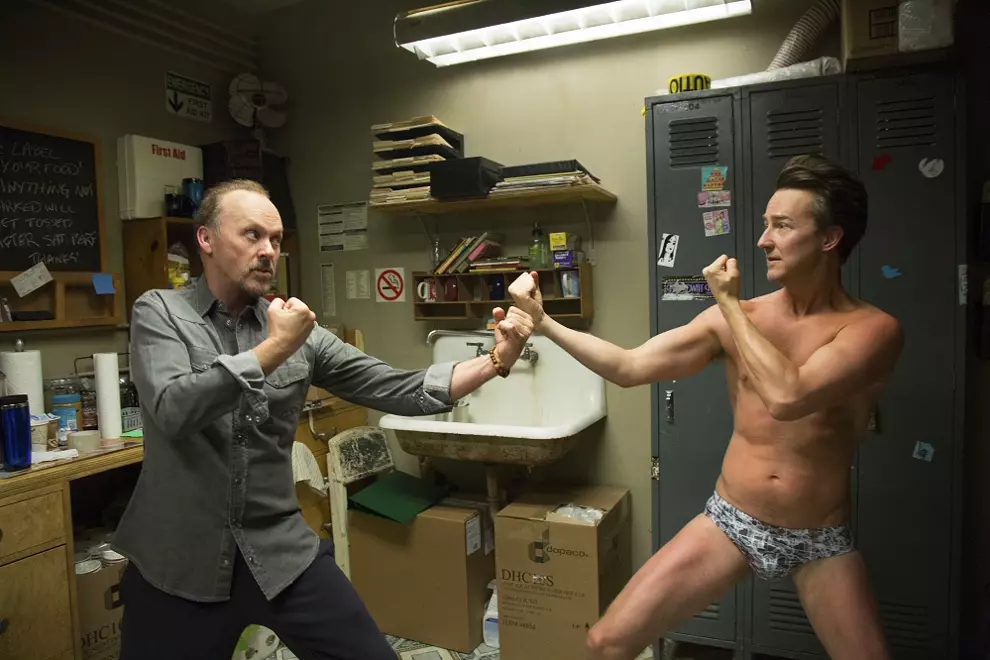
Whilst there’s a technical impressiveness to Lubezki’s invention, the grand visual gambit doesn’t obscure the performances. Instead, it encourages them: the lack of cuts giving space for the actors to take a hold of a scene, for their portrait of theatre to play out more like theatre. An exchange where Keaton and Stone verbally, viciously spar achieves real resonance by not looking away when the emotions get ugly; elsewhere, scene-stealing Edward Norton and top-of-her-game Naomi Watts get to show off both their acting chops and their comic timing free from breaks-in-the-action. Each actor —Andrea Riseborough, Amy Ryan, Lindsay Duncan, and Zach Galifianakis round out the principle cast— seems overjoyed to be working with a text (and meta-text) so meaty; and seem, with Norton and Watts, happy to be playing up turns that mock the actors themselves.
Keaton is less impressive, but there’s an Oscar-nomination awaiting for daring to rise to the challenge, for answering a film written for him by bringing all his own baggage to the table. Like the character he plays, Keaton, too, is haunted by a cape-crusading past; and Birdman marks his own attempt to win credibility in the face of waning popularity. Within the film, and without, the world applauds someone working so close-to-home, performing a performance in which fantasy and reality wobble and weave. Whether Keaton’s comeback, Inarritu’s evolution, or the film’s moments of profundity are “for real” is a question that lingers unanswered, and unanswerable, due only to the slippery state of what currently constitutes reality.
Seeing life through a lens, walking through endless frames, constantly captured on-camera, it’s difficult to tell where just-shooting-a-film begins and just-living-life ends; Birdman, in his dissociative duality, the hallucinatory hero the 21st-century deserves.
INTO THE WOODS

 Into The Woods —Stephen Sondheim’s fairytale-riffing Broadway musical— is, in many ways, a natural fit for Disney; the animation-titans/branding-empire having a long history of taking properties in the public domain and bringing them back to monetised life. Yet, the House of Mouse often has an uneasy relationship with the source-texts, seeking to make ‘family-friendly’ the grim and Grimm, to airbrush away the horrors and perversions at play. Which makes Into The Woods an interesting Disney property, given Sondheim’s songs and James Lapine’s book are commentaries on feelgood fairytale cliché, out to tap into the dark desires —both primal and literal; the sexual subtext of the Wolf ‘eating’ Little Red Hiding brought front-and-centre— oft glossed-over on the rush towards Happily Ever After.
Whilst the film seems somewhat horrifying as simple prospect —a family-friendly Disney musical, directed by Rob Marshall, performed by a celebrity cast— Into The Woods verily thrums along, moving swiftly through its irreverent numbers, with Emily Blunt and Meryl Streep both delivering standout performances. After its second act ends at the place of Happily Ever After, the film dares push exploring what happens after The End. This final act is both Into The Woods’ most interesting and its most problematic: Lapine (who wrote the screenplay) examining the morality of fairytales, making a commentary thereon, yet never transgressing those moral certainties; this film, too, deciding who ‘deserves’ to die, and punishing those who dare do wrong (ie. any woman who exhibits desire). Its values, in the end, feel plenty Disney, Into The Woods becoming, by its end, a preachy parenthood movie about kindness to children and the importance of family.