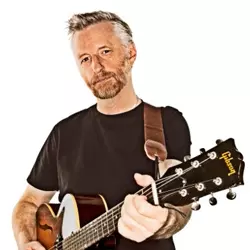
 Billy Bragg Profile
England, Half-English is in stores now.
The Bard Of Barking is positively beatific. As the Queen Mother lay in state awaiting her final resting place among kings, queens and forgotten heroes, Billy Bragg is nattering lengthily about what it all means; how significant the passing of this - the last loved Royal - really is. Now the Queen Mum is gone, there's nobody left to lead the family into the future - or at least to keep the public engaged with the House of Windsor. This, says Billy, is the beginning of their end.
"Well, you can hardly see the masses falling in love with Queen Camilla, can you?" he says happily. "I've been keeping a bit low key about this because I don't want to insult a generation of people who are devoted to the Queen Mother and her children; the last people to love the Royals, probably. You know, the people in their 60s, 70s and 80s; the war generations. It is hard to see a future with the kind of support there's been for the royal family in the past.”
"None of the Queen's kids are going to get the public involved and behind the royals. The Queen Mother's death marks a significant point in English history; a time of change on many levels. However, we mustn't be premature or too loud about this. It is proper to let the last rites be observed."
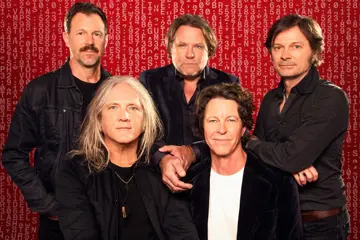
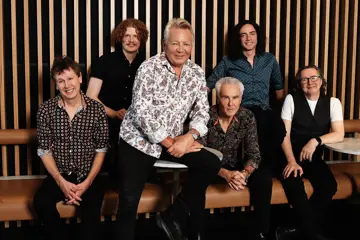
You can talk about what it all means and Billy does for well on the next 15 minutes flicking across the social and political structure of Britain, more precisely England, with the eye for detail for which he's become renowned. Billy's back with his band the Blokes (that includes the legendary Ian McLagen, keyboardist with the Small Faces and The Faces, mate of the Rolling Stones) and yet another statement of concept England, Half-English. In fact, the bugger has jagged it.
"The whole notion of what it means to be British and the British Parliament for that matter is coming under pressure. Being British has had less and less meaning since the 1940s, when it had a very serious and very important meaning because the fate of England, Scotland, Wales and to some extent Ireland was tied together hence the Battle of Britain. That's what I was talking about before: the Queen Mother was the living representation of those people, those times, that Great Britain. Many people now are casually patriotic and casually British and I think if more people could become casually English in the way the Scots have become casually Scots, I think we could start to marginalise the racists and the football hooligans and start to feel more relaxed about belonging to that identity."
The title, England, Half-English, was first coined by the English writer Colin MacInnes, author of the classic Absolute Beginners and City of Spades.
“Half English described the way in which Fifties' society was being increasingly informed by a diversity of cultures and attitudes, each in turn contributing new ingredients to the idea of an English identity. The most obvious were the American influences on English pop music and culture and teen fashion and the impact of post-war African and West Indian communities in England.”
Forty years later Billy has revived the idea; so, yes, it's about identity, the need to reclaim a notion of Englishness from those with racist and political agendas.
"Identity is purely personal, it's what you think you are," he says. "It only becomes a problem when someone else tells you what you are. I am no longer prepared to allow others - the far-right, the football hooligans, Norman Tebbit - to define my identity. My job as a songwriter is to reflect the world around me. There has been a change in the perception of who we - the English – are. I think that the politics of identity should become a real debate, a new agenda to which we can all contribute."
And, of course, the royals have a much smaller place and space in that identity.
"You can probably sum up what I feel about the monarchy by saying that millions of people each week watch Coronation Street - and the fact that millions of people watch it says something about us as a nation, in the same way the monarchy says something about us as a nation. A lot of people get pleasure out of watching Coronation Street. I don't particularly watch it or like what it stands for, but I don't want to abolish it. And that's how I feel about the monarchy. I feel very strongly that you should take away their royal prerogative and make the people sovereign in Parliament not the Crown; I think we should have all that land back and let them have a few big houses and a couple of bicycles. But they represent to some people an important part of what they think this country is about. I can live with that; they don't do no one no harm, it's not like fox hunting."