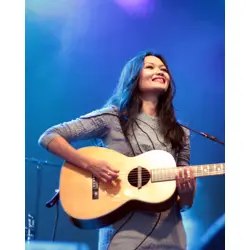
 Bic Runga Profile
Within Aotearoa, Bic Runga is one of the nation’s most beloved singer-songwriters. Beyond it, her song Sway has granted her a kind of pop immortality, even if her name and face don’t carry the same global recognition as Lorde or Neil Finn.
Over the past 30 years, Runga has been a fixture on compilation CDs like World Famous in New Zealand and Nature’s Best (New Zealand’s Top 30 Songs of All Time), and it’s hard to find anyone who begrudges her brand of confessional indie pop. Yet it’s been 15 years since her last album of original material, making Red Sunset, and tonight’s concert, a comeback of sorts.
“It’s so hard to release new music now, there are just so many other things to look at,” Runga told Radio New Zealand in a recent interview. Judging by the enthusiasm in the room tonight, there are plenty willing to pay to hear her play it – and they’re not all Kiwis.
This is the first Australian show of the Red Sunset tour, and if there’s any tension about playing to a non-New Zealand audience, it doesn’t show. Over the next hour, that ease proves one of Runga’s greatest assets.
What has kept her from releasing music is partly explained by Kody Neilson, the man fronting her support act, Silicon. Known for his work with the unhinged live band The Mint Chicks (alongside his brother Ruban, founder of Unknown Mortal Orchestra), Neilson is also Runga’s husband and the father of her three children.
Silicon’s gentle neo-soul is so slight it barely registers. Neilson plays organ while his heavily processed voice drifts over simple rhythms – music that feels closer to ambient décor than performance, or perhaps the sound of someone retreating into a more therapeutic mode after expending so much in a previous incarnation. Whatever its purpose, tonight it becomes background to chattering, middle-aged Kiwis, a fate that likely awaits any support act. Later, Neilson returns as Runga’s drummer, alongside keyboardist Carl Bennett and Cass Basil, a member of another legendary Auckland band, Tiny Ruins.
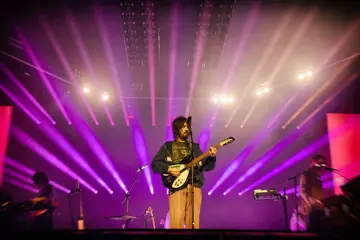
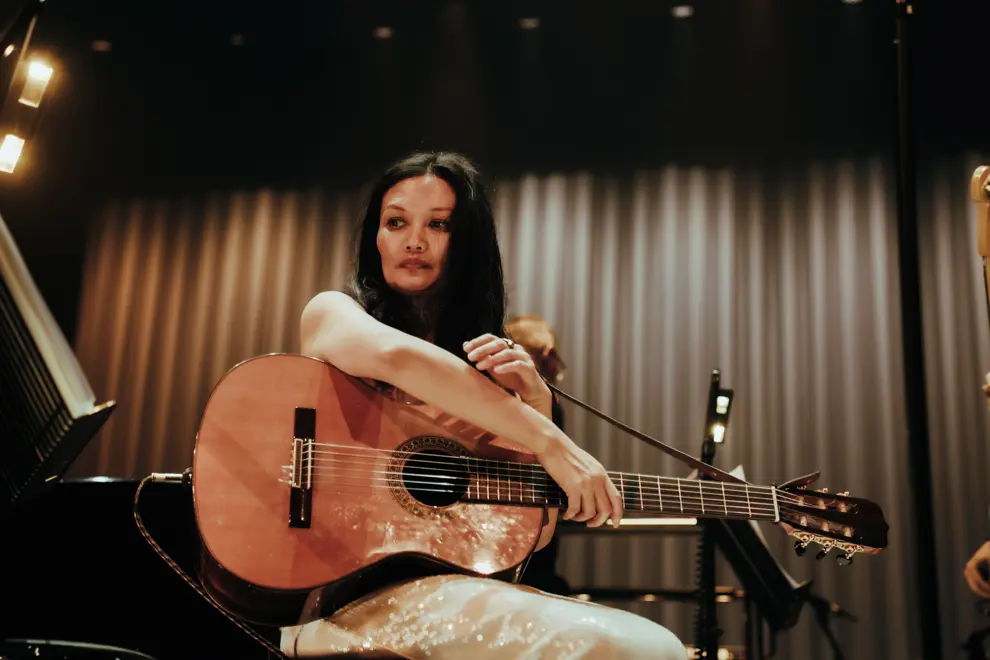
“It’s definitely an older crowd,” a woman behind me says. She’s not wrong. Many are here for one of the great songs of the 1990s. We’ve waited over a decade for a Bic Runga tour and, as the set opens with Glass Atrium, the short instrumental that begins Red Sunset, we’re made to wait a little longer. Over its fading chords, Runga strides centre stage to welcome us. Dressed in a loose red suit, she seems content, if faintly fatigued.
Opening properly with Paris in the Rain, a song about her time living and recording in the city of love, it’s a thrill to see her so comfortable and move with the air of someone with little to prove. The song, she has said, is inspired by the idea that as the world moves forward, the people in the city change, and the weather, but not the city itself.
This interesting idea becomes the first of many that are distilled to a simple, open, musical form that leaves space for the listener to fill. The song itself is sparse and repetitive, and its loose disco stomp would work well as the soundtrack to a fashion show. Unlike a fashion show, Runga moves with no real sense of performance or grand return, her hands often in her pockets, and you get the feeling it would be the same show were she at Marvel Stadium or Cafe Gummo.
Her 2002 single Get Some Sleep, is the first to really arrest the audience, and its propulsive guitar part and bright, effulgent melody is a reminder of what turn-of-the-millennium Runga was like, and how few anywhere in the world could match her. We soon return to newer songs which move with a very different energy and are perhaps more suited to a cocktail bar or piped through speakers by a swimming pool at a resort in Bali.
To this listener, at least, they sound like an accurate representation of the sort of music parents of three children would like to hear in the evening. More Sade than Slade. Whether she is singing about the weather (It’s Like Summertime) going into outer space in your mind (Escape From Planet Earth) or parenting (Hey Little One), the songs are all mid-tempo chill neo-soul with busy but restrained drums from Neilson (whose body never unfurls from a hunched G shape over the drums), a vocal melody that rarely troubles her upper register and arrangements that never test the talents of Basil and Bennett.
Just as this relaxed mode begins to feel definitive, the title track Red Sunset arrives: a muted, bass-driven disco cut that could have emerged from a mid-1980s Madonna album or the indie-disco revival of the late 2000s. It’s simple but effective, foregrounding her voice and impressionistic lyrics and hints at a possible new era for Runga. “So, the album just went to number one in New Zealand, which is really cool,” she says, with a smile and a half-shrug.
The instantly familiar Something Good draws the loudest response of the night so far, all murmured verses and enthusiastically sung chorus. Home Run follows, a song that originated from the sessions for her 2002 album Beautiful Collision and resurrected as the closer for her new album.
It is around here that the gravitational pull of Sway begins to assert itself. A few audience members join in unison to sing its chorus, unable or unwilling to wait. The anticipation becomes part of the show’s quiet drama.
If she can hear this premature singalong, Runga seems unbothered. She no longer feels the need to shape a set around expectations. She has, after all, already written herself into a kind of permanence. The song that launched her, even when sung by some possibly intoxicated fans, is still a kind of miracle that has long since taken on a life of its own. A staple in karaoke bars, covered by Beabadoobee and reinterpreted by R3hab and Amy Shark.
When the song that preceded it, her first local hit, Bursting Through, arrives, it feels like a reminder of that earlier emotional clarity. It too is a song built around the almost guileless simplicity of a few descending notes on the guitar and a voice that soars and swoops above. The sort of song that deserves an orchestra. Another early hit follows: the harmonica-driven rave-up Listening for the Weather, before the band leave the stage and we get a solo performance of Drive, which proves to be one of the highlights of the night.
The band returns, and the inevitable arrives. Sway begins, cheers fill the rooms, phones are aloft, and everyone is singing from the same book. Runga’s voice is almost, but not quite, overwhelmed by the love for a song that she freely admits she had no affection for when she wrote it. As its final chords ring out, Runga and her band gather to smile, wave, and bow. Then, almost immediately, the audience begins to file out in an oddly brisk, almost unceremonious exit. Happy, unforced, and content to leave things as they are.