 Bangalow Chess League Profile
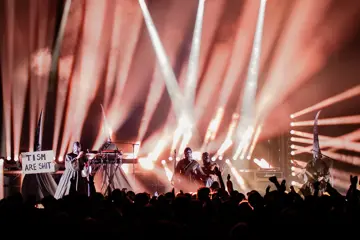
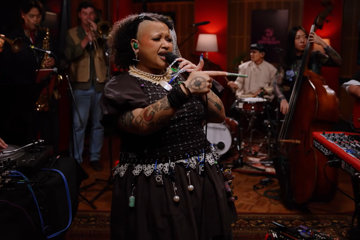
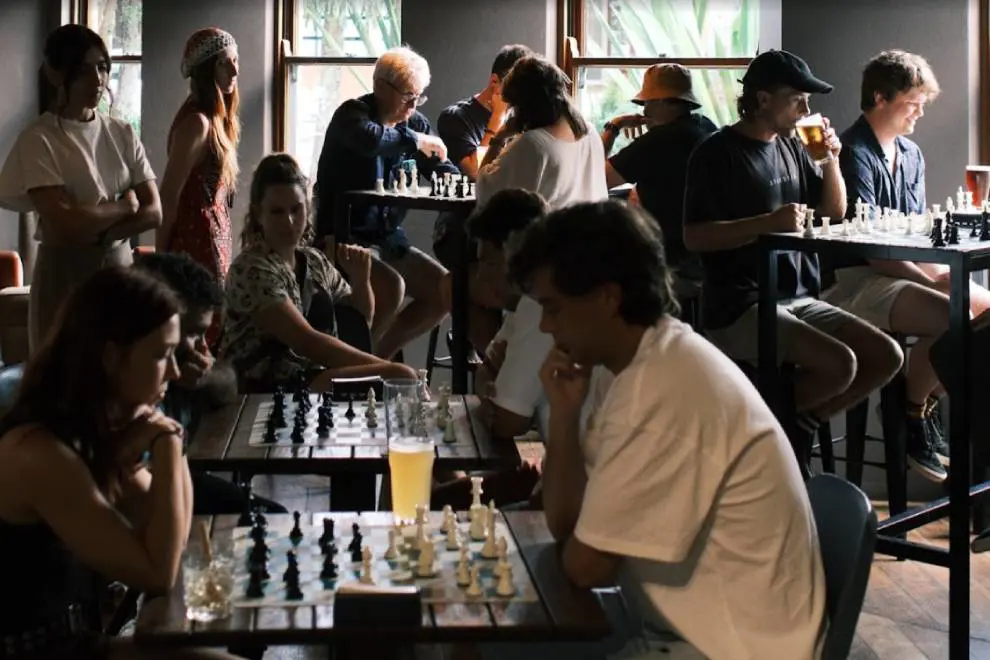
A competitive game of chess is usually expected in a place like a library, but at a pub metres away from a band performing for its hearty patrons?
It’s a peculiar combination that seems tricky to make work, but the exponential growth of the Bangalow Chess league has proven otherwise.
The endeavour was created by brothers Evan and Daniel Manttari and Shyla Bernstein, largely as a way to get off their phones and have a reason to go out.
As kids, besides being outdoorsy, the brothers would challenge their dad to chess, even if it’d take a hundred games to beat him. Later in life, they’d try to face each other on Chess.com, but it didn’t compare to playing in person.
Also, as Daniel says while holding up his phone to me, “This social media is not very social. It’s anti-social.”
Over the past year, they’ve built Australia’s only multi-venue weekly chess league from scratch, which is based in New South Wales’ Northern Rivers. Free tournaments are held at the Bangalow Hotel on Tuesdays, Byron Bay’s The Rails on Wednesdays, and Mullumbimby’s Bacco Wine Bar on Thursdays.
Obviously, each bustling pub is better known for its plentiful drinks and weekly live music than the strategic board game.
The matching system is both simple and accessible. “Anyone who comes to the chess night can beat players of any rating,” Daniel explains. “If you’re a beginner, you’re not going to be competing against the sharks; you’re facing other beginners. It keeps the playing field a lot more equal.”
There are numerous reasons why the pub was chosen to host their league. For starters, they wanted the location to be somewhere interesting, separate from the intimidation and severity chess often carries if you’ve never given it a go.
More importantly, the pub as a meeting place already had everything they needed: “It’s a community hub as it is. [Strengthening] that was always the intention. Chess was the tool used to make that happen.”
People can come in for a beer, grab dinner, but if they want to give chess a crack or watch others play, they’re free to. A $20 bar voucher is up for grabs every evening, yet showing up puts patrons in the prize wheel, giving everyone a chance of victory.
In proper grass-roots fashion, the brothers initially ran the league out of their own pockets before finding sponsors. It’s paid off since its first run that brought ten of their friends to Bangalow, with more potential to grow.
“We see it eventually turning into a national chess league with different states,” Daniel says about its future. “All your different towns will have a representative – they fight for their state place and the top five people from each state will come to the national competitions.”
So, how did the brothers convince pubs to get on board with their niche idea? Live music was always a staple in the Manttari household, as their dad performed at RSLs, clubs, and pubs for many years.
Eventually, Evan was a full-time musician for five years and had his foot in the door with the Bangalow Hotel’s management. They pitched an offer they couldn’t refuse.
“Evan was like, ‘Well, chess can really be any night of the week. People are going to come to it or not. It doesn’t have to be a Friday night event,’” Daniel recalls. They locked in their setup on the venue’s quiet nights. As the league grew, so did the turnouts, bringing in an average of around 20 to 30 people when there’d normally be three.
“It’s been a good win for business on what would be quiet nights where they’re struggling, still having to pay wages,” Daniel says. “Instead of running at a loss, they can now actually run a profit for that evening.”
It’s been warmly embraced by the community, and cultivating that has been the most fulfilling part. Daniel’s made half a dozen friends he wouldn’t have met if not for the league, and all kinds of people, including backpackers, retirees, students and the pub staff, join in and get chatting.
“It doesn’t surprise me, but it amazes me because I could see it coming,” he admits cheerily. “The level of sportsmanship from people is great. So is how many people are eager and want to help be a part of something.”
For instance, where there used to be more opportunities for younger people to connect with older people, the league fills that gap. “I’ve always had a respect for elders and talking with people older and wiser than me,” Daniel says.
“Being able to see young 19- to 20-year-olds playing a game with a 60-year-old, who chat afterwards about the game, is really cool.”
They’ve started their own State of Origin series, “Coast vs. Hinterland,” which has introduced some fun rivalry between players. “We had a guy from Argentina who was like, ‘I’m coastal, I was born on the coast of Argentina,’” Daniel recalls.
Also motivating them is harnessing human connection in today’s volatile digital world, given social media and AI are rapidly altering those behaviours.
Daniel is optimistic, though: “People in human relationships are one of the only things that is going to be left up. What else brings humans together? We’re still going to want to socialise. We’re going to want to be together. You can’t have a virtual AI-driven chess competition socialising with humans.”
Live music, then, is the binding agent that connects people for this goal. Daniel poses two questions: “Think of a concert you went to, now tell me all the songs that they played,” and “Tell me how you felt at that concert.”
You’re more likely to remember the elated emotions than the transient specifics, and that’s exactly what Bangalow Chess provides. Music is the soundtrack, and people come for the game of chess, but what they ultimately remember is being welcomed into something bigger: A strong local community.
For more information about the Bangalow Chess league (including how to sign up as a new player), head along to their official website.