One of the most frustrating parts about looking back into musical history is seeing the prices that things used to go for.
Recently, this author was looking back at the early days of the Big Day Out festival.
A staple of the Australian concert scene for 22 years, it's a little disconcerting to look at the poster of an event such as the debut edition of the Big Day Out – which boasted acts such as Violent Femmes, Yothu Yindi, Cosmic Psychos, and a little bunch of upstarts called Nirvana – and see that it cost a mere $40.
Using an inflation calculator, we can see this equates to roughly $95 today, but that's still nothing to sneeze at.
Likewise, when Nirvana played headline dates around the country in January and February of 1992, ticket prices were between $15 and $20. Just imagine the notion of seeing a band like Nirvana for what equates to $35-$47 in 2026. (That is, if you ignore the obvious reason as to why that's impossible.)
One of the more depressing things a concert lover can do is this sort of walk down memory lane, lamenting what you could have seen if you were born years earlier, had the wherewithal to know just who the future stars would be and where you could find them, and the finances to afford it all.
Famously, tickets to the iconic Woodstock Festival in 1969 cost just USD $18 in advance or USD $24 at the gate. In hindsight, this sounds amazingly cheap, and even when you realise this equates to AUD $222 or AUD $304 today, it's still amazing value for money given the calibre of acts on offer at the time.
This year also marks 40 years since the iconic post-hardcore outfit Fugazi formed. Legends of the genre, the group were renowned for their blistering live shows and unwavering ethics.
One of the more famous aspects about the group was their desire to keep ticket prices as low as possible without the group losing money. The figure that is usually thrown around in relation to this concept is $5, which was traditionally how low the group endeavoured to keep the entrance fee, though this couldn't always be the case.
For comparative purposes, USD $5 in their formation year of 1986 equates to roughly AUD $21 today, and the group kept these low prices until their final shows in 2002, where USD $5 equated to around AUD $13.
Even when they visited Australia, the prices were kept as low as possible for an international act. On their final tour here, in 1997, shows cost $15, which amounts to $32 today.
Rising Prices
In recent years, we've seen prices rise in myriad areas, and of course, concerts aren't immune from this.
Rising inflation, petrol prices, rent for venues, wages for workers, and the general cost of living increase has meant that gigs have become more and more a luxury item.
Even local pubs have found themselves rising ticket prices as insurance costs grow higher, and free gigs are becoming progressively rarer.
A 2026 study from the Australian Live Music Business Council (ALMBC) pointed out that back in the mid-'80s, concert tickets cost between $12 and $15. 40 years later, premium tickets for major events can exceed $500 while VIP packages breeze past $1,000.
Not only does this make the barrier to entry even harder to afford, it means that music fans are becoming more and more selective when it comes to choosing what they're going to attend.
The latest report from ticket resale platform Tixel has shown that as concert prices continue to rise, punters are gradually expecting more bang for their buck.
By the time the Big Day Out came to a close in 2014, ticket prices had risen drastically from its first year of just $40 in its first year to $185 ($248 today), with prices having risen by roughly $10 on average across its past decade.
Likewise, rival festivals at the time – such as Soundwave – were priced relatively comparatively.
In 2010, Big Day Out tickets retailed for $140 to Soundwave's $145. In 2013, when Soundwave held what became arguably its most famous event – a bill which featured Metallica, Blink-182, Linkin Park, A Perfect Circle, and more – tickets cost $187 ($257 today) while the Big Day Out retailed for around $165 ($227).
Notably, these prices – though they sound refreshing – are actually relatively comparable to similar events on offer these days.
Comparisons about the quality of acts on bills, or the variety offered by festivals may arise, but prices for the events have – on average – risen accordingly over the years.
Searches
However, it's far from a unique, modern concept to be inquiring about the cost of concert prices.
Utilising Google Trends data, we can actually see how music lovers have become increasingly interested in ticket prices.
In a graph of search interest over a specific time period, Google Trends shows the data on a relative scale from 0 to 100: zero suggests insufficient data, 50 indicates half the popularity, and 100 signifies the peak interest during a time period.
Exploring the term 'ticket prices' globally from 2004 until now, we can see that there was a relative baseline in interest on the topic for some time. The term hovered around the 21 mark until it started to rise in 2009, presumably in response to the global financial crisis.
It hit a peak of 33 in July 2010, hitting successive highs of 43 and 44 in July 2012 and 2013, respectively – which is, notably, the US summer period. Again, these numbers hovered around here until they plummeted to an all time low of 13 in March of 2020 as the global pandemic launches.
Since then, the term has gradually risen, skyrocketing to 65 in August of this year, before hitting an all time peak of 100 back in August.
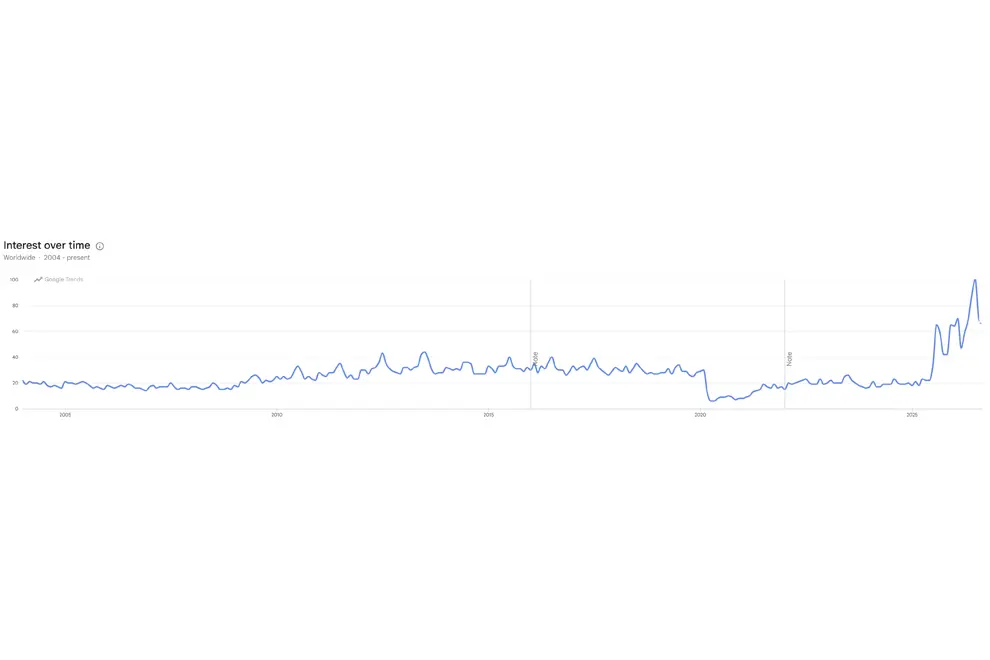
Global Google Trends searches for "ticket prices” between 2004 and 2026.
In Australia, the trend is relatively similar, albeit with a lot more of a jagged presentation. Interestingly, while it largely followed the same trajectory, a longtime peak of 93 came about in July 2013, and while the term has been growing increasingly since the pandemic years, a huge jump occurred in February of 2026, before zooming to its first-ever 100 just this month.
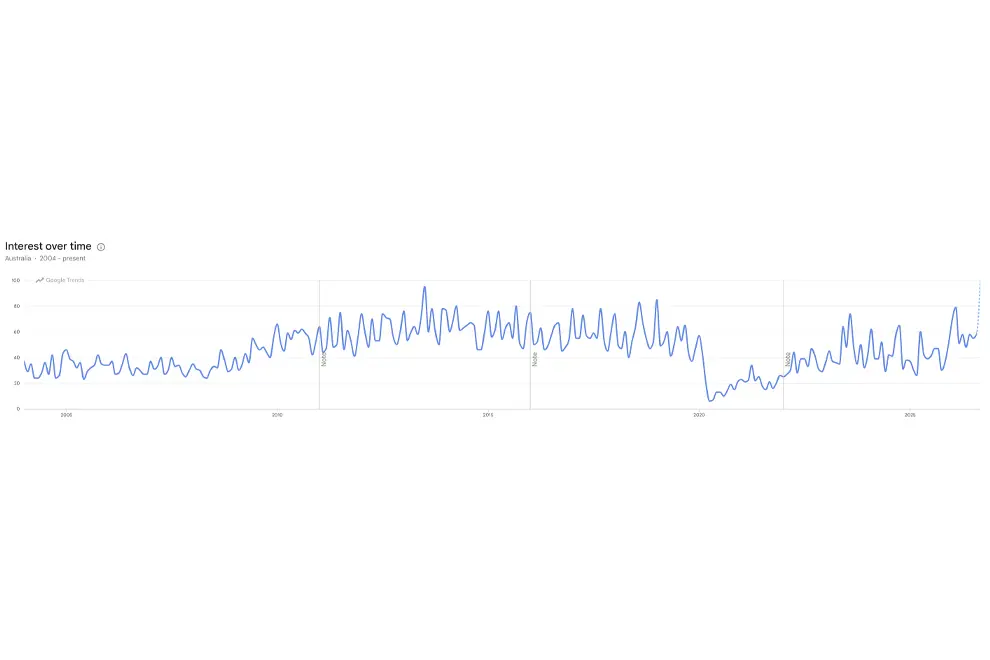
Australian Google Trends searches for "ticket prices” between 2004 and 2026.
In recent years, too, this increase in searches for ticket prices has also seen a noted increase in searches for 'cheap concert tickets'.
Looking at global searches of the term since 2004, it reached its peak back in July 2005, and it would slowly fall over the years (again, rising a bit alongside the GFC), before bottoming out alongside the pandemic.
Since then, it's been a gradual rise, and in May 2026, the term hit 35 which it hadn't done since July of 2015
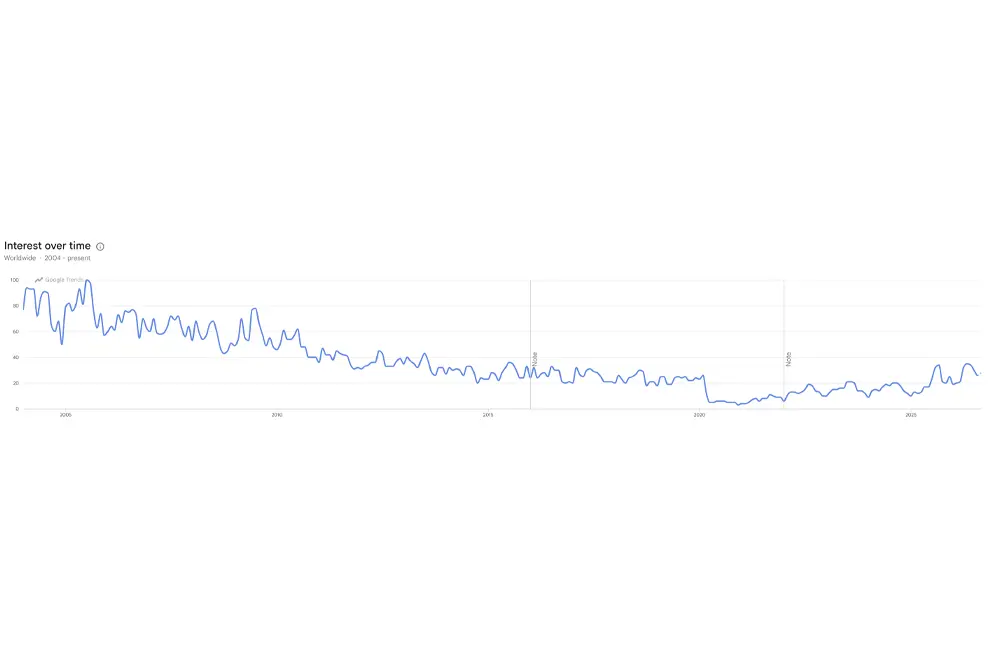
Global Google Trends searches for "cheap concert tickets” between 2004 and 2026.
Interestingly, searches for these terms also follow a similar trend as that of searches for discounted tickets. Global searches for 'concert discounts' and 'concert ticket discounts' have both followed a similar trajectory since they emerged as terms of interest in May 2008.
Since then, the former has had a steady interest before and after the pandemic, though it started to rise massively in August 2025. Fast-forwarding to May 2026, and it's hit a peak of 100, having hit an earlier peak of 79 in December.
Searches for 'concert ticket discounts', however, have historically been lower, but interest has risen to the point where they've started to make a noted dent on the Trends, hitting its own peak of 13 last December.
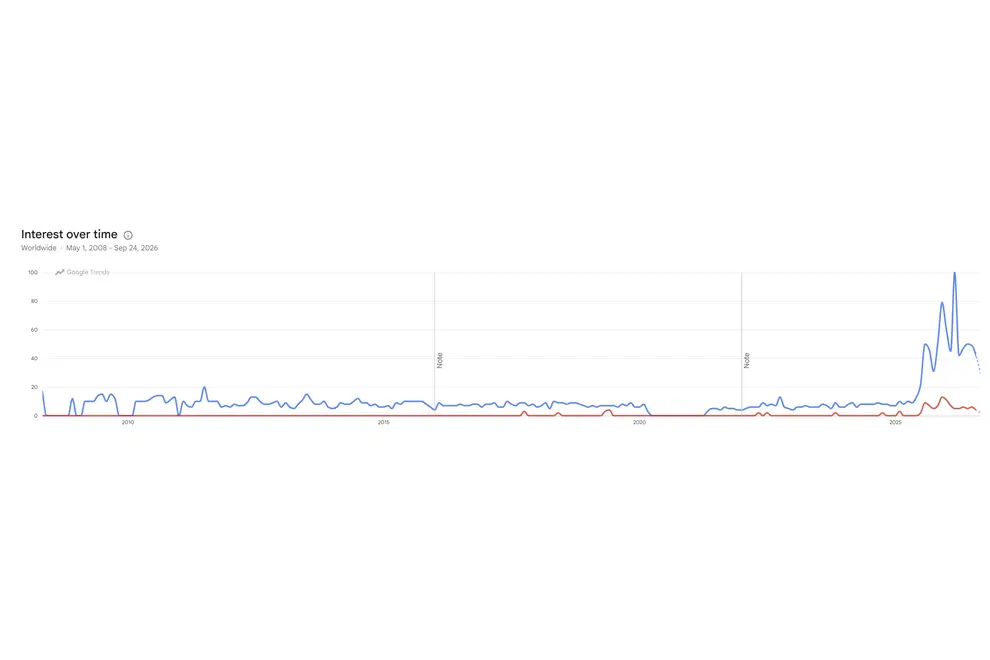
Global Google Trends searches for "cheap concert tickets” (blue) and "concert ticket discounts" (red) between 2008 and 2026.
Another, more interesting approach is to look at terms such as 'cheap concerts' and 'free concerts'. In both instances, they again follow a similar trajectory, but looking at the latter from an Australian perspective offers a unique insight.
Zooming in on 'free concerts' in Australia over the past decade, we can see there's perennial interest in the term, peaking annually around February before dipping into a valley for the next six months before it begins to rise.
As one would expect, there's a dip in 2021 and 2022, before jumping to 75 and 76 for the next two years. In 2025, it hit 82 and held steady for the following year.
But while these are new heights for some time, they're not the highest it's ever been. That record belongs to February of 2017 when it hit 100, while February 2019 follows in second place at 89.
So what does this mean? Well, free concerts are something music fans are always hungry for, but even as the cost of living increases and searches for 'ticket prices' rise, searches for 'free concerts' haven't quite followed the same trend.
That said, there may be a noted increase come February of 2027, but currently, it's an interesting snapshot of gig attendance in the current climate.
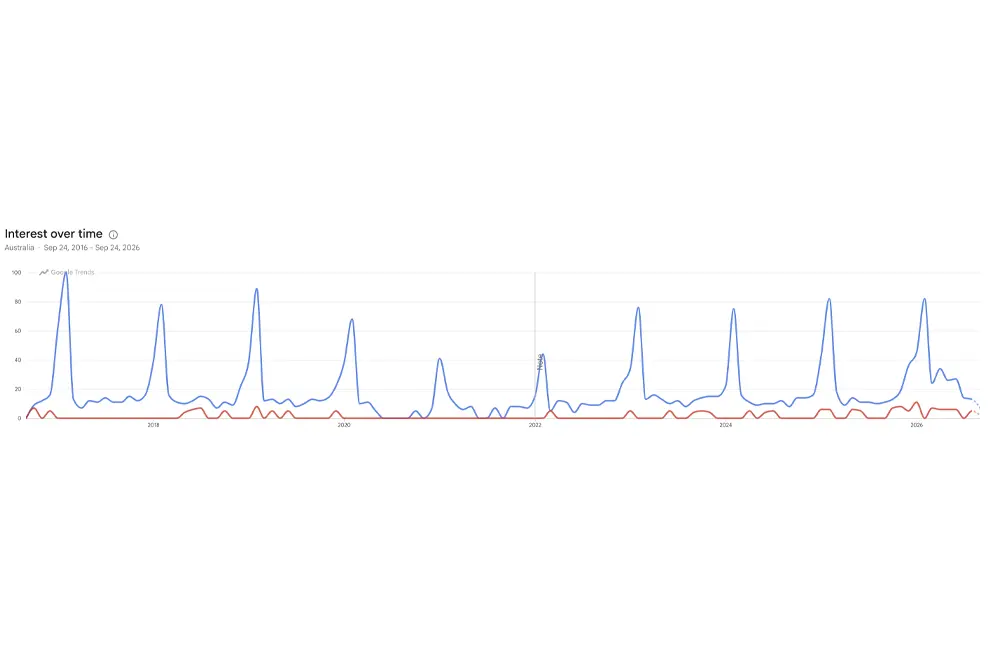
Australian Google Trends searches for "free concerts” (blue) and "free gigs" (red) between 2016 and 2026.
Incidentally, this past decade has also seen a massive rise in searches for ticket resale services. It's hard to say exactly how these track, but while the term was moderately popular – around the mid to low 30s – until 2020, it's seen skyrockets up to a peak of 100 in August 2023.
It's since ebbed and flowed, typically peaking around February, with an average around the 60s over the past three years.
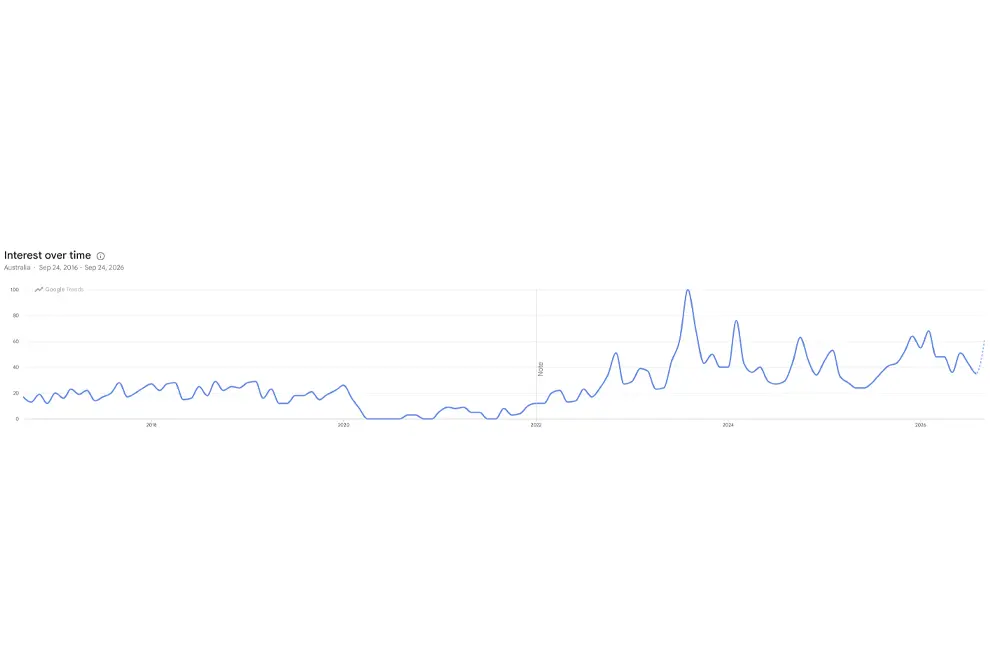
Australian Google Trends searches for "ticket resale” between 2016 and 2026.
Additionally, searches for Australian ticket resale service Tixel slowly rose since it launched in 2018, hitting an early peak of 24 in December 2019, before rising to an all time high of 100 in February 2024 compared to the 5 that a search for 'ticket resale' attracted.
Massive jumps have since occurred in the warmer months, and it's looking like another upswing is in the works.
For comparison, the 100 peak 'ticket resale' experienced in August 2023 equates to a 36 when Tixel is overlaid on that search, bringing that initial number down to a seven. When Tixel peaked at 100 in February 2024, 'ticket resale' was at a comparative 5.
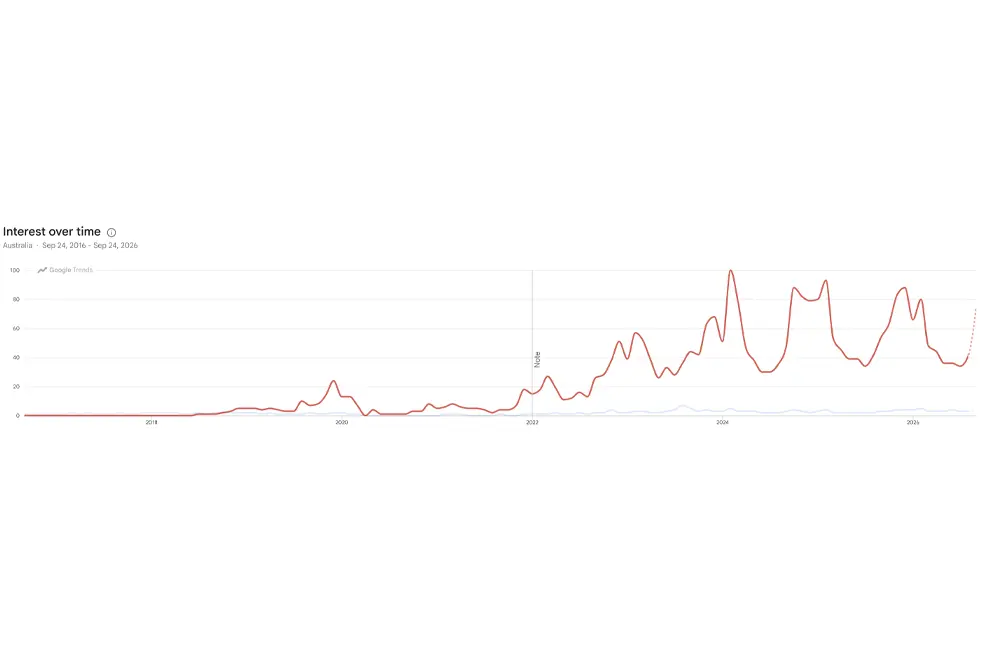
Australian Google Trends searches for "ticket resale” (blue) and "tixel" (red) between 2016 and 2026.
What's interesting here, however, is that while ticket prices are rising, demand for cheaper tickets are increasing, so too are searches for resale services. Perhaps this means that fans are eschewing the notion of buying tickets on release day to save money, and instead buying them closer to the date of the event itself with hopes that they'll score a cheaper ticket.
Or, perhaps it means they're realising with the increasing cost of living that there's a market for them to make some money back by offloading tickets they can no longer afford.
What is clear, however, is that things are heading in an untenable direction, and music lovers could well be priced out of their favourite pastime if we're not too careful.