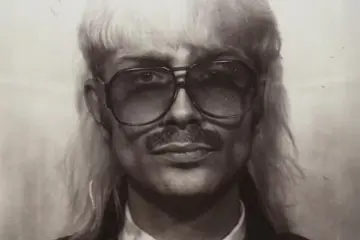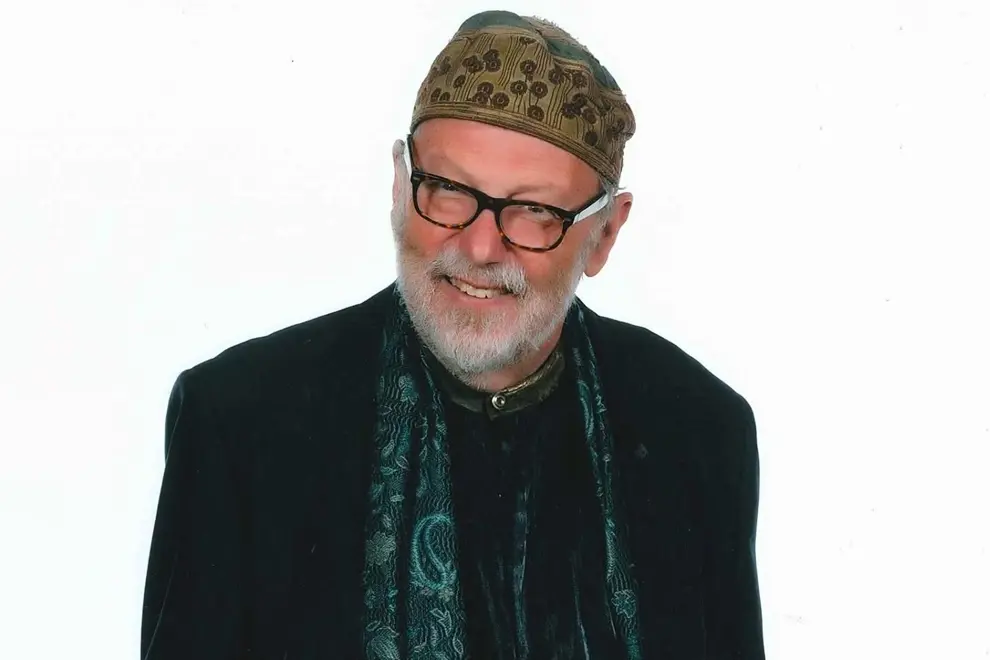
It wasn’t just rock idols who catapulted Glenn A. Baker’s world. His exuberant personality and style of writing left their mark on them as well.
When Keith Richards spotted Baker backstage at what was then Ellis Park Stadium in Johannesburg in South Africa in February 1995, he went over and put his arm around him.
“Are they (The Rolling Stones’ staff) looking after you, are they, mate?”
Richards rated Baker highly from earlier encounters and spoke affectionately about the band’s Australian visit in February 1973.
But he was a bit vague on a detail of their entrance at Sydney’s Royal Randwick Racecourse. “What were those white things that took us about?”
“They were four white horses, and you were all in black horse carriage that took you right to the stage, Keith.”
Bob Dylan went a step better. He gave Baker a massive bear hug. He remembered him from a piece written about him in The Bulletin, and sent a message to him through promoter Paul Dainty that he wanted a catch-up during a 1986 tour.
They met in his dressing room at the Sydney Entertainment Centre during soundcheck.
Baker, who regarded hearing Like A Rolling Stone for the first time as a life game-changer was very nervous. Dylan was witty, cheeky, and totally accommodating. “It was a full circle for me.”
In a Los Angeles record company board room, Ray Charles serenaded him and gave him a dance around the room.
Another idol was Pete Townshend. The Who leader was so enamoured by Baker that he asked to meet him when The Who hit Sydney. At the show he paid tribute to the Australian writer – “it was my birthday that day, too, so it was an extra special moment” – and later wrote to him asking him to write a book about him.
Baker had to turn down the offer because of his work schedule. But he kept Townshend’s letter as a keepsake.
When a celebrity died, Baker would be the one that radio and TV stations would call on to comment. His personal encounters provided him with anecdotes few Australian scribes could come up with, and his encyclopaedic knowledge summed up the celeb’s legacy.
Jimmy Barnes said Baker was who he went to when he wanted to find out something about Australian music history.
Finding Hits
Glenn A.’s extensive record collection helped him find hits for others. These included suggesting John Kongos ‘70s jungle rhythm hit He’s Gonna Step On You Again to The Party Boys as it fitted in with their dual-drum setup.
Jimmy & The Boys’ I’m Not Like Everybody Else was something Glenn A. found on a Kinks B-side.
Looking For An Echo was a plaintive American doo-wop song written by Richie Reicheg and recorded in 1975 by Kenny Vance.
It was about a doo-wop singer recalling how he and his childhood friends formed a band in Brooklyn and looking for a place to enhance their sound.
It became a Top 10 hit in Australia for Sydney retro-pop outfit Ol’ 55, whom Baker managed.
He met them while working in the public service. A junior clerk called Geoffrey Plummer with a rockabilly haircut played in a ‘50s rock band in wine bars around Cronulla.
It was a ‘50s pop culture moment of TV’s Happy Days and films such as American Graffiti.
When Baker checked them out, he offered to manage them, and created a whole concept around them.
He changed their name to Ol’ 55 after the Tom Waits song, and recreated their characters to be the rough one, the cute one, and the greaser.
Accountant Peter Brien became flamboyant frontman Frankie J. Holden, and saxplayer Nick Aitken was renamed Wilbur Wilde.
Issued through Mushroom, their debut album Take It Greasy sold 350,000 and made them one of the biggest live acts. He also co-wrote two of their hits.
He created a ‘60s concept outfit Punkz (later Cheek) who had a hit with So Much in Love.
Baker’s relationship with Ol’ 55 soured as personality clashes emerged. He quit, telling the world “I’m leaving for health reasons… I got sick of them!”
However, earlier this year when Baker’s health started failing, they had a friendly catch up. One of them told Baker, “We’d never have done it without you.”
Glenn A. responded, “That’s a good call.”
“But it’s true, Glenn.”
“Well you gave me a lot to work with.”
Crazy Passion
Baker’s crazy passion for all things music and the written word came from a childhood that could often be traumatic and lonely.
Just before his teens, he discovered who his biological father was. He was adopted by his stepfather. The family lived in Coogee in Sydney, and then Canberra.
When Glenn was 10, seven-year-old brother Johnny drowned. His parents split up not long after. He often had to live with his grandmother.
Rock music was his soother, his healer, his friend. He attended 12 schools in ten years.
He was brought up a Catholic. But at 20 he became a Mormon, determined to give his children a stability he never had.
He went on to have six children and 13 grandchildren. His son Oscar recalled life in the Baker household as filled with "music and chaos".
At 15 Baker had to leave school to support the family. Glenn Baker knew he was going to be famous. In his teens he’d added the A to his birth name to make him stand out.
As he started freelancing for ‘70s music magazines, record companies asked him to do bios and sleeve notes for their releases. He broadcast on 2JJ before switching to Triple M.
He wrote sleeve notes for over 600 albums. He published 17 books, hosted Qantas’ in-flight show on pop music for 20 years, and famously won the BBC’s Rock Brain of the Universe contest three times in the mid-’80s.
In 1979, he set up retro label Raven Records with rock historians Kevin Mueller and Peter Shillito, specialising in reissues and compilations. It operated until 2017.
He was also the Australian bureau chief for Billboard for 20 years. Apart from giving Australian artists, executives, and associates a worldwide voice, the role gave him a global clout and access to more rock legends.
The Billboard gig gave him opportunities to travel the world. He’d happily pay thousands of dollars in airline excess baggage fees as he lugged home hard-to-get vinyl gems and bootlegs from all over the world.
He used those trips to widen his net to become a travel writer. He won Australian Travel Writer of the Year twice, in 1995 and 2000.
Being a travel writer gave him tremendous experiences from the 150 countries he visited.
These included journeying to Havana, Cuba, to follow Ernest Hemingway’s narratives, reporting from war-torn Beirut, and visiting Damascus to visit the resting place of John The Baptist’s head.
One of his favourite moments was travelling in a rubber zodiac among Arctic icebergs, and marvelling at the sights.
“I thought I’d seen it all. Then three huge humpback whales rose out of the water to play tag with us. You couldn't beat that. It was just spectacular!”
When he was with The Stones in Johannesburg, he got mugged. He chuckled, “It was the first time for me, and in a perverse way it vindicated my existence as a travel writer!”
What stood out about Baker’s writing – music or travel – was how the wild-eyed passion and authoritative power so struck you that you felt compelled to buy the record, see the show, catch the movie, or follow his journeys.
It was rock writing at its best, and something increasingly becoming scarce these days.
Even as his body started to fail him, his burning curiosity about the world around him never dimmed.
On hearing of his passing, Canadian music writer Eric Alper pointed out, “Baker's real legacy isn't any single book or broadcast.
“It's the sheer scale of what he chose to remember and pass along, at a moment when so much of that history could easily have gone undocumented.
“Anyone working in Australian music journalism today is, in some way, working in a field Baker helped build the archive for.”
This piece of content has been assisted by the Australian Government through Music Australia and Creative Australia, its arts funding and advisory body