Radio Birdman Profile
So far we’ve look at Radio Birdman’s rise and fall during their initial tenure, and how the band dissolved in Europe after being unceremoniously dumped by their US label Sire Records, who’d offered them the world and then just pulled the plug and left them in the UK, the band having basically packed up their lives to break it in America (where they were scheduled to undertake a massive tour with Sire figureheads the Ramones once they’d started a stir in Europe). This exacerbated the inter-band strife which had already been manifesting just due to spending so much time in each other’s pockets, so after they played what would be their final gig of the band’s initial tenure at Oxford University on 10 June, 1978 the band just started drifting apart. The album they’d recorded at Rockfield Studios in Wales just a couple of months earlier was in stasis because the situation with Sire meant that they couldn’t access the master tapes, but the band basically disintegrated and went their separate ways, most limping back to Australia in dribs and drabs.
Accounts of what happened immediately after the split are slightly cloudy and vary from description to description. Apparently the rhythm section bailed first – drummer Ron Keeley and bassist Warwick Gilbert quit – but band founders and creative mainstays Rob Younger (vocals) and Deniz Tek (guitar) resolved to get another rhythm section in due course and continue on, but when they both returned to Australia a few months later the band’s other guitarist Chris Masuak had moved on and already formed The Hitmen, Tek telling Stomp & Stammer back in 2007 that Masuak, “wasn’t interested in Radio Birdman anymore. So there wasn’t the critical mass to keep it going. We hung it up for 15 years”. Tek and keyboardist Pip Hoyle had their medical studies to finish, the others had new careers and vocations bubbling away (Keeley stayed in the UK and worked in advertising, while Gilbert became a successful animator for Disney Studios) and it seemed like the band was finished. Except for those recordings from Wales. After years of trying to get the tapes to release the album in Australia, and conscious of shitty bootlegs from the sessions that were starting to emerge, Tek reverted to his last option – he’d kept his own ‘safety tapes’ from the sessions, and he used this to press up what became Radio Birdman’s second album, Living Eyes, which finally hit the shelves in early-1981, some two-and-a-half years after the band had actually ceased to be.

“The thing was that I don’t think it would have even happened except that Sire was so busy dealing with the legal stuff from dropping all of these bands and trying to figure what to do to survive as a company that they never got around to crossing off our recording session – no one told us that we couldn’t go there and do it so we just showed up and did it,” Tek recalls of Living Eyes’ genesis amidst all of the label fallout. “So the people who owned Rockfield, I don’t think they ever got paid, and because they never got paid I don’t think they released the masters because they own the tape until it gets paid for. So we’re there and I happen to have a safety copy of the mix on seven-and-a-half IPS quarter-inch tape – not the best format for quality but okay, just the safety copy – and I took that with us when we left Rockfield, and it just sort of sat in my closet for a couple of years. Then I guess we looked at whatever we’d signed and what the ownership of all that was, and we still retained in our contact with Sire the rights for Australia and New Zealand – on anything. So we thought, ‘Oh, we’ll just master it from this safety copy – this dub – and release it here!’ As long as we didn’t release it overseas we weren’t infringing upon anyone’s rights, so that’s what we did – that was where the first version came from, and we put the band New Race together to put a tour together to promote it.”
New Race was a bit of a star-studded affair, featuring Tek, Younger and Gilbert plus Ron Asheton of The Stooges on guitar and Dennis Thompson of the MC5 behind the kit. They played Stooges and MC5 songs as well as material by The Visitors (Tek’s post-Birdman outfit) and staples by bands like Blue Oyster Cult, and even though they used the Birdman logo and played mainly their songs they stressed in interviews that this was a different band entirely and that they were just paying homage to the Radio Birdman songs, which they still considered sacrosanct. They only played sixteen shows (spawning two live albums in the process), but they were nearly all sold out such was the reverence with which all involved were still held by the Australian rock community.
"The last thing you want leveled at you is, ‘Well, they got back together and they were shit’. You’ve got to at least be able to play."
But the fact remained that the version of Living Eyes now available in Australia was of slightly dubious audio quality, and attempts continued to regain the original masters from Rockfield in Wales. Eventually over a decade later in 1995 John Foy from Sydney label Red Eye managed to retrieve the tapes, and finally Living Eyes could be presented as the band had actually envisaged.
“Years and years later we were finally available to get the original masters out from Rockfield, and reissue it in a remixed form,” Tek explains. “When we finally got the original tapes it was great – we not only got the master of the final mix on proper format but we also got the multi-tracks couriered over, so Rob and I remixed it. We figured that if we were going to re-release it then we might as well do a different mix. Whenever you live with something for a period of time there’s always things that you would change, and this was a golden opportunity to change them.
“I think just the sounds are a little bit different, maybe a little bit tougher. The drum sounds were improved on the remix, and some other things. But you know, it’s like [The Stooges’ seminal 1973 album] Raw Power – everybody hated that mix when it came out, I remember Ron Asheton telling me that he and his bother when they got their copies and listened to it they went out into the street in Ann Arbor and just pitched their copies down the street like Frisbees because they hated the mix that much. But then years and years later Iggy remixes it – Iggy and Henry Rollins remixed it – so you get this new mix of Raw Power, and you know what? It didn’t sound any good! It was much more traditional, like a hard rock mix, but man I prefer the Bowie mix because I grew up with it. Some it’s good to have [both versions of Living Eyes] available.”
Both of the versions of Living Eyes are included in the new Radio Birdman (1974-1978) CD Boxset (reviewed by The Music), but this exciting development also had further reaching ramifications. The band’s legacy had continued to resonate, and young bucks Silverchair had reignited interested by covering New Race at the 1995 ARIAs (with help from You Am I’s Tim Rogers) and had even flown Tek to the States to record the track for a b-side. By this time the band members had well-and-truly moved on (especially Tek, who after completing his medical degree served as a jet fighter pilot in the US Marine Corps, even randomly having his call sign of ‘Iceman’ usurped by Val Kilmer’s character in 1986 gangbuster flick Top Gun), but when the band finally reconvened for the first time (minus Keeley) to remix Living Eyes (as well as debut Radios Appear, which they decided to spruce up again while they were at it), they discovered that the former acrimony which had divided them had dissipated with the passing of time – they were enjoying each other’s company again, and all felt the music had aged really well – so when the then-massive Big Day Out festival offered them a spot on the 1996 line-up they agreed to reform. Radio Birdman were back. They played their first Australian gig since the infamous Paddington Workers Club show in late-1977 (discussed in Part Two) at Sydney venue Selinas at Coogee Bay Hotel on 10 January, 1996 and the ball was rolling once more.

They’d go on to play Big Day Out again in 1997, as well as touring Europe, and continued to play sporadically for the next decade or so (with slightly reconfigured line-ups, mostly to do with the rhythm section). They managed to record their third long-player Zeno Beach which was released in 2006 (a great collection of Radio Birdman originals, although with a different feel in places due to Tek now sharing songwriting duties with Younger, Hoyle, Masuak and new bassist Jim Dickson who’d replaced Gilbert in 2000). They finally managed to undertake their first ever American tour (a lazy 56-date run, also in 2006) and were also inaugurated into the ARIA Hall Of Fame in 2007 (alongside the Hoodoo Gurus, prompting that year’s excellent ‘Clash Of The Titans’ tour). They quietly pulled up stumps in 2008 and it seemed like that would be it – until earlier this year when the new boxset was announced following the discovery of the tapes at Trafalgar (discussed in Part One), as well as the corresponding tour (which has just wrapped up). Getting back together in 2014 was not a decision that the band took lightly.
“We’ve gathered a lot of fans over the years, people keep testifying their interest in the whole thing, and now and then people feel like getting back together and playing and so forth, so if there’s a nexus point where you can stick out a boxset and do a tour and do some good shows and have a few laughs then I don’t mind taking that opportunity,” Younger muses. “You don’t go out aiming to play shit shows, of course, but just like a lot of people I consider most reunions to be pretty odious, and I’ve participated in a few of them anyway. But the last thing you want leveled at you is, ‘Well, they got back together and they were shit’. You’ve got to at least be able to play. You’re not going to look young, and in some senses you’re out of time – the context is completely different and all that – but the least you can do is give it a good shot; be entertaining, get stuck in and have a good night. Beyond that, it’s complicated, and anything else that is added to that to make it a good experience for people is great.”
“I think the band really comes into full realization in the live setting – I don’t think any of the studio albums really do it justice,” Tek offers. “They’re good in themselves – they’re good for what they are – but they don’t really capture what the band’s like live. That’s the other piece of the equation that we want to present, and it’s fun – we enjoy playing and getting back out there. To be able to do this now something like forty years since the band started – I think the band’s first show was in September of ’74 and it’s now October of 2014, that’s forty years – if anybody had said back then that we’d still be doing this in forty years… you’d just think they were completely insane.”
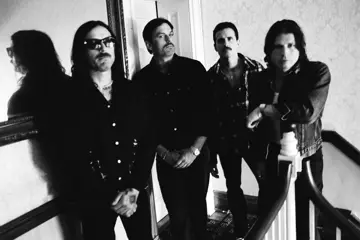
But despite their enthusiasm this reunion wasn’t without its share of controversy. When the touring line-up was announced the obvious glaring omission was that of Masuak on guitar (his role having been usurped by Birdman newbie Dave Kettley of the New Christs). A lot of fans were unimpressed, and Masuak himself spoke out against his omission, putting his stance thusly; “…this decision is a result of a last desperate and bullying demand from a singer who’s [sic] animosity towards me has spanned decades and whose antipathy towards the band is well documented. I now marvel at the absence of the integrity, honesty, loyalty, courage, and ethics that characterise this band’s rhetoric and mythology.” Yet Younger – the singer in question – has a vastly different take on how this all went down.
"I think the band really comes into full realization in the live setting – I don’t think any of the studio albums really do it justice."
“There’s been a lot of dissent about it, but it’s been a diversion and no more than that,” he shrugs. “If you want to know where I stand with it – I was asked to participate in this [reunion] on the understanding that [Masuak] wasn’t in the band. It wasn’t my idea, and I read a statement from Chris that I’m something along the lines of a ‘petty and vindictive lead singer’ and was the reason that he wasn’t included, but that’s not how it happened. I was asked to participate ‘if Chris wasn’t in the band’ – I mightn’t have been asked if the intention was for him to be in the band, but it wasn’t put like that. It was put to me that ‘this is the way it is’, but to be quite frank it wouldn’t have occurred at all if it wasn’t done in this way. And people outside the band – the rest of the world – have no right to tell us who we can and who we can’t play with anyway. They don’t own the friggin’ band! They don’t know the situation. If people knew the situation – and I’m not going to elaborate on it, and it would only be my viewpoint anyway – but if they knew the situation then they wouldn’t be banging on this way.
“Of the original founding members, Deniz and I started it but Pip was in the original line-up and that was it – it was Warwick and Ron as well. Hang on, no it wasn’t, it was Carl [Rorke – bass] originally – even Warwick joined later! So we’ve got three original members and Jim’s been in the band for eleven or twelve years now anyway, and that’s what we’ve got. The band sounds decent and we can honour these songs.”
Tek too was reluctant to be drawn into debate about the 2014 reunion line-up.
“All I’ll say about it is that it’s a great line-up, and it’s a line-up that will present the songs in the best possible way – the way that the songs were meant to be presented – so I’m very happy with the line-up now,” he tells. “I go a long way back with Nik [Reith] – he was in my solo band for five or six years and we made a lot of recordings together. There’s a lot of great drummers in Australia, but I don’t think that there’s anybody here who’s really better than him.”

While we have Younger and Tek being so effusive about Radio Birdman’s history, it would be remiss not to ask them a couple of more broader questions, specifically about the band’s iconography and legacy. The infamous Radio Birdman logo which can be found on every release and on banners at shows was designed by Tek and actually pre-dates the band, and has long been synonymous with both the band and their music.
“It kinda did add to it all,” Younger reflects. “Deniz came up with that symbol before we even started the band actually, and we affixed it to that aggregation. It had never been applied to anything before, but he had the symbol before we actually formed the band. It went through a few stages in design, but it’s been like it is now for quite a while. I quite liked it. I had this romantic notion, daft as this actually sounds, that we could just put the symbol up – shine it into the sky like the bloody Bat signal or something – and that would signify we were playing, we didn’t even have to use words. I must have been out of my mind, but I did like the idea of having a symbol and the rest. Of course these things can get turned into other things and interpreted in different ways and so forth after a while – it’s better having a logo than some fascist logo or something, which we were accused of and some people said it was. But that’s alright – it just added to the whole mystique anyway. Jumping to easy conclusions like that is preposterous.”

The other element of Birdman iconography is of course the uniforms that they sported at various junctures – basically just matching outfits sporting the logo – although Tek is reticent to put too much import on this facet of the band’s past.
“I think having a logo is important to the band’s history,” he concedes. “How that logo is presented isn’t probably that important – whether it’s on a big flag behind the stage or whether it’s on a patch on your arm or a badge – but having a recognisable logo I think was good for us. The uniforms was just a drop in the bucket; we had some army shirts and we wanted them to be black, so one of the band girlfriends tried to die them black but they ended up grey, and she sewed patches on them. We wore them for probably about two or three gigs and then either lost them or just got bored with the idea and went onto other things. The idea of having a band uniform was never a big thing, we were just always looking for some way to include performance art into what we were doing. In the early days we would smash up TVs – we’d have televisions turned onto different channels and we’d smash ‘em up – and we’d have radios and wear different crazy stuff. We were always looking to challenge the audience a little bit more, and the idea of having uniform shirts was just another step along that road that didn’t last very long.”
"I used to think that you had to die anyway before you left a legacy."
This did lead to some rather random backlash when people misunderstood the uniforms use of the logo as some sort of fascism, Chris Bailey famously having a dig at Birdman during one of the shows when The Saints opened for them in Sydney. “They were opening for us at I think that first Paddington Town Hall show in April of ’77,” Tek remembers, “and when The Saints went offstage after they’d played their set he said something like, ‘Stick around for the Hitler Youth’, which I thought was a cheap shot. We had to be the most anti-authority, anti-fascist band in history with our attitude of going our own way and not bending to the rule of authority or the establishment, if you look at what we did we just thought him calling us that was ludicrous. We had a symbol, but there’s a lot of symbols out there in the world – it doesn’t mean it’s a swastika, just because you have a symbol. There’s a Christian cross out there, there’s the Jewish Star Of David, The Rolling Stones’ tongue, the Blue Oyster Cult symbol – I don’t recall any of them getting accused unduly of politics. I think that comment said more about him than it did us.”
Which brings us to Radio Birdman’s legacy. It’s difficult to pinpoint exactly how much Radio Birdman impacted the Australian rock’n’roll scene, but – as we espoused at the introduction to Part One – their legacy has been widespread and imperative to the growth and continued sustenance of our cherished underground guitar scene, a movement that is still the envy of the world today. The band, naturally, are far more self-effacing about their contribution to our country’s cultural heritage.
“I suppose I’m proud perhaps to some degree, I don’t really dwell on that,” Younger muses. “I used to think that you had to die anyway before you left a legacy – that was more a product of my childhood where the guy from Legacy would come around after my parents died to talk to us and ask us what we needed, and the guy determined that I was a complete no-hoper. Rock’n’roll legacies are a bit spurious – they’re a dodgy concept anyway, because it’s a collection of ideas that you gather and you just filter them through your own taste and consciousness and it turns out a certain way. How much credit you should take for it is a moot point really, but if you originate something and people latch onto it and thirty or forty years later people think, ‘Well, they came up with something interesting there’, and they still believe that then it’s down to you. You’re left with that and you can take it – you can strut around thinking that you’re a wondrous visionary – or you can say, ‘I was lucky’, or not consider it at all; it just depends. To acknowledge it is okay, but to embrace it is probably a little bit too much – it’s an unfolding exchange of ideas and so forth, a reiteration with a new twist. Music’s always been like that, so you wouldn’t want to claim that you started anything. I mean I’m happy that people like the stuff – I wouldn’t be getting a gig now if I hadn’t done Radio Birdman. One thing leads to another.”
In a similar vein, Tek admits to feeling some pride in what he and his friends achieved together in such a short period of time.
“Yeah, yeah I do [feel proud],” he admits. “It inspired a lot of other musicians to do their own thing – I know that it did because they’ve told me as much – and if you can take from your own influences the things that you love and mix that up and then create something of your own from your influences, and then another generation picks that up and does the same thing, then you’ve sort of passed it long. You’ve managed to become a link in that chain of great music, and that’s all that anybody can really expect to do, and if you’ve done that it’ a wonderful thing. We’re very pleased about and proud of that, and I guess the boxset represents that.
“That was the whole pint of doing [the boxset], to provide the definitive release for the true diehard fans – people who really love the stuff that we did. We wanted to put together something for them that was truly definitive – it’s probably the last reissue of any of these things that we’ll see, other than the vinyl that’s coming out – and have it be something that’s really affordable. That’s why we did it – we did it for the people.”
As ever, Radio Birdman doing it for the people. Vivien Johnson summed up their legacy well in her 1990 tome Radio Birdman: “Radio Birdman were not typical – they were proto-typical. The energy of the response they generated in their audiences and their utterly uncompromising attitude towards any and every attempt to limit their music inspired in their wake an explosion of punk bands coming out of their old dancing grounds in Sydney, Melbourne and Adelaide.” For this – and their amazing catalogue of music – Radio Birdman are without doubt one of the true greats in the rich canon of Australian rock’n’roll. Yeah, hup!