"All filigree" was how a social-media friend of mine described the new episodes of Legion, currently airing on Foxtel channel Showcase, and I'm not ashamed to admit that while I thought I knew what filigree actually meant, I had to go to Google for the dictionary definition. For the record, filigree is "ornamental work of fine wire formed into delicate tracery", and that's a pretty apt description of where Legion's at as its second season gets underway.
The lavish weirdness of this comic-book adaptation, which draws inspiration from some of the lesser-known corners of Marvel's X-Men universe, had a point in the first season, providing in sound, vision and tone a depiction of protagonist David Haller's addled psychological state.
David had for years been considered - and indeed considered himself - schizophrenic, only to discover that everything happening in his head stemmed from being possibly the most powerful psychic on the planet, in addition to a malignant mental parasite called The Shadow King riding shotgun in David's psyche since David was a boy.
With all that going on upstairs, a touch of the surreal is probably in order, yes?
But Legion kinda sorted that out by the end of Season One (I recommend you track down and rewatch the first eight-episode run, available on Blu-ray from your friends at Fox Home Entertainment), with David evicting The Shadow King from his skull and embarking on a new life of fighting the good fight alongside his super-powered pals.
Which brings us to that filigree comment - with David now relatively sane, any visual or aural extravagance on Legion wouldn't be a representation of the lead character's state of mind so much as a flourish. A welcome flourish, certainly, but perhaps lacking that whole raison d'etre thing.
I have to admit, this was something niggling at my mind when watching the first new episode of the series. I really dug the first season for a lot of reasons, its groovy aesthetic certainly high up there, but I wasn't down for weirdness for weirdness' sake. And it initially seemed that Legion was doubling down on that, throwing in stuff that felt like outtakes from some of John Boorman or Nicolas Roeg's more self-indulgent '70s-era freakouts. (Still, if you're gonna have an aesthetic, there are worse artists and eras to emulate.)
I'm now three episodes into Legion's second season, and it's not so much a metaphor for navigating mental illness or instability anymore as it is a good vs evil skirmish on a strange battlefield that spans time, space and states of mind. And, hey, it works for me, mainly because series creator Noah Hawley, his collaborators and especially his cast - led by Dan Stevens, giving a performance as David that mixes together finely-detailed character work and good old-fashioned star quality - are seemingly committed to telling a fairly straightforward story but taking the scenic route when it comes to creative choices.
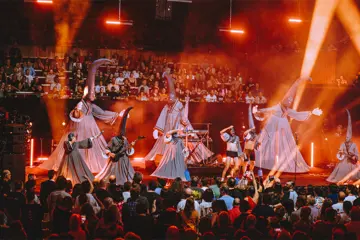
By which I mean a werewolf in a wheelchair, androgynous robots (are they robots?) with feminine features, bushy moustaches and auto-tuned voices, dance battles in lieu of fistfights and narration by Jon Hamm doing a really neat Rod Serling imitation.
Here's the upshot of Legion, Season Two so far: that evil Shadow King is using David's ally Oliver (Jemaine Clement!) as a physical vessel while he searches for his own body (to quote Gandalf, "He must never find it"), and he's also infecting people all over the world with some sort of psychic virus that leaves them kinda catatonic. Oh, and their teeth won't stop chattering, which is creepy as hell. David and his superfriends find themselves allied with former adversaries Division III (with sardonic company man Clark, played by the invaluable Hamish Linklater, as their primary point of contact) to chase down The Shadow King, but David is also receiving transmissions from the future - one possible future - that inform him The Shadow King actually isn't the biggest bad on the block.
"So it's a race," David says when he's informed of what's what early on. "We're in a race." Yep, you are. And I'll tag along till the finish line, whichever direction you may take.
By the way, if you're in the market for a genre piece that does a very provocative take on mental illness, track down the six-episode series Channel Zero: Butcher's Block, which recently aired on pay-TV station SyFy. It'll truly mess with your head, and that's even before Rutger Hauer shows up to perform a little light trepanning on one of its main characters.