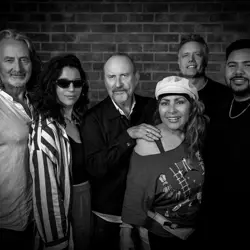
 Men At Work Profile
It's a little difficult to think about Australian music over the past 50 years without turning one's attention to Men At Work.
Though they only existed in their initial and most famous form for seven years, their impact was felt far and wide.
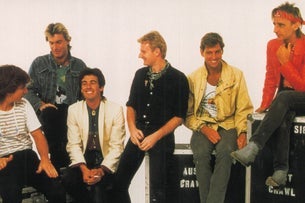
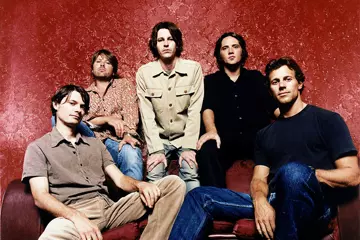
Initially coming together in the late '70s as a collaboration between vocalist and guitarists Colin Hay and Ron Strykert, the group expanded soon after, eventually settling on its classic line-up, which was rounded out by Jerry Speiser on drums, John Rees on bass, and Greg Ham on keyboards, saxophone, flute, and vocals.
Their debut single – Keypunch Operator – arrived in 1980, and the following year they shared the first taste of their debut album Business As Usual with the release of Who Can It Be Now?
The track hit No. 2 on the singles chart, and while most artists couldn't hope for more, Men At Work were far from done.
After Who Can It Be Now? topped the US chart, the Business As Usual album arrived in November 1981, and on December 21st, both it and its second single Down Under (initially a far different B-side of Keypunch Operator) debuted atop the Australian charts.
Both would stay in that spot for six consecutive weeks, though the record would take two weeks off to let Blondie have some time at No. 1 before returning for three more weeks. In the US, it spent 15 weeks at No. 1 before some bloke called Michael Jackson knocked them off the top with Thriller.
Down Under would go on to top the US charts for four weeks in early 1983, with North America launching a newfound love affair with the band and their home country as a result. Down Under became a cultural touchstone, and when Australia II won the America's Cup later in 1983 and the song was used as the team's theme song, it became anthemic.
As Hay explains over Zoom, Men At Work might have started with humble origins to have fun making music, but their eventual success was exactly what he was hoping for. "World domination was definitely on my mind," he laughs.
If one was to scale down the band's timeline to a digestible paragraph, it almost reads as though they were an overnight success. The truth was far from it, however. Though Hay never particularly viewed the time spent putting in the hard yards as a slog.
Growing up in Scotland to parents who owned a music shop, his formative years were spent hearing plenty of new music, with the '60s bringing with it cuts by The Beatles and The Kinks. "I never really had any other desire or wish to do anything else," he notes.
Moving to Australia as a teenager, Hay began to write his own songs though he didn't know what form they would take, or what would come next.
"I met Ron Strykert, the other guitar player in the band, in 1977 and he was extraordinary," Hay recalls. "It was like a little flash of lightning.
"I knew that I wanted to work with him and I knew that he was brilliant. I had to go off and do a musical, and I said to him, 'Let me go and do this, and when I come back we'll work together.' And that's what we did.
"It's a cliché as well, but there's 15 or 20 years of work towards becoming an overnight sensation. But once we started to play, once we started to develop an audience, that's when it felt like it was really starting to move. And once we made the first record, then it was a runaway train kind of situation."
Men At Work would follow up their debut with 1983's Cargo, which topped the chart in Australia and hit No. 3 in the US, before 1985's Two Hearts fared moderately well, but comparatively worse than its predecessors.
In 1984, however, there had been some internal tension which resulted in Rees and Speiser being replaced by session musicians. It was an incident that Hay regrets, and one that darkened the final years of the group, who finally called it quits in 1986.
A decade later, however, Hay and Ham hit the road to tour South America with a batch of other musicians for what has been described as a 'reunion' of the band – despite it only featuring the two of them from that first line-up.
"There was a conversation that Greg and I had when we went over to his place for dinner one night," Hay recalls. "He said, 'Let's go on tour.'"
What initially began as "just a conversation" without any real plans of where to go with it would end up being an undertaking that would take place on and off for the next six years.
"We would ask all these younger guys to come and play with us, and usually go to South America and tour," he remembers. "What we wanted to do was to maybe let a new band develop, but we wouldn't really force it.
"We would just kind of try different musicians that we knew and some people we didn't know, and just see if a new permutation of Men At Work presented itself.
"It really didn't end up happening that way," he admits. "And after a few years of going on the road, I just got a bit sick of it and I didn't want to do it anymore."
When Men At Work first split, Hay wasted no time in launching a solo career, releasing Looking For Jack in 1987, and sharing a string of new records ever since.
As the second iteration of Men At Work toured, so too did more solo records arrive. However, part of the reason why this material didn't take the form of material under the band's name – and why a new band didn't develop, as per Hay's intention – was the involvement of Ham.
"I wanted to write more songs," he admits with caution, careful not to cast any aspersions upon Harm. "The only difference between creating, say, a Men At Work song at that particular time and me writing a solo record, was Greg's involvement.
"He just really wasn't creatively available to me. I wanted to get him to work, and it was difficult to make creative time and creative space in order for those songs to develop."
As the solo material continued to arrive, the early '00s also brought with it another international spotlight. While Hay would also join Ringo Starr's fittingly-titled All Starr Band (a role he has occupied on and off since), he'd become a fixture of US television.
Alongside his music appearing on the medical comedy Scrubs, Hay would also make an onscreen appearance performing Overkill, and in 2004, his song I Just Don't Think I'll Get Over You was featured on the Grammy Award-winning soundtrack to Garden State, the directorial feature debut from Scrubs' actor Zach Braff.
The story of how this came to be can be traced back to a decade earlier, when Hay had been dropped by his label MCA. This coincided with the time when his friend, Mark Flanagan, had acquired the Los Angeles club Largo.
"It was just a small place with tables and chairs," he recalls. "The food wasn't great, but he really curated that club himself, and if he liked you, he'd have you on.
"But Flanagan said to me, 'Will you come play at my club?' And so I went and played at his club, and I played there every month."
Beginning when the club opened in April 1992, Hay would be a fixture of every Saturday night, rubbing shoulders with the famous clientele – solely because he "didn't really have anything else going".
Jon Brion, Aimee Mann, Grant-Lee Phillips, and Elliott Smith are just some of the names that Hay recalls that played the club alongside his own appearances.
Curating a younger group of friends which were musicians and creatives, one of those creatives was Braff, who had recently managed to get his role in Scrubs.
He brought along series creator Bill Lawrence, and found himself frustrated that he wasn't hearing any of this music – specifically Hay's solo work – on the radio. "So he said, 'I'm gonna use a bunch of your songs in my show and see if that makes a difference,'" Hay remembers.
As it turns out, Braff's influence may have worked a little too well, to the point where so many people had discovered Hay's work without the prior context of Men At Work.
"I went into a coffee shop in Springfield, Illinois a number of years ago, and there was a guy who was about 20 years old and a guy who was about maybe 45 or something like that," Hay recalls. "The young guy says, 'Hey man, I love your music. Overkill is my favourite song.'
"And the older guy looked at him funny and he said, 'You know who that is?' And he goes, 'Yeah, he's in Scrubs." And the old guy says, "What's Scrubs? He was in Men At Work.' And the young guy goes, 'What's Men At Work?'"
In 2019, however, Hay made the decision to resurrect the Men At Work name for touring purposes – a decision which can be traced back in part to Ringo Starr.
"The reason I did it was an experiment, really," he admits. "I was touring with Ringo at the time in Europe, and all these people were coming along to hear these old songs. Ringo's all about hits. He goes, 'Every song has gotta be a hit. That's it. There's no two ways about it.' Occasionally we'll play a new song from his record, but all the rest of the songs have gotta be hits.
"So you had Steve Lukather playing Toto songs, Hamish Stuart playing Average White Band songs, and at that time Edgar Winter playing Edgar songs and me playing Men At Work songs.
"I said to the guy who produces Ringo's show, I said, 'You think I could tour Europe?' He goes, 'Well, if you called it Men At Work you could.' So I thought I'll try it and just see if we've got an audience, see how many of them there are."
By his own admission, the passing of Ham in 2012 meant that it could never be the original band, but the idea was to go out and simply see what sort of audience would show up. "In a way, that's what I'm still doing," he admits.
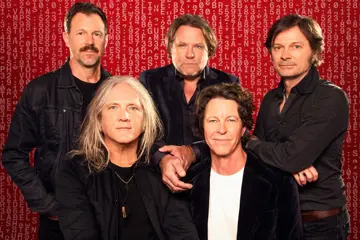
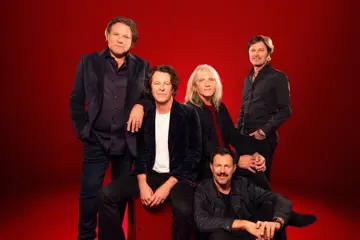
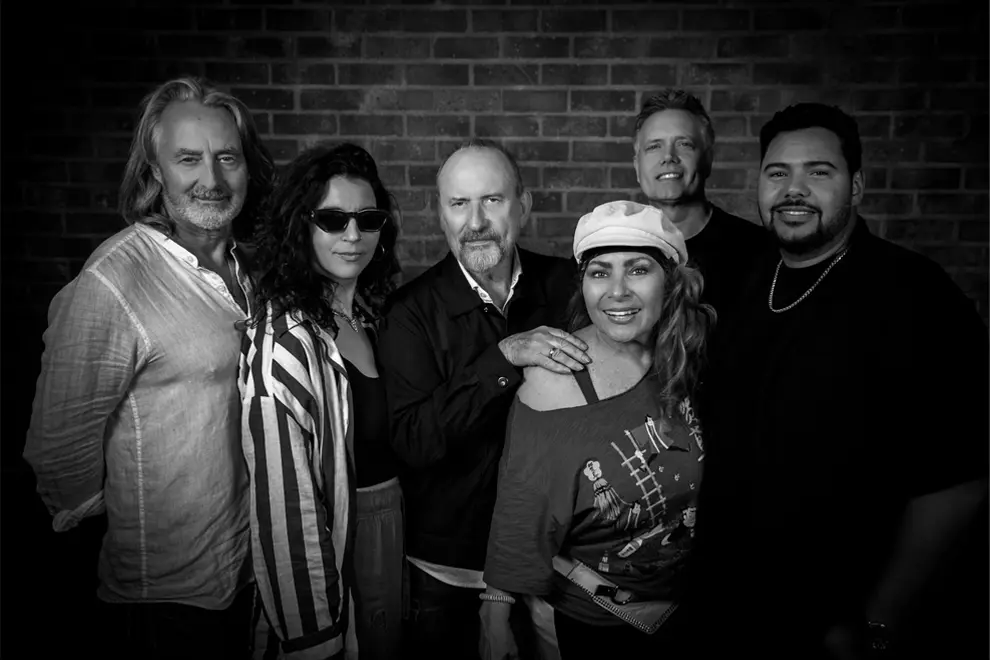
The discovery that an audience was indeed still there was both a pleasant surprise and a validating experience. Joined by wife Cecilia Noël and a batch of talented artists hailing from around the world, the nascent iteration of Men At Work has been hard at work touring in the years since, with Hay's own solo work taking place alongside it all.
Having his foot in both worlds has allowed him a unique insight as to what the crowds are like. "It's interesting because there weren't that many more people that came to see Men At Work than come to see me solo," he says with a smile.
"And in a way, there's still not that many more people that come to see Men At Work as opposed to coming to see me. But it's a matter of going out and doing things that really make sense where you think that you're going to maximise the potential for people to have a great experience."
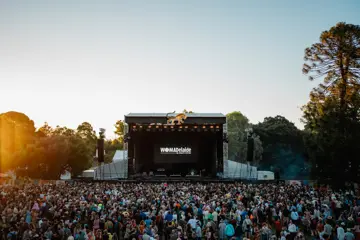
For Australian fans, they'll finally get the chance to catch this current version of the band this October, when Men At Work play a run of headline dates alongside appearances on the Red Hot Summer Tour alongside a reformed Australian Crawl.
"They were around the same time we were around and they were really, really successful like we were successful," Hay recalls. "There's all these other bands that people love and want to see, and it's a festival setting – there's going to be 10 or 12,000 people, and that is a great way to see the band.
"We just did a tour in the US and we did a tour last year with Toto and Christopher Cross. Those kinds of bills make sense to me because if someone's sitting at home and they like Christopher, they're not saying, 'Oh, I'm not gonna go and see that because that band Men At Work are on.' The chances are that if they look at the other two bands, they'll go, "Oh, that's cool. I'll go. I like them as well."
In fact, for those wondering why Australia has waited so long for Men At Work to make their way back home, well, it's the announcement of a line-up such as this which has made it possible.
"I've been kind of wanting to wait for the right situation," Hay admits. "I've been asked for the last five or six years to come back and do this tour, this Red Hot Summer Tour, but the timing never worked out right, or else it was going to be too long of a commitment.
"This year when they came to me and they said, 'James [Reyne] is up for it, are you up for it?' I thought, 'Perfect. That's a perfect pairing.' So the conditions and circumstances are right to maximise the potential for it to do well."
As the Australian return looms, and so too does the 50th anniversary of Men At Work's formation, Hay admits he's incredibly proud of everything that he and his bandmates achieved back in the day.
"Iit shocked me at the time because we were a truly global success," he notes. "It wasn't just the United States of America, which was the last country to pick up on the band, but the whole of South America, India, Japan, the whole of Europe, the UK, and then North America."
By his own admission, it's hard to explain just what it was that made Men At Work so beloved at home and abroad, but Hay points to one specific gig – in Tathra, New South Wales – as an example of the sort of indescribable connection between band and fan.
"It was probably my favorite tour of the whole band," he recalls. "It was before we became really successful. It was the tour we did in 1981 before we left to go overseas, and people seemed to kind of realise what was going to happen to us, and they gave us all their spirit, all their well wishes, and were sending us on our way
"But we played this gig in Tathra, and I thought there was magic in the air. I really was convinced that this was just so special, and I didn't know why. There was something otherworldly about it. I'm not a religious person by any stretch of the imagination, but there was some divinely magical thing in the air."
When the show wrapped, the band continued on, they went overseas, and Hay embarked upon a solo career after the group's dissolution. However, the memory of that Tathra show always stuck with him.
"A few years ago I was in Sydney and I did a solo show," He adds. "After the show I was signing CDs, and the guy who was last in the line came up to me, signed his CD, and before he walked off he just looked at me and he said, 'Ah, excuse me, mate. I was at that gig in Tathra,' and walked off. And I thought, 'Ah, it wasn't just me.'
"I'd just like to think that we had something that was just really different," Hay muses. "Something that people all over the world picked up on and wanted to experience."
Tickets to Men At Work's upcoming Australian tour dates and the Red Hot Summer Tour are on sale now.
Men At Work
Live In Concert – Australia 2026
Tuesday, October 20th – State Theatre, Sydney, NSW
Friday , October 30th – Royal Theatre, Canberra, ACT
Wednesday, November 4th – Palais Theatre, Melbourne, VIC
Thursday, November 12th – Fremantle Prison, Fremantle, WA
Wednesday, November 18th – Civic Theatre Newcastle, Newcastle, NSW
Red Hot Summer Tour
Saturday, October 17th – Queens Park, Toowoomba, QLD
Sunday, October 18th – Sandstone Point Hotel, Sandstone Point, QLD (Sold Out)
Saturday, October 24th – Berry Showground, Berry, NSW (Sold Out)
Sunday, October 25th – Keirle Park, Manly, NSW (Sold Out)
Saturday, October 31st – Roche Estate, Hunter Valley, NSW (Sold Out)
Sunday, November 1st – Coolangatta Beach, Coolangatta, QLD (Sold Out)
Saturday, November 7th – Victoria Park, Ballarat, VIC
Sunday, November 8th – Mornington Racecourse, Mornington, VIC (Sold Out)
Saturday, November 14th – Sandalford Wines, Swan Valley, WA (Sold Out)
Sunday, November 15th – Glenelg Beach, Glenelg, SA
Friday, November 20th – Riverstage, Brisbane, QLD (Sold Out)
Sunday, November 22nd – Sidney Myer Music Bowl, Melbourne, VIC (Sold Out)
This piece of content has been assisted by the Australian Government through Music Australia and Creative Australia, its arts funding and advisory body