 The Chicks Profile
Any artist will likely agree that when it comes to maintaining a presence in the world of music, brand recognition is crucial.
It's easy to see why. If a fan knows what you're called and how to find you, they're more likely to come along and buy your music and tickets to your shows. After all, imagine how many tickets Bob Dylan would sell if he suddenly started putting his birth name of Robert Zimmerman on the marquee?
As the years have gone by, we've seen countless instances of artists changing their names. Some have experienced massive success, and others haven't quite managed to make it.
One of the biggest examples is Prince, who famously protested against his record label Warner Bros. and the glacial pace at which he perceived they were releasing his archival material by changing his name to an unpronounceable symbol, and thereby going by the name The Artist Formerly Known As Prince.
It was a gutsy move which only lasted until he reverted back to his old moniker three years later, but it highlighted just how artists could survive a change in their names. Or perhaps he was only successful because of how public the Warner brouhaha was? Or maybe it was because, well, he was Prince?
Years earlier, Cat Stevens had also flirted with a high-profile rebranding.
The story goes that in 1976, Stevens had almost drowned in California, crediting his salvation to a promise he had made to God moments earlier. In response, he converted to Islam the following year, and in 1978, he took on the name Yusuf Islam.
He'd take a 15 year break from studio records, but when he returned, the chart success was minimal. In time, he would simply revert to Yusuf, and in recent years, he's gone by Yusuf/Cat Stevens – and a return to hitting the charts has also followed.
There have also been a number of Australian acts who have altered their monikers and gone on to great success, too.
Cub Sport, for example, were initially known as Tim Nelson & The Cub Scouts before shortening it to Cub Scouts and subsequently drawing ire from Scouts Australia. Adelaide's West Thebarton Brothel Party realised that the name of their group chat didn't translate well to a billboard and shortened it to West Thebarton, and Eves Karydas went by Hannah Karydas before switching to Eves and then lengthening it to Eves The Behavior.
New Zealand's Shihad famously altered their moniker to Pacifier after the word 'jihad' (which they had originally misheard while watching Dune) drew widespread controversy after 9/11. They subsequently returned to the name after two years, however, remaining Shihad until they split last year.
More recently, Miley Cyrus has also undergone a high-profile rebranding, dropping her surname for the more recognisable Miley.
It's also not the first time she's rebranded, either. After all, when she made her high-profile debut in 2006, it was as the the titular character on the Disney Channel's Hannah Montana.
While she would co-exist with her TV persona for some time, Cyrus shed her teen image around 2009, going solo under her birth name.
But how effective were these name changes in the eyes of the public? Utilising Google Trends data, we can actually track how fans responded.
In a graph of search interest over a specific time period, Google Trends shows the data on a relative scale from 0 to 100: zero suggests insufficient data, 50 indicates half the popularity, and 100 signifies the peak interest during a time period.
Looking at a decade of searches between 2006 and 2016, we can see that while searches for Hannah Montana were rising in popularity until March 2008 (months before the series entered its third season), that's when searches for Miley Cyrus shot ahead.
In fact, searches in March 2008 saw Hannah Montana at 15 on the scale compared to Miley Cyrus' 13. The former would drop steadily for some time, while the latter more than doubled its presence. Hannah Montana briefly made a resurgence in 2009, but since August 2009, Miley Cyrus has won out constantly.
In June 2010, Miley Cyrus had a score of 51 to Hannah Montana's 16, and in August 2013 – two years after the series concluded – Miley Cyrus was at 100 to Hannah Montana's 5.
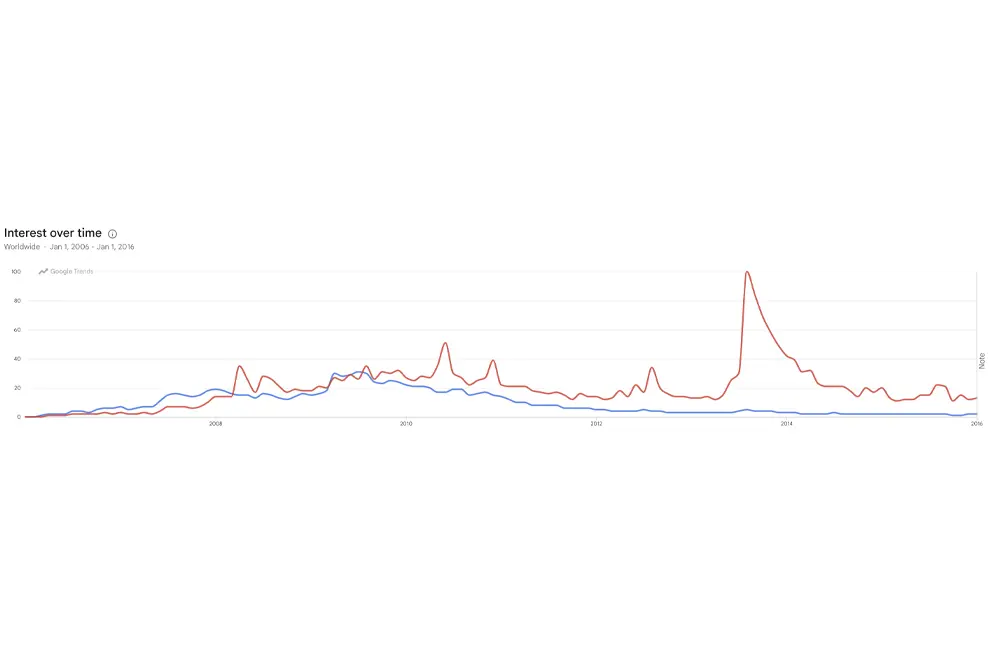
Google Trends searches for "Hannah Montana” (blue) and “Miley Cyrus” (red) between 2006 and 2016.
That's all well and good, and it makes sense, given the trajectories of the terms in the public eye, but how is this new branding going?
Well, it's early days, but a search of the terms over the past five years shows that Miley has always been beating its longer counterpart at every turn.
If we zoom into the past three months, we can see a big gap of 100 to 85 between the two – coinciding with her change – and widening to 45 to 32 this month.
Given that 'Miley' has always been a more popular search term than 'Miley Cyrus', this seems to be a case of good branding. But to be fair, she was rarely going to be confused for any other Mileys.
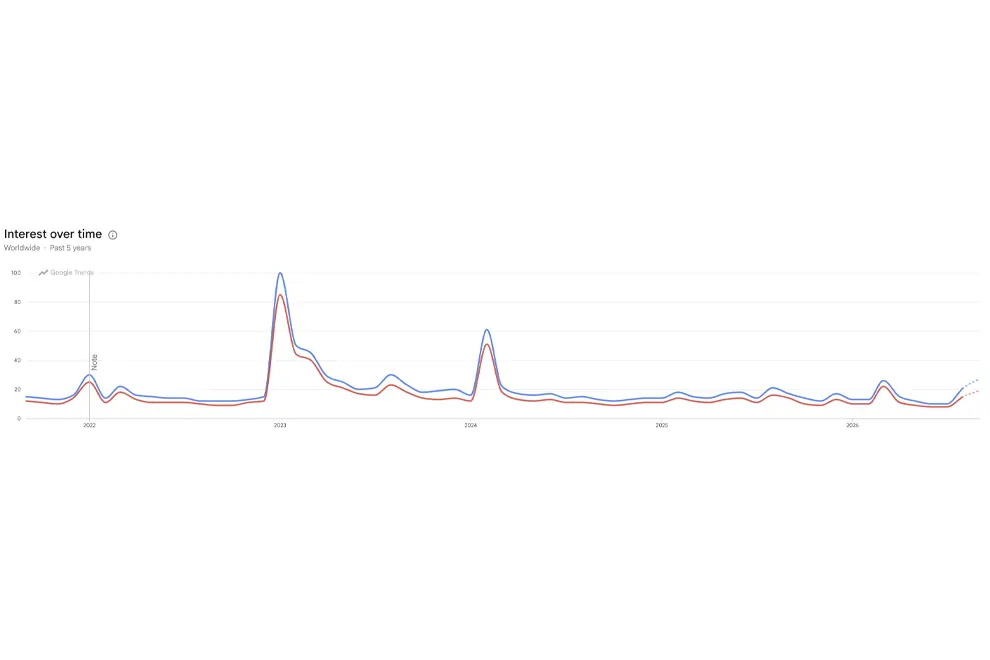
Google Trends searches for "Miley” (blue) and “Miley Cyrus” (red) between 2021 and 2026.
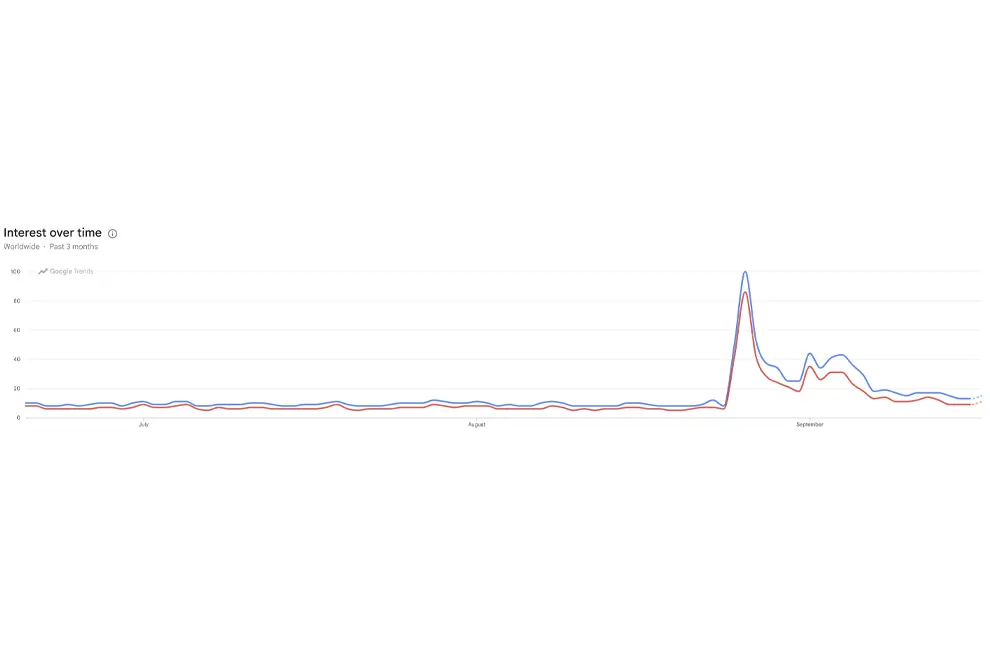
Google Trends searches for "Miley” (blue) and “Miley Cyrus” (red) between June 2026 and September 2026.
On an Australian tip once more, Chet Faker is a famous example of going between names frequently.
When he launched his music career, Melbourne's Nick Murphy often found himself confused for another local musician of the same name, so he adopted the Chet Faker moniker
After a few years of massive success at home and abroad, he announced in 2016 he would be reverting to his birth name, before going back on that in 2020. These days, the two names sort of co-exist, serving to host different musical sides of Murphy, but there's a sense of confusion for his fans.
Interestingly, while Chet Faker scored a massive spike in popularity from 2012 onwards (reaching a peak of 100 in January 2015 to Nick Murphy's 3), this gradually fell in the coming years, while Nick Murphy received a gradual bump from 2016 onwards.
While there were a few spikes here and there, in January 2023, the two terms actually reached parity, and since then, it's been neck-and-neck to see which term is the more popular one.
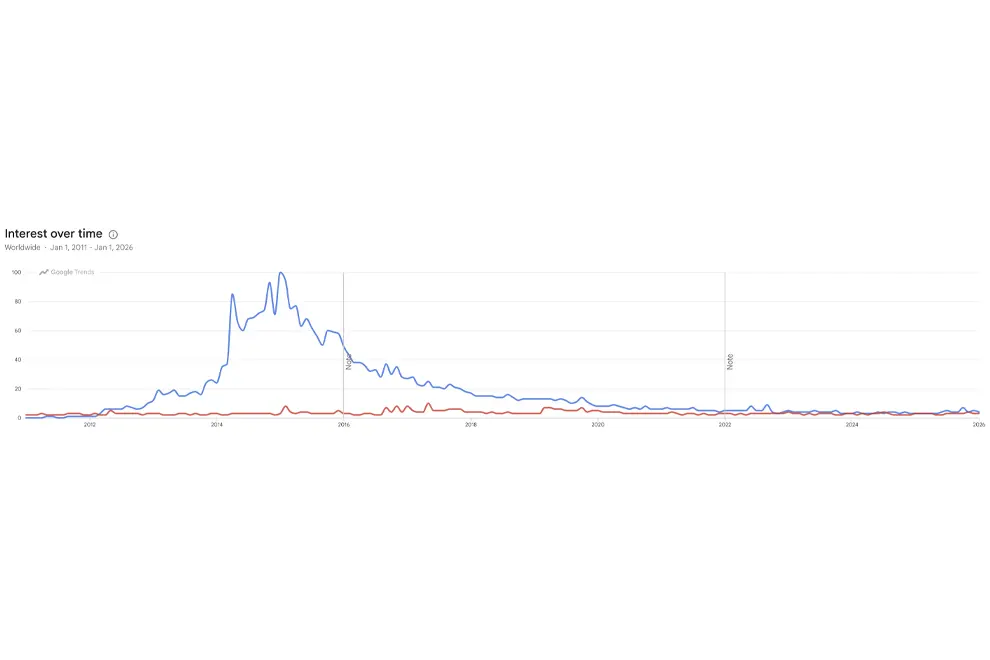
Google Trends searches for "Chet Faker” (blue) and “Nick Murphy” (red) between 2011 and 2025.
The world of rock music isn't immune from such changes in names, either. A few years back, English punk duo Slaves announced that they would be changing things up in response to claims their name was offensive to those who had been subjected to actual slavery.
Admitting it wasn't their intention to cause offence, the band capitulated regardless, celebrating their tenth anniversary in 2022 by switching over to Soft Play and noting their old name was no longer representative of who they are.
During their first decade, the group had actually garnered quite a bit of attention. Given the words 'slaves' and 'soft play' both have non musical meanings, a search for 'Slaves band' shows that their initial popularity peaked in June 2015 alongside the release of their debut album, and slowly ebbed and flowed until their name change in 2022.
It was at this point at which interest in 'Soft Play band' began to grow, overtaking their initial moniker by 20 to 15 in August 2023, and reaching a high of 80 to 22 in July 2024, coinciding with their first album by this new name.
Since then, both names have been relatively neck and neck in terms of searching, but 'Soft Play band' forged ahead at 40 to 22 in April of 2026, indicating that even a decade of brand recognition hasn't seen their efforts to rebrand prove futile.
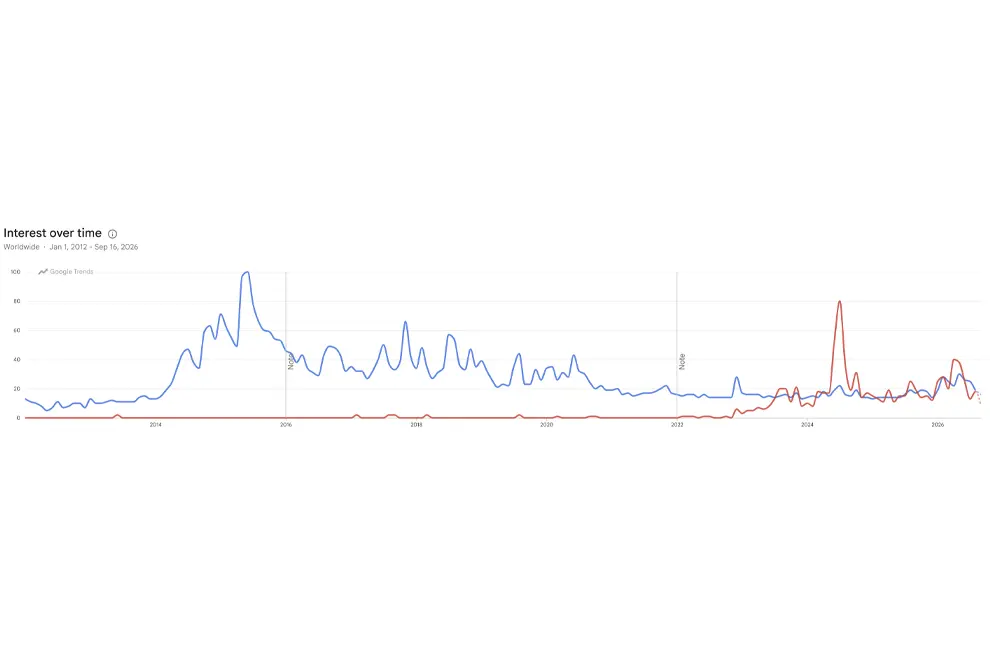
Google Trends searches for "Slaves band” (blue) and “Soft Play band” (red) between 2012 and 2026.
A more localised example can be seen by way of Jack White and his band The Raconteurs, or as they are officially known in Australia, The Saboteurs.
Formed in 2005 as a side-project for White, they had to change their name for the Australian market given that a Queensland band already had the Raconteurs name. Despite a financial offer to change, the Queenslanders held steady, and instead White's group became known as The Saboteurs.
Despite this, the efforts to change their name for Australian fans seemed to fall by the wayside a bit.
Looking at the band's initial nine-year run of 2005 to 2014, searches for The Raconteurs spiked in Australia in May 2006 by 100 to 51 when they released their self-titled record.
Another spike would occur alongside the second record in April 2008, but even then The Raconteurs won out at 46 to 43. The only time The Saboteurs overtook things was in August 2006, when the localised variant had a Google Trends score of 24 to the 0 of its counterpart.
While a reunion in 2018 – including a debut Australian tour – would also take place, The Raconteurs always reigned supreme, indicating that no matter what the group have to legally call themselves Down Under, fans always know what they're looking for.
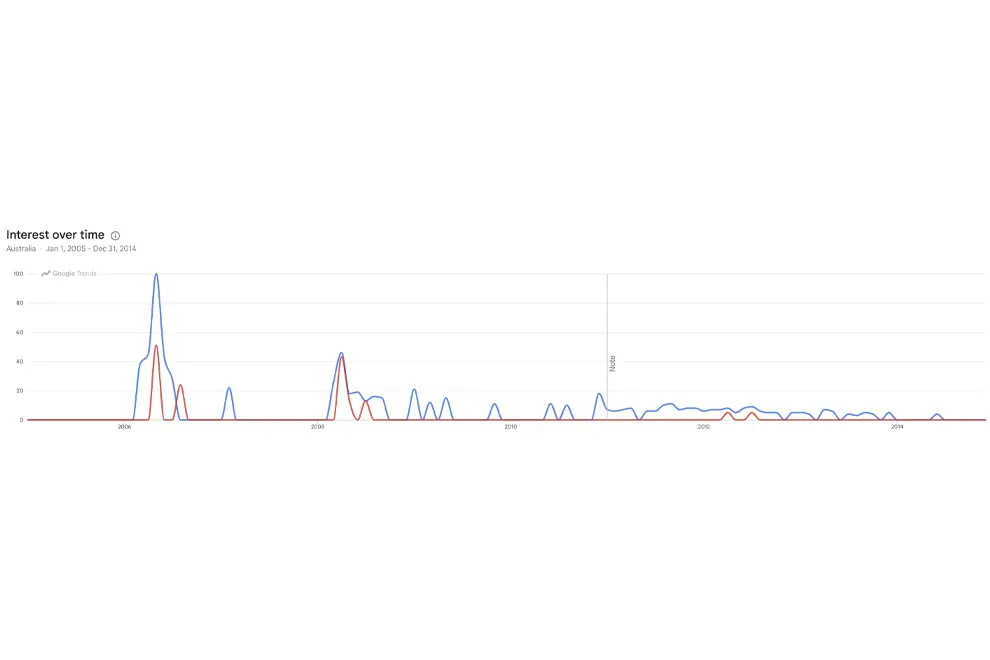
Google Trends searches for "The Raconteurs” (blue) and “The Saboteurs” (red) between 2005 and 2014 throughout Australia.
The hip hop genre is one that is filled with artists shifting names throughout their career. We can't go past The Notorious B.I.G. going by the likes of Biggie Smalls, and we can't overlook Tupac Shakur being known as 2Pac and even Makaveli.
We've seen Jay-Z play with variations of his name, including Jay Z, Jay:Z, and even Jaÿ-Z, and we've witnessed the likes of Ty$ helpfully expand his name to Ty Dolla $ign, too.
One of the more famous examples is probably Snoop Dogg, who's had more names than hot dinners, going from Snoop Doggy Dogg to Snoop, the Doggfather, and even the likes of DJ Snoopadelic and Snoopzilla.
In 2012, however, he took a reggae-inspired turn, explaining he would be adopting the name Snoop Lion. In the long run, it was short-lived, but at the time it seemed like this was going to be what we'd have to learn to refer to the Snoopster (that's one of ours, not his) by.
However, his efforts to completely go by a new name seemed to have been soured by previous attempts. So much so that when he announced the shift in August 2012, searches for Snoop Dogg were at 84 on Google Trends to Snoop Lion's 54.
Queries for the latter soon fell off, and while they did manage to get a little closer in April 2013 (47 to 26), there seemed to have been no chance at all in Snoop Lion taking over the world of hip hop.
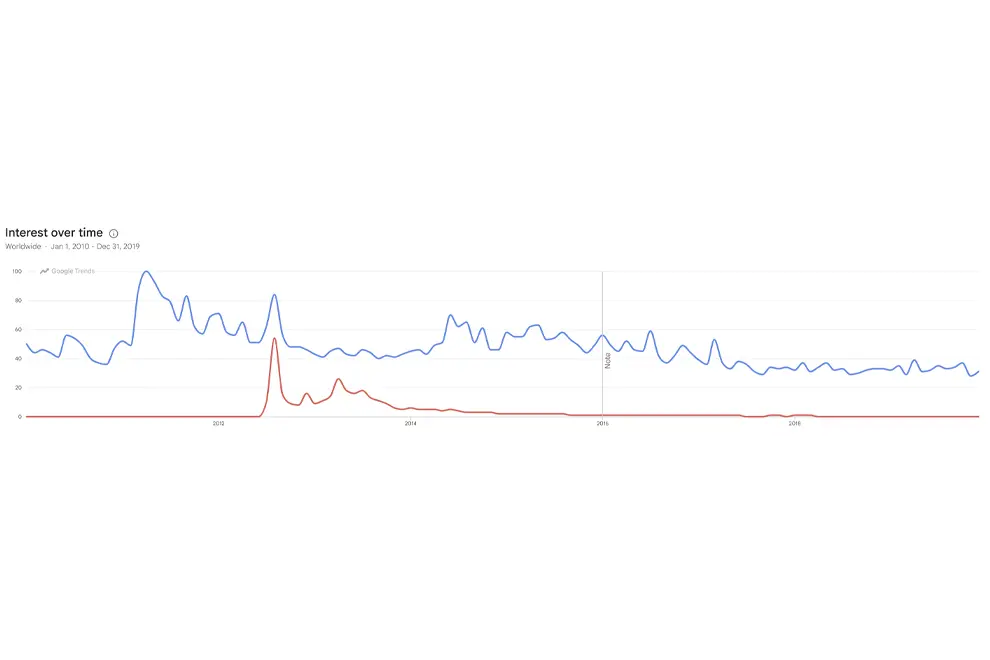
Google Trends searches for "Snoop Dogg” (blue) and “Snoop Lion” (red) between 2010 and 2019.
A more earnest rebranding could be found in Yasiin Bey, who – until 2011 – went by the name Mos Def, accruing legend status in the genre along the way. Legally adopting his new name after 12 years of being privately referred to by it, the plan was to eliminate any separation between his musical and personal personae
However, there's a chance that Bey may have accrued too much goodwill under his Mos Def moniker, because while his name-change announcement saw searches hit 73 for Mos Def and 4 for Yasiin Bey, his nascent handle has never performed better on the likes of Google.
While Mos Def would hit a peak score of 100 in July 2013 to Yasiin Bey's 16, there's always been a vast chasm when it comes to interest in the two names.
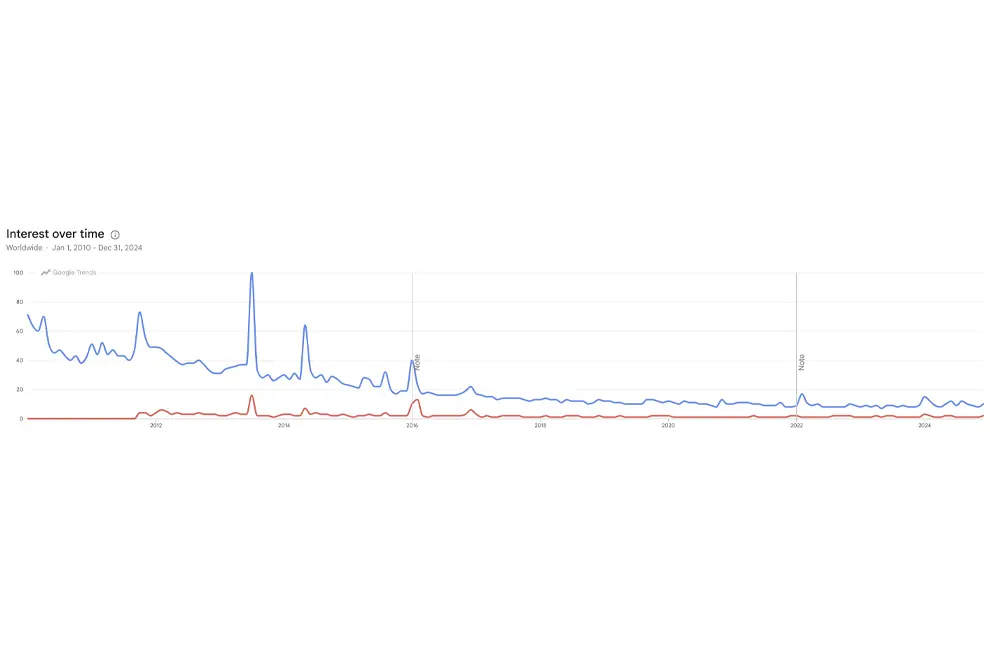
Google Trends searches for "Mos Def” (blue) and “Yasiin Bey” (red) between 2010 and 2024.
Another high profile example comes by way of controversial rapper Kanye West, who – since 2018 professionally, and 2021 personally – has gone by Ye, though his releases have arrived under both names.
This one is slightly difficult to examine via Google Trends given that 'ye' is also a surname, a pronoun, and many other things. However, if we level the playing field by searching for the likes of 'Kanye West music', 'Kanye music', and 'Ye music', we can see that for the most part, 'Kanye music' is the prevailing preference for fans, while 'Kanye West music' has remained a perennial underdog.
'Ye music', however, has come and gone in terms of popularity. In December 2017, the term was at 44 compared to the 23 of 'Kanye music'. There was a noted peak of 56 for 'Ye music' in December 2018, exceeding its closest rivals by 22 and 14, though these ebbs and flows have continued.
Ultimately, it appears that despite the occasional increase for searches in 'Ye music', his birth name will seem to win out for the foreseeable future.
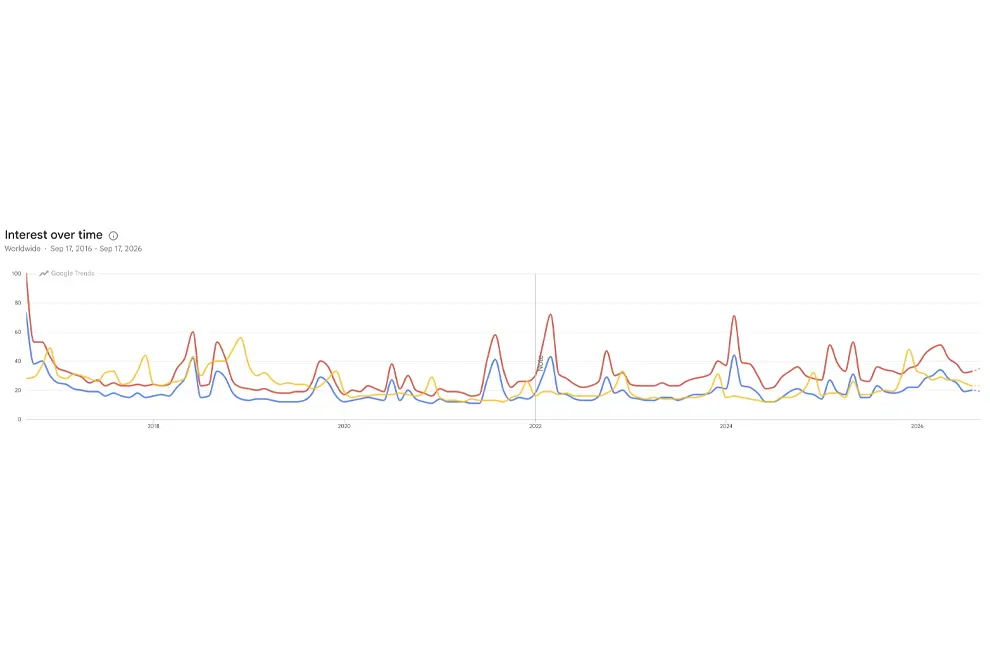
Google Trends searches for "Kanye West music” (blue), “Kanye music” (red), and “Ye music” (yellow) between 2016 and 2026.
In the world of country music, there's been a few famous changes over the years (and no, we're not going to mention Garth Brooks' regrettable stint as Chris Gaines).
However, it turns out that 2020 was a rather prolific year for artists changing names. In fact, within the space of two weeks in June 2020, both Lady Antebellum and the Dixie Chicks announced new monikers.
For Lady Antebellum, they had long referenced the Antebellum South in their name, with 'Antebellum' referring to the period before the US Civil War. However, after they had been educated of the racial connotations that such a handle brings with it, they ended 14 years of Lady Antebellum by shortening it to Lady A.
Frustratingly for them, it turned out their name had been used by an African-American performer who had used it for 20 years. Labelling their ignorance of prior use as "pure privilege", a legal settlement was eventually reached, but it was a messy period of time for the Nashville trio.
Strangely, Google Trends indicates that the band had probably been better off always using Lady A, with the Lady Antebellum name never only ever besting its competitor once – by 62 to 60 – a year after the release of their debut album.
While the group's former name definitely rose in popularity as their profile did, Lady A has always been the more popular term. A small spike (14 to Lady A's 53) occurred in June 2020 when they swapped names, but since then, Lady Antebellum has flatlined while Lady A has grown to new heights.
Of course, there's actually a chance here that, while the original Lady A was herself performing for decades, searches were simply just shortened to 'Lady A' instead of attempting to spell 'Lady Antebellum'.
That said, adding the word 'music' to searches for both phrases doesn't show any drastic changes, so that might be an odd situation.
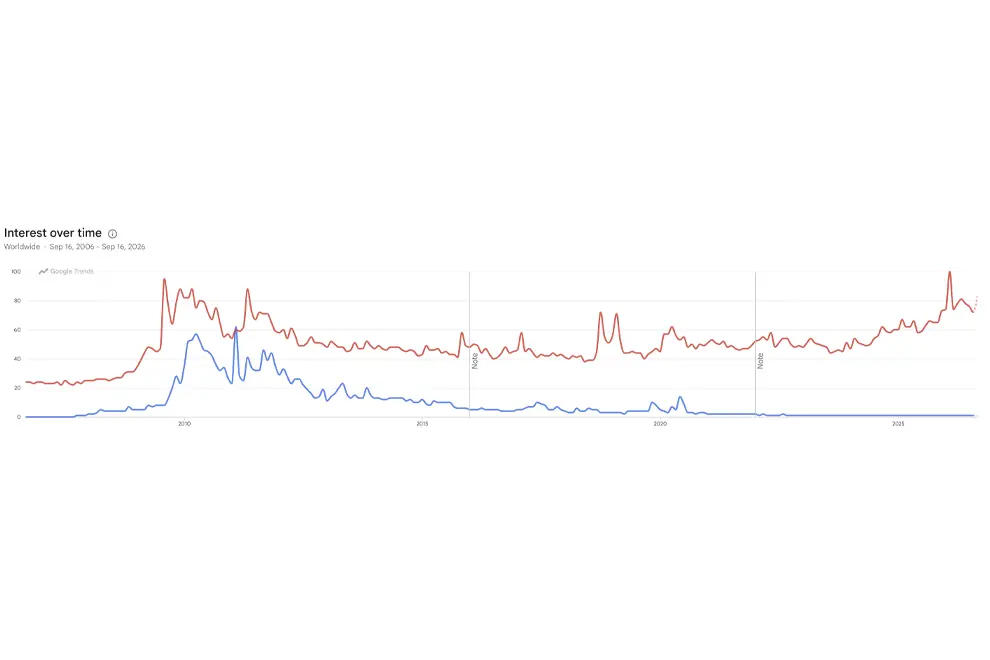
Google Trends searches for "Lady Antebellum” (blue) and “Lady A” (red) between 2006 and 2026.
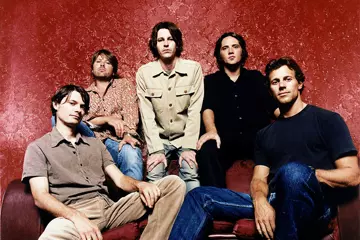
The other change to take place in June 2020 was when the Dixie Chicks decided that their own history of referring to a somewhat regrettable period in US history necessitated a switch to The Chicks.
Having received the blessing of a New Zealand duo with the same name, the Texan trio released their first new album in 14 years the following month, and it was a commercial success.
Unlike Lady A's switch, The Chicks' seemed to have been a little bit more beneficial. An analysis of Trends for the past 15 years shows that while 'The Chicks' did share comparative popularity with the former name for most of the time (save for a spike in searches for 'Dixie Chicks' across 2015 and 2016), news of the name change saw their original moniker nosedive soon afterwards.
Interestingly, 'Dixie Chicks' skyrocketed past 'The Chicks' briefly in December 2023, hitting 100 compared to 40, though was likely due to news of co-founding vocalist Laura Lynch passing away that same month. Since then, The Chicks have reigned supreme, with a new peak of 47 to 11 being recorded back in May 2026.
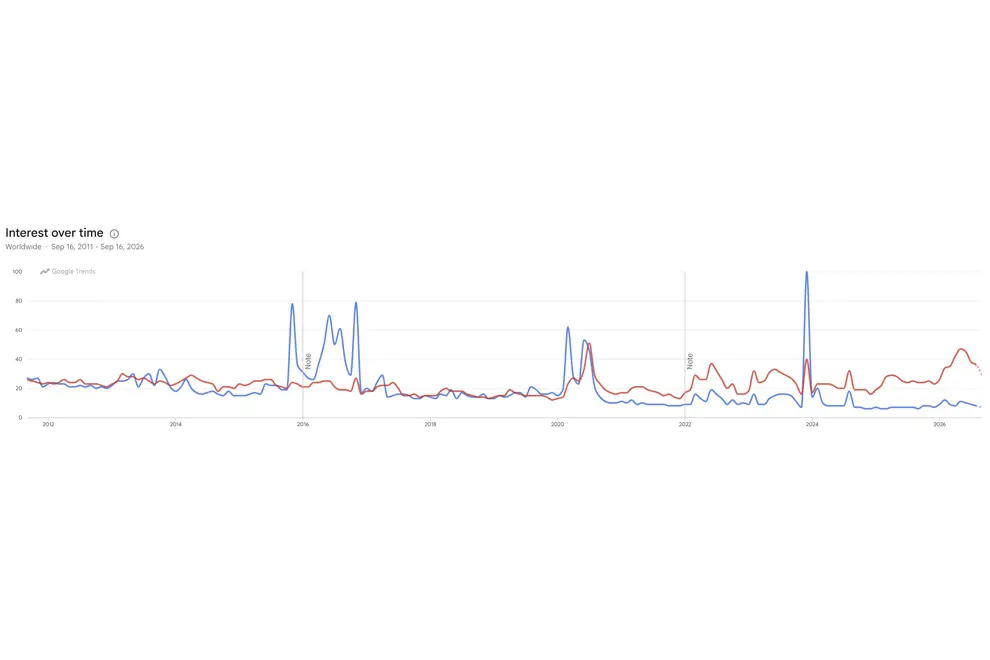
Google Trends searches for "Dixie Chicks” (blue) and “The Chicks” (red) between 2011 and 2026.
Lastly, one of the more successful rebrandings in recent years has to be that of Joji.
While the Japanese-Australian musician is these days known for chart-topping records like Nectar and singles like Glimpse Of Us, his formative years were spent on YouTube, where he occupied the Filthy Frank persona.
A bizarre blend of surrealist and toilet humour mixed with satire, Filthy Frank was a massive success on the platform, even inspiring a musical project dubbed Pink Guy.
A few months after Pink Guy released his debut album in 2017, Joji made his own debut, and since then, both Filthy Frank and Pink Guy have been a thing of the past.
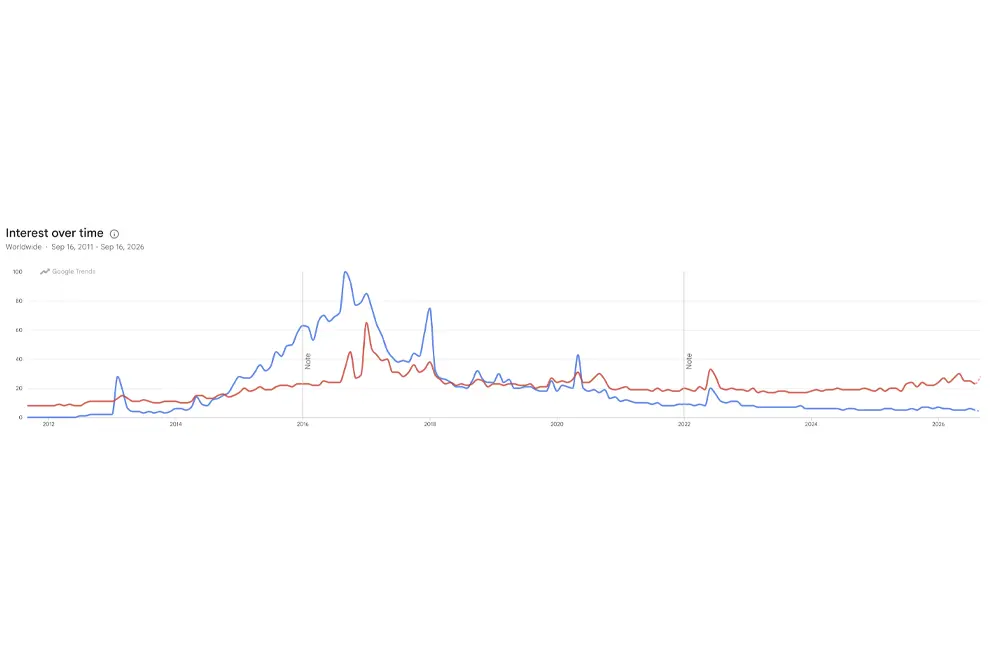
Google Trends searches for "Filthy Frank” (blue) and “Pink Guy” (red) between 2011 and 2026.
A look at the past 15 years sees that Pink Guy and Filthy Frank had relatively even search interest until May 2014, at which point Filthy Frank took over, reaching a peak of 100 in September 2016 compared to Pink Guy's 34.
Since then, Filthy Frank gradually fell off, eventually being overtaken by searches for Pink Guy.
However, if we add in searches for Joji, we can see his 2017 debut swiftly overtakes his previous monikers, blasting past them as his musical career takes off. Joji reached a major peak in June 2022 – coinciding with the release of Glimpse Of Us – at which point searches for Joji are at 100 as compared to Pink Guy's 8, and Filthy Frank's 5.
Perhaps this indicates that Joji is a rare example of an artist's earlier, decidedly more immature work being successfully overshadowed by an attempt to grow and to expand into more mature fields.
Either way, it shows that if ever there was an artist successful at pulling off an entire rebrand, Joji appears to be one of the biggest.
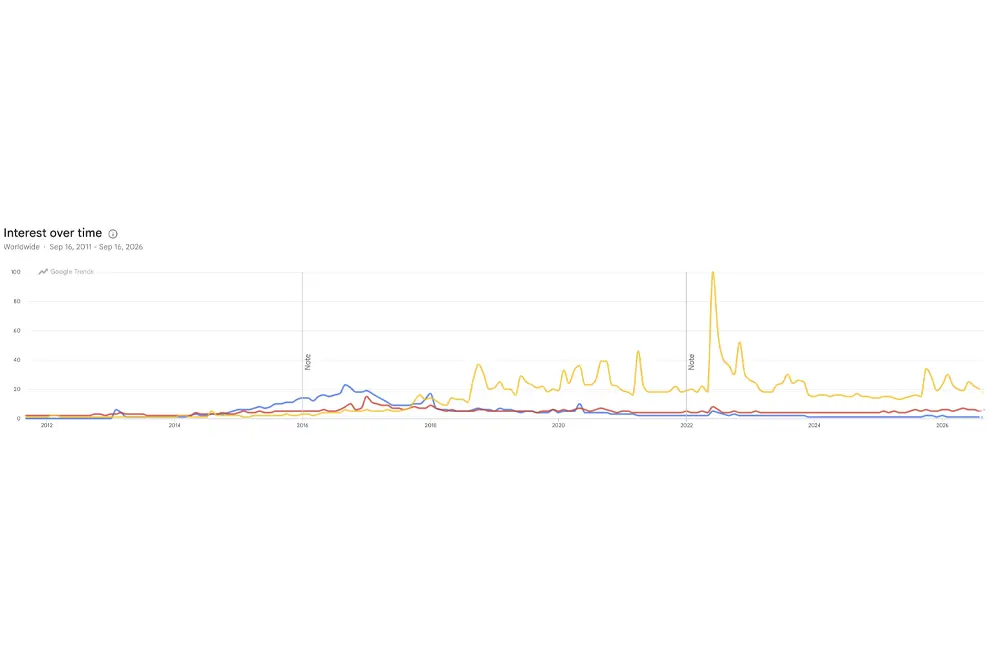
Google Trends searches for "Filthy Frank” (blue), “Pink Guy” (red), and “Joji” (yellow) between 2016 and 2026.