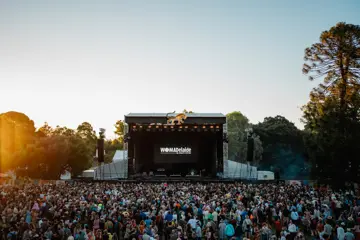
The night before we speak, Stuart Murdoch spent his birthday on a stage, turning a few thousand people into an impromptu choir for songs he wrote before most of them could drive.
He does not much care for birthdays, he tells me, so a show suits him fine. What worried him was smaller than stage fright – a cold, picked up somewhere between airports, that he feared might take his voice with it. It didn’t, but the worry is instructive. Murdoch has fronted one of the most beloved bands of the last three decades, and he still budgets his body the way you might a bank account that once went to zero.
That is because, for the better part of his twenties, it did. Murdoch fell ill with myalgic encephalomyelitis at 21, and the diagnosis – if you could call it that, given how little anyone understood it – swallowed the life he had been building. University ended. He went home to his parents. He was, in his own phrase, “out of the game.”
“If you take everything out of your life, then what’s left?” he asked in the 2008 documentary about the making of If You’re Feeling Sinister, the 1996 album Belle and Sebastian are now performing in full across the world. “If you get rid of all your friends, if you stop listening to all music, through necessity, then what comes out of the void? What comes out of the silence?”
What came out, it turned out, was a piano. It sat in his parents’ house, and it became the one place his rationed strength could go. “Every bit of energy that I had, I would go straight to the piano after breakfast and just play for a while, and then go and rest, and then play for a while,” he recalls.
“I remember quite distinctly the first song I wrote. It was just a very simple arpeggio, and then I started singing some words, and I thought, ‘Well, that’s it. I’ve written a song.’ It was definitely my reason to exist for a number of years.”
He has told this story before, in songs and in a film, but never as plainly as in Nobody’s Empire, his lightly fictionalised novel about those lost years, published in Australia in 2025.
There, the moment at the keys reads less like an origin myth than a door swinging open in a wall he hadn’t known was there. “I had thought about trying to write songs quite a few times before I got ill, but I couldn’t,” his narrator says. “It was a closed door. It wasn’t just closed; it was invisible. But just then the door appeared to me.”
It would take the better part of seven years to walk through it. By early 1996, though, with his health creeping back and a band assembling around him in the Glasgow church hall where he lived and worked as caretaker, the songs arrived all at once, in a rush he has never quite repeated. “I was writing so much,” he says, “but it was probably because I had so much stored up in me, emotionally and otherwise, from the years and years of nothing.”
Listen to If You’re Feeling Sinister with that in mind, and its cast of runners and cyclists and schoolgirls stops looking like whimsy. “They’re absolutely about desire,” Murdoch says. “They’re about desiring the subject of the song but also desiring to be the person the song is about. I’d been unwell for so long that an athlete, a star of track and field, would simply be beautiful to me.”
To hear the record in sequence now, from the tentative opening bars of The Stars of Track and Field to the gallop of Judy and the Dream of Horses, is to hear something of that convalescence in its 41 minutes.
Performing the songs live, Murdoch says, is a kind of exultation. “The concerts are always good. My Achilles heel is getting colds. As long as I don’t get that, I find them terrific. They’re certainly the most energetic thing to do, and I find it very uplifting.”
Murdoch has never truly shed ME, and when the subject comes up, the usual hesitant clarity he has around his own creative process and experiences hardens into something closer to anger. “It’s been glacial,” he says of the science.
“You’ve got a lot of well-meaning people doing research, but there’s never been a breakthrough. The powers that be have no interest in trying to understand an illness they can’t get to grips with. I would put forward the notion that a lot of ME people, people suffering in their homes, in their beds, are second-class citizens. They’re not being given a fair deal.”
Ask him what a fair deal would look like, and his answer is almost bureaucratic in its modesty. “Just to have ME cared for in the same way as other long-term illnesses like cancer or MS, and given the same funding per head of population.
“A lot of the time ME gets dismissed because you don’t die of it. But it’s been described, and for some people it’s quite true, as a living death, and that can go on for twenty or thirty years. I’m lucky I’ve never been that bad. But there are people in my circles who are very poorly.”
A couple of years ago, the illness flared again, and Murdoch found himself living inside the very years he was trying to write about. “We cancelled four consecutive tours, and I had a pretty hellish time for a year and a half,” he says. “The one thing that kept me going was putting the book together. Even though I couldn’t work much, I could work enough. Even though I was writing about the early nineties, I was still writing about now.”
So what, exactly, worked for him? How does a man who once split his days between the piano stool and the bed end up bounding across stages on the far side of the world? Murdoch is careful, first, to draw a line between himself and Stephen, the novel’s stand-in.
“Stephen, in the book, doesn’t get over ME. He gets set in the right direction by events and perseverance and friendship and love. But for me personally, it was having my life turned upside down and music coming in at the same time as spirituality. When I look at it now, that was the turning point of my life. Even though I was saddled with an illness, I was set off in a certain direction. I had to pursue music. It was like the open door ahead of me.”
The rest, he says, was patience and design. “It took almost seven years from that point to where the band formed, my health coming back and, at the same time, learning how to play guitar and write songs. I’ve been able to shape my life around what I’m capable of doing. The band has been very supportive, so I get up to do the concerts, and then I rest. It’s almost like it’s tailor-made for me.”
I press him on the timing, because it seems too neat: music and faith, arriving together? “Precisely the same time,” he says. Do they still feel inseparable? “Absolutely. My interests are Christianity, Buddhism and spirituality more generally. When I wandered into the Buddhist centre about twelve years ago, the monk or nun just said, ‘Don’t believe anything you hear. Test it out for yourself.’”
What is striking, talking to him, is how little of the convert’s certainty there is in any of it. Murdoch sounds less like a man who found the answer than one who is still enjoying the question. His counsel to anyone drawn toward religion could just as easily be about a record, a book or a band.
“I always say to people, you might hear ten things that bore you and then one thing that connects. Take that one thing, put it in your pocket and use it, and leave the rest. You might wait a whole lifetime to find a person or an organisation you’re perfectly aligned with. Don’t wait. Use what you hear.”
His instinct to pocket the good thing and pass it along is what had him running meditation classes online through lockdown, and he insists it springs from the same well as the shows. “For a long time I was battling away, trying to make my band successful. Then you get to a point where you go, we’re here, this is us, we’re in a lucky position where we get to play music. How can I be useful? It feels good to share some of the good things that have happened to you. It’s just like doing shows. I love it.”
Finally, I ask why he keeps returning to this stretch of his life. It is there in the album and more obliquely in its predecessor, Tigermilk, in the novel, even in God Help the Girl, the 2014 film he wrote and directed, in which Melbourne's Emily Browning plays a young woman fighting ill health and saved by music.
And now, with these concerts, he is revisiting it night after night. Murdoch laughs. 'Eventually, if I'm going to do this again, I'll need to get a different story.”
Onstage, the old story still holds. “I can be doing a set list night after night; we can be in Austria or Brazil,” he says, “and I’ll know I can stick in a song from Sinister at this point, and I will just disappear back into that time.”
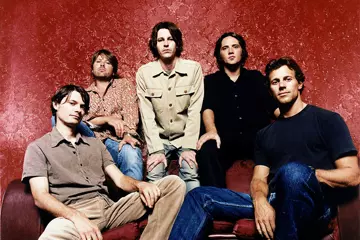
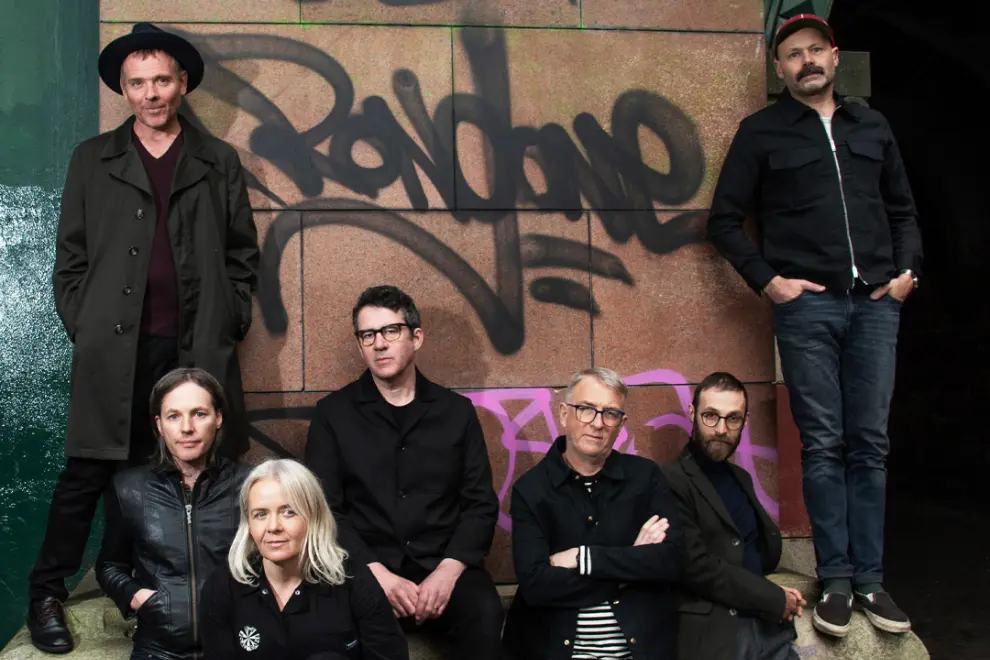
Belle and Sebastian return to Australia this month, celebrating the 30th anniversary of If You’re Feeling Sinister. Tickets are available.
Presented by Destroy All Lines
BELLE AND SEBASTIAN
2026 Australian Tour - If You’re Feeling Sinister in full + fan favourites
Saturday 12 September - Palais Theatre, Melbourne, VIC
Sunday 13 September - Enmore Theatre, Sydney, NSW
Tuesday 15 September - Fortitude Music Hall, Brisbane, QLD
Friday 18 September - Astor Theatre, Perth, WA