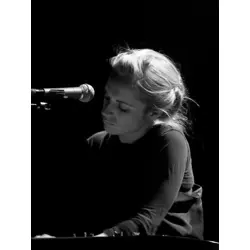
 Agnes Obel Profile
Agnes Obel is in her studio in Berlin – where she created her latest and fifth album, The Meaning Of Flowers – when we connect via Zoom. It’s around quarter past 10 in the morning over there.
The Danish artist, producer and composer discovered she was pregnant while touring off the back of her previous album, 2020’s Myopia. Obel mistook her pregnancy symptoms for a virus, until blue lines on a pregnancy test proved otherwise. She immediately cancelled the remaining dates of her tour and returned to Berlin.
During her pregnancy, significant changes in Obel’s brain chemistry caused her to experience “a peculiar sense of an inexplicable interconnectedness with all things alive”.
Some of The Meaning Of Flowers songs were written while Obel was pregnant and others took shape after she'd given birth. “I found out I was pregnant in the spring or summer of 2020,” she recalls. “Then I immediately could feel my perspective and also my brain changing, and I just wanted to document it; I was not aware of it becoming an album.
“The first song I wrote was The Meaning Of Flowers, and I wanted this new feeling I was experiencing in a song. We all were at home at that time [Covid lockdown], so I was just making music every day anyway. So that's how the whole thing started.
“And I kept on having new epiphanies and experiences that I wanted to investigate musically that, for me, were really different from what I had been interested in before. Also, after she was born, I had this strange feeling of being connected with everything living and thought it would be fun to see if I could make a pop song about this sort of animated force that runs through the trees, the grass, the fish, you and me – what is that force and how can you understand it? And how can you maybe represent it in a song, you know? So it was also a little bit of an experiment.”
Lead single Laymelli (which had a working title of ‘Metamorphoses’) was inspired by the life cycles of insects and Italian philosopher Emanuele Coccia’s book, Metamorphoses (2020). Obel’s vocals are pitched down here, like an inner voice or essence of something.
During the closing track, Faustian Deal, whispered vocalising sounds like the secret conversations of trees – just like in Laymelli’s visualiser.
Obel herself supplies vocals, piano, keys, synths and samples on this record, bringing in guest musicians to add strings, bass, lap steel, harmonium, flute, sax, percussion and backing vocals.
“I was trying to see if I could find instruments that could sort of embody something more chaotic, also something that could convey transformation,” she enlightens. “And so I ended up working with synths and strings in sort of a more ‘opening up’ way, and trying to make them sound orchestral – even though I just recorded it here in my studio.
“Then drums, which is new for me. So I started with some recordings I had of some Brazilian percussion and drums that I edited together. And then I asked a drummer – I didn't know him before – called Julian Sartorius, who I knew could play like this; very eclectic and actually almost electronic, even though it's organic materials he's playing on.
“He came to Berlin, and I recorded with him. And he was actually very close to this sound I was looking for. It's really cool stuff.
“It was about conveying something complex, like, you know when you look at a garden, and there's all these plants, and then you see further down, there's small insects, and then it's small, weird moss stuff going on and some dirt and, like, you can just go on and on and on and see things – that was the feeling I wanted to convey in the music. And I can't play piano like that. I can't do it with a piano. I had to find another way of expressing this sort of complexity.
“There are a lot of strange bells and percussion and small wooden drums. We also had a water drum we recorded. There's something about drums in this unconventional way that really, for me, conveys the chaos and the maximalism that I think biology can feel like, you know? The complexity of something that you just understand the tip of the iceberg of.”
Obel pulls from a distinct sonic palette and her world-building is immersive. Sounds blossom and bloom throughout her fifth studio album – the title is fitting. This is mystical music to awaken your inner child.
The Meaning Of Flowers is dedicated to Obel’s daughter, but it’s not about her. “It's more about new life and new things that happen to your mind when you go through a transformation like this,” she explains.
Reflecting on what her daughter has taught her, Obel says, “I really think she taught me exactly this: to find your inner child.
“I think all kids can teach us all something very important: that we appreciate the moment and be in the moment. And we have to sort of re-find that thing every day, you know? And I think kids, especially small kids, are so good at this; it's so natural to them. It's just so life-affirming and so beautiful to reconnect with your inner child. And some grown-ups have actually kept this alive in them; I've seen it with some artists.”
Jen's On The Way is one of my favourite songs on the album. It’s playful (“I bang my head on a flower”), but those sawing strings add eeriness. Of this curious track, Obel enlightens, “My closest friend, her name’s Jen and she's famously always late. It's not really what the song is about; it's [about] this state of waiting for something. You can't really get there, but you know you will get there if you start to relax. It's like the creative process has this sort of a strange urgency where you can't push it, but you have to still find this balance of trying to grasp something that is maybe within your reach. And this is kind of a ridiculous state.
“Like, if I have an idea – a musical idea – I become a little bit like the song. I feel like this is what I was trying to convey. And then I just used Jen, because she's famously always late and also always makes you wait [laughs]. I needed some kind of concrete situation – I didn't want to say exactly the situation of writing songs. It was more easy for me to get close to it with using my friend's famous lateness.
“She's actually really in contact with her inner child. And so she will be caught up in the moment and be late, but it's okay. I am actually starting to love it.”
Does she get distracted along the way and stop to pat a cat or chat with people, which makes her tardy? “Yes, or start sewing her outfit from scratch; she’s a costume designer. But she's also the type who would call you when the first snow comes here in Berlin, and she calls you early in the morning to say, ‘Okay, we have to go out and play in the snow,’ you know? I don't have so many friends who do that. And she's just really good at embracing the moment and having fun. And then the byproduct of that is that she's always late.
“I also got her to sing choir on the song, because she has such a cute voice. And, yeah, I'm really happy with that song. I'm happy you like it.”
For her latest set, Obel also found inspiration in the poetry of Enheduanna, the world’s earliest named poet/author who lived nearly 5,000 years ago.
When asked how she discovered Enheduanna’s work, Obel says, “English is not my first language, so I have to sort of immerse my brain with some poetry when I write lyrics. I was looking for poetry about birth, but in a more metaphysical sense, and I could not find anything. So I ended up finding this collection with spiritual verses.
“There was also a lot of Indian poetry, very old cosmology and stuff like that that was having something about new life. I was like, ‘Okay, I found the book, something about this subject, for the first time.’ And the first poem, and the oldest poem, was a poem by Enheduanna, a Sumerian priestess who was writing to the goddess of war, sex and childbirth. This goddess is called Inanna.
“And it turned out that Enheduanna used her whole life to write poetry to this goddess. And also had a temple in – this is before Babylon even, you know? And it was a very, very cool mythological language. I was like, ‘Okay, this corresponds really well with my experience of childbirth – it's not something that lies within day-to-day experiences [laughs]. It's something quite warlike or, I dunno, some kind of nature force, something really grand that you have no control of. And it was also nice to feel so connected with something that's 5,000 years old; like we are all the same, across time.
“Maybe all these stories we have that we are so special, and we are such a product of our times, are a little bit exaggerated. These kinds of experiences are really unifying and the same, you know? And it was beautiful to read this.
“And then, of course, when I wrote this song, I'm trying to talk about childbirth, and I'm trying to use this kind of mythological language as best as I can. So you try to tell a myth when you write a song and, for me, that made more sense than saying, ‘I went to the hospital’ [laughs]. And also because, to be honest, I barely remember anything. The whole thing was so unreal and traumatic.
“We're talking over 30 hours, emergency C-section and the whole shebang. So, yeah, yeah, a near-death experience. I don't really remember anything except for the fear in the eyes of the people who were speaking to me. And also these crazy contractions; I think they are like the way Enheduanna describes Inanna, when she's walking the earth, and it shakes, and everything is lying to waste behind her, like scorched earth tactics. This is how it felt, for me.
“And then also I remember I went there some days before, ‘cause I was worried – I couldn't feel my daughter moving; you know, all this paranoia you have. And then I went to this hospital, and I could just hear all these screaming women. I was thinking, ‘Holy moly!’ And then I saw this young doctor coming out looking so scared, like he did not know what the hell was going on.”
That's not reassuring. “It's not reassuring, no,” she agrees with a laugh. “That's what I was thinking, ‘Uh-oh, so that's what I'm gonna be doing.’ So I dunno, I needed this grand language, and Enheduanna helped me do that by describing this great natural force that is as powerful as wars and sex and all these grand natural phenomena.”
The Meaning Of Flowers is out now.
AGNES OBEL
2026 AUSTRALIAN TOUR DATES
THURSDAY 24 SEPTEMBER - QPAC CONCERT HALL, BRISBANE
Presented by QPAC
SATURDAY 26 SEPTEMBER - HAMER HALL, MELBOURNE
SUNDAY 27 SEPTEMBER - SYDNEY OPERA HOUSE, SYDNEY