Picture it. A winter night in Melbourne in 2004. Outside the Palais Theatre, a bitter wind is blowing in off Port Phillip Bay.
Inside, Scotland’s most enduring indie band Belle and Sebastian are finishing their first show in Melbourne, promoting their latest album, Dear Catastrophe Waitress, and the crowd is on their feet. The band is coming back out for an encore, ready to launch into Me and the Major, a highlight off their already classic 1996 album If You’re Feeling Sinister, but the audience has other plans.
A chorus grows amongst the fans, calling for one of their most beloved songs, Lazy Line Painter Jane, a duet between the band’s singer Stuart Murdoch and guest vocalist Monica Queen. “But we don’t have anyone to sing Monica’s part,” says Murdoch.
The chorus immediately turns to one supporting local singer-songwriter Jessica Venables, who takes to the stage and delivers Queen’s part perfectly, much to the delighted shock of the band. By now, a swathe of the audience is on the stage dancing with the band.
As the song finishes and venue security guide the fans from the stage, a woman walks up to Murdoch, whose shock grows even greater before it turns to joy and they embrace. The pair walk to the microphone. “And here is Thea Martin!” says Murdoch, laughing. “The girl from the front of the Lazy Line Painter Jane record!”
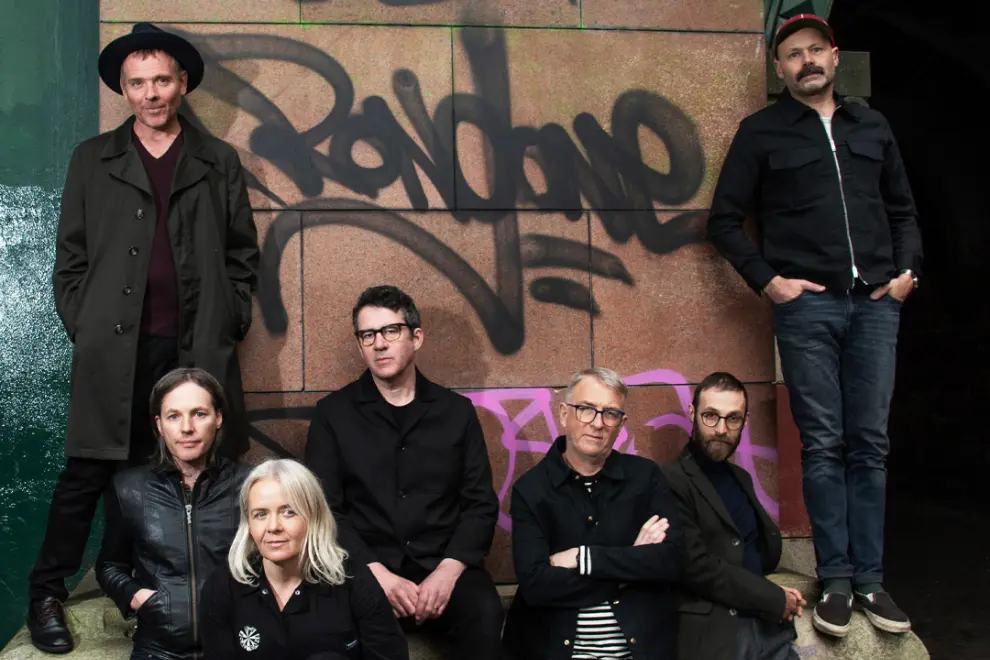
Twenty-two years on from what Murdoch once called one of the band’s favourite ever shows, Belle and Sebastian are playing the Palais Theatre for the – 2004, 2015, 2018, 2022, 2024 – sixth time, and this time they’re playing If You’re Feeling Sinister in full.
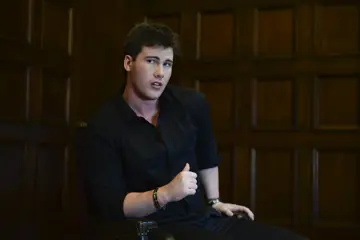
In an unwitting echo of that first show, it begins with the woman from the album’s cover. In a prerecorded video, Ciara MacLaverty answers questions from an unseen Murdoch about her memories of the time, their friendship, his ability to balance chronic illness and songwriting, and the impact of seeing herself in the window of a local record store. As her laughter fades, the Scottish nonet arrive.
“Welcome to the second recording session of this quite new band,” says Murdoch, MacLaverty’s face now replaced by the interior of a recording studio. “Tape’s rolling”, adds guitarist Stevie Jackson, who looks as Buddy Holly might have had he made it to 1965. We know they’re about to play the first song from the album, The Stars of Track and Field, and this shared knowledge brings the audience closer to the band.
Belle and Sebastian, and Murdoch in particular, have never held the listener at a remove. As soon as the internet would let him, he was blogging and writing about his life in Glasgow, simple accounts of life and reflections that reinforced the persona that came through in his songs. During lockdown, these became guided meditations and thoughts about illness, creativity and spirituality shared on social media. Once the gentle strumming and Murdoch’s hushed singing set the album in motion, the distance between performer and audience has all but disappeared.
Sinister is known for being a personal, intimate album, one not built for performing to venues of around 2,500 people. With sensitive backing from the band, most notably keyboard player Chris Geddes and multi-instrumentalist and singer Sarah Martin, Murdoch’s songs are given just enough energy to reach the back of the room and, in a move that seems totally at odds with their confessional nature, bring people to their feet.
Me and the Major – one of the few songs that manages to be a harmonica-driven speeding train of a song as well as a tender character study – gets a triumphant run-through with Jackson on vocals. It’s a glorious moment of release in a series of songs that, despite the euphoria in the room, deal with illness, loneliness, shame and ennui.
As the band work their way through the album, Murdoch becomes increasingly emboldened as a raconteur. He pauses the show to talk about the “spring energy and good vibes” he felt walking around today. “You’re all fit and sporty here,” he continues. “Even the goths are sporty. We’re going to do a love song now, a legitimate love song. This is Dylan in the Movies.”
Later, Murdoch takes a seat at a keyboard dressed up as a piano where he takes a sip from a soft drink bottle with what appears to be Chinese text on it. “I don’t know what this is called, but if they paid me money to promote this I would,” he says, taking another sip.
“I don’t even know what it’s for. What if I get a massive hard-on and then have to perform for you? Gosh. That’s about as rude as we get.” That this is his introduction to Fox in the Snow, perhaps the song that has generated the most tears in the band’s catalogue, without detracting from its power is a minor miracle.
Everyone stands and dances for Get Me Away From Here I’m Dying, a song the band reclaim from earnest buskers around the world, and almost everyone sits down again for If You’re Feeling Sinister, which Murdoch introduces as a song he wrote after he got a bus pass that allowed him to venture to the edge of Glasgow.
It’s one of his most astonishing voyages of empathy in a career filled with putting himself in other people’s situations. A brief discussion of corporal punishment (“well, the songs didn’t write themselves”) precedes The Boy Done Wrong Again before the album closes with Judy and the Dream of Horses, which gets a coda that allows Jackson to go into full Velvet Underground ‘What Goes On’ mode as he thrashes out the three chords on his Telecaster while Murdoch dons a horse’s head.
The album over, the band briefly leave before launching into the “fan favourites” section of the show with the glam rock stomp of I’m a Cuckoo. Murdoch has more banter to share. This time it's a short slide show of his day in Melbourne, which took in the beach boxes at Brighton Beach, and a series of photos of number plates that lets him riff on Victoria’s various slogans, culminating in Murdoch’s delight at the bravado of “The Education State”. “Who came up with that one?” he asks no one in particular.
The band begin the home stretch with Martin leading them through the deep cut Little Lou, Ugly Jack, Prophet John, and the band’s biggest UK hit, Funny Little Frog.
In what is now band tradition, thirty audience members join them on stage for The Boy With the Arab Strap. Where once there was chaos and spontaneity, the intimacy between band and audience has become formalised. With a back catalogue as dense with great songs as Belle and Sebastian’s, there are inevitable wishes for a slightly different setlist but no one seems to be leaving the show disappointed.
Even a heavily tattooed and musclebound security guard, who had to fend off the pleas of fans to allow them onstage, gives his begrudging respect. “It’s not really my thing,” he says, wrinkling his nose. “It was great to see everyone in the theatre standing and dancing though,” he adds. “Haven’t seen that before.”