 Paul Kelly Profile
If there’s one person in the Australian music industry you’d love to chat to, it’s the one and only Paul Kelly.
The master story-teller through song is just as eloquent and engaging through speech, so is there any better way to spend a Tuesday afternoon on the opening day of BIGSOUND?
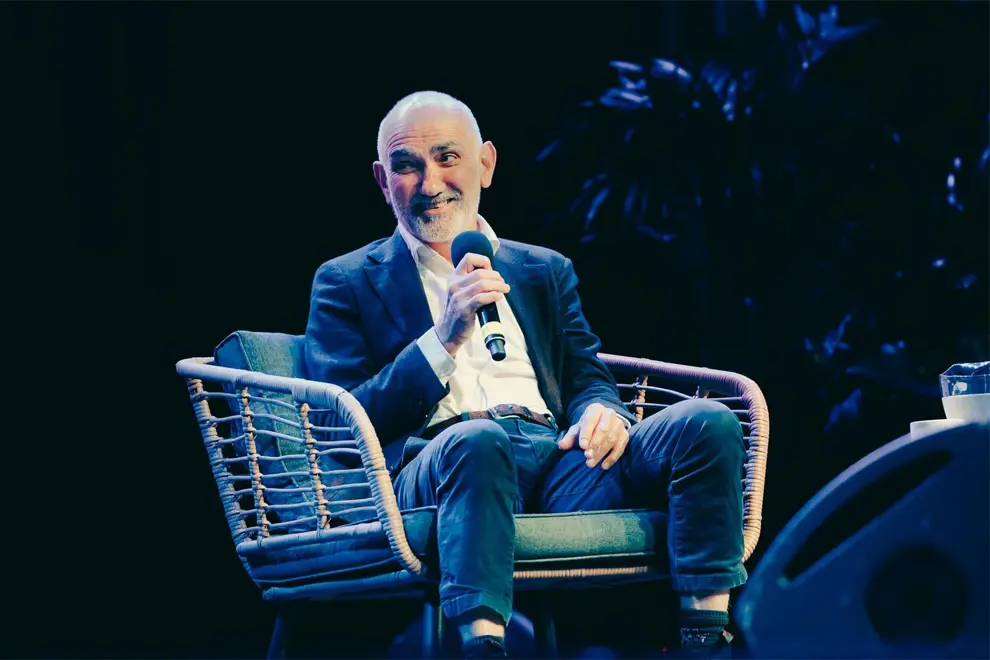
Kelly took to the stage of The Fortitude Music Hall to have a conversation with the ABC’s Sarah Kanowski and we all felt like we were around a small table in his kitchen, just as he had done with Archie Roach when they wrote together around Archie’s kitchen table back in the late ‘80s.
That’s just one of the stories that was touched on in the 40-minute discourse following on from a sold out pop-up performance at Brisbane’s Lefty’s Music Hall the night before where a very lucky 350 people got to experience the great man in his element.
The 71 year-old legend of Australian music who released his thirteenth album, aptly named Seventy last year shared why he decided to go all ‘Adele’ in titling his album after his age.
“I think seventy is a great number,” Kelly mused. “It’s a biblical number. For a long time it was the expected span of a person’s life.”
The mortality of our existence has been put under the microscope lately with the death of a number of prominent entertainers (Dolly Parton, Sam Neill, and Tim Curry, just to name a few in the last month), but to hear Kelly speak of marking that milestone and what the age means to him highlights the importance of the fact that he is still making music.
Kanowski referenced American novelist Elizabeth Straut saying that she was so happy to be turning 70, adding that "all the rest is gravy”. A reference not lost on Kelly although, the majority of the population will be hoping that he Kelly looks after himself very carefully!
Kelly went on to discuss the recording of the bonus track from the ’Deluxe’ version of his latest album, Hoagy Carmichael’s classic, Stardust.
“It’s my favourite song of all time,” Kelly continues, “Mysterious, endless... it’s a song about a song so I guess it attracts somebody who’s interested in writing songs.”
He went on to gush about how his reworking of the track pushed him out of his comfort zone, even after all these years. “I counted up the chords in the song and the version that I put together had 17 chords, all diminished and augmented…I just had to learn them and work out, you know, how to play them.”
The raw honesty with which Kelly answers questions perpetuates the sense that we already know him, but hearing him answer questions so humbly and candidly, revealing more about himself still, is why conversations like these can fill a room full of industry people.
Talking about his youth and how he decided to dabble in song-writing, after writing poetry as a teenager, reveals those humble beginnings, starting with critiques from his singing grandmother.
“Criticism and advice. She didn’t much like my voice, she thought I was just going to ruin it,” Kelly chuckles, referring to taking on the classics in his early 20s, before continuing. “She did give me a fantastic piece of advice, she said, ‘If you’re nervous before you go on, get somewhere quiet and just take deep breaths’, and that’s the best advice I’ve ever got.”
“I didn’t write my first song until I was 21,” Kelly reveals, before discussing those Australian acts that inspired him, “I remember being inspired by Daddy Cool, but I felt that it was a bit beyond me.”
He further elaborated on the folk scene in Adelaide as a child, citing Dave Clark, an Adelaidean singer, songwriter and poet, as someone that inspired him to write stories, create characters and depict the world around him, rather than restricting himself to his own experience.
He reminisced on the first single he ever released, in April 1985, from his first solo album, Post; From St Kilda To Kings Cross. “I based it on a Robert Johnson song, From Norfolk To Virginia,” he admits, though the track is actually called From Four Till Late.
Regardless, Kelly notes he was living with Don Walker in Kings Cross and wrote the track while dabbling on a white grand piano in the house.
What did Walker think? “I had shown him some of my earlier songs and I sang one to him and he just said, ‘Keep writing’. That’s the best advice I ever got.”
When speaking about the late Archie Roach, you can tell the fondness that Kelly had for the great Indigenous artist, revealing that he asked Roach to support his first ever concert at Hamer Hall in Melbourne.
“It was a big deal for us so we got Archie to open up for us and he just did twenty minutes and sang three songs and finished with They Took The Children Away,” he recalls.
“When he finished, the whole audience was dead silent and Archie thought he’d bombed, so he just sort of turned and walked off stage and as he walked off, the swell of the crowd just built and built and built.”
This led to the famous songwriting sessions around the kitchen table with Roach and Ruby Hunter and cold lamb sandwiches on white bread. A most wholesome thought.
Kelly would go on to reference the recent passing of Dolly Parton. “I tend to love the (songs) where her folk roots come through,” he mused. “Songs like The Bridge and Down From Dover.
“I mean, they’re just heartbreaking big sad songs but they’re so beautifully written. They’re story-telling songs.”
Kelly would go on to reflect on his most famous story-telling song, How To Make Gravy and how he nearly didn’t write it.
“I had a complete panic attack,” he admitted. “There are so many Christmas songs, why does the world need another one and how the hell am I going to write it?” referencing the compilation Christmas album that John Farnham was putting together to raise money for the Salvation Army.
The rest is, of course, history, with the song not only establishing itself as one of the best Christmas songs of all time, but also creating ‘Gravy Day’ on the 21st of December as a homage to the day the gravy should be made.
The forty minutes went too fast. Listening to Kelly is like listening to a grandparent who has so many stories to tell and only ever feels like they’re scraping the surface.
He rounded out the talk contemplating what he may have done if “the whole music thing hadn’t panned out”. What would he be doing instead?
“I could have been a sports writer about football and test cricket,” he suggests. “Yeah, maybe!”
This piece of content has been assisted by the Australian Government through Music Australia and Creative Australia, its arts funding and advisory body