 Shazam Profile
Though it's undoubtedly still something that occurs, it almost feels quaint to think back to a time where if a radio DJ didn't announce the song, or your knowledgeable friend wasn't on hand, then that song you heard one night at the club might be lost forever.
Sure, you could potentially hum a few bars in hopes that someone recognises it (and subsequently get immortalised in a classic late-'90s song in the process), but often, you may be doomed to wonder about what that song was for years to come.
While this might feel like we're talking about some historical snapshot of the 'bad old days', it's definitely still someone that happens with great frequency. You might be at the grocery store, hear a catchy hook, and try to work out what it was that had you grooving down by the spices.
Often, however, it's a problem that is easily solved thanks to a little invention called music recognition software.
What's Music Recognition Software?
As the name suggests, music recognition software is a technological service which serves to recognise the song you're listening to.
These days, the idea is that you simply grab your phone, tap a button, and your phone will let you know who sang the song that has you stumped.
It's something which 50 years ago may have seemed like science fiction, but it's rather ingenious in how it works. What these services do is utilise the microphone on your smart device to listen to a sample of the audio which needs identifying and then creates what is called an acoustic fingerprint.
This process involves the audio being broken down into a numeric signature which is unique to the audio – much like a fingerprint. It then cross-references that (or checks the acoustic fingerprint, if you will) against the same codes within its extensive audio database, and when it gets a match, it lets you know what it is.
As the name suggests it's the same logic as fingerprinting. If everyone's fingerprint is unique, then checking it against a massive database (which hopefully contains the one you're searching for) is the best method to find the answer.
These days, we've got countless services like these, but it wasn't always the case.
After all, the Beastie Boys recounted how back in 1986, “Your mom busted in and said, ‘What's that noise?’” If she had music recognition services, the famous trio wouldn’t have had to helpfully respond with, “Aw, Mom, you're just jealous, it's the Beastie Boys”.
Utilising Google Trends data, we can actually track how music lovers have searched for services to identify their unknown songs over the years.
In a graph of search interest over a specific time period, Google Trends shows the data on a relative scale from 0 to 100: zero suggests insufficient data, 50 indicates half the popularity, and 100 signifies the peak interest during a time period.
Looking at global Google Trends data ranging back to 2004, we can see that searches have been made for terms like 'music recognition' for decades, hitting an early peak of 18 in March 2004 and ultimately remaining relatively steady for close to two decades.
In June 2025, that number zoomed up, and by August, it hit 61 before humping up and down ahead of a peak of 100 in May 2026.
Interestingly, the term 'music recognition' was the main thing users searched for until January 2016, at which point terms like 'what's that song' were indexed by Google.
We can see then that the nascent term was at 16 compared to the 6 of 'music recognition', and it largely remained in a period of steady growth over the decade, hitting an early peak of 40 to 8 in July 2022.
Rising alongside the popularity of its rival term, the term has actually since won out completely, hitting a score of 84 in August 2026 compared to 32.
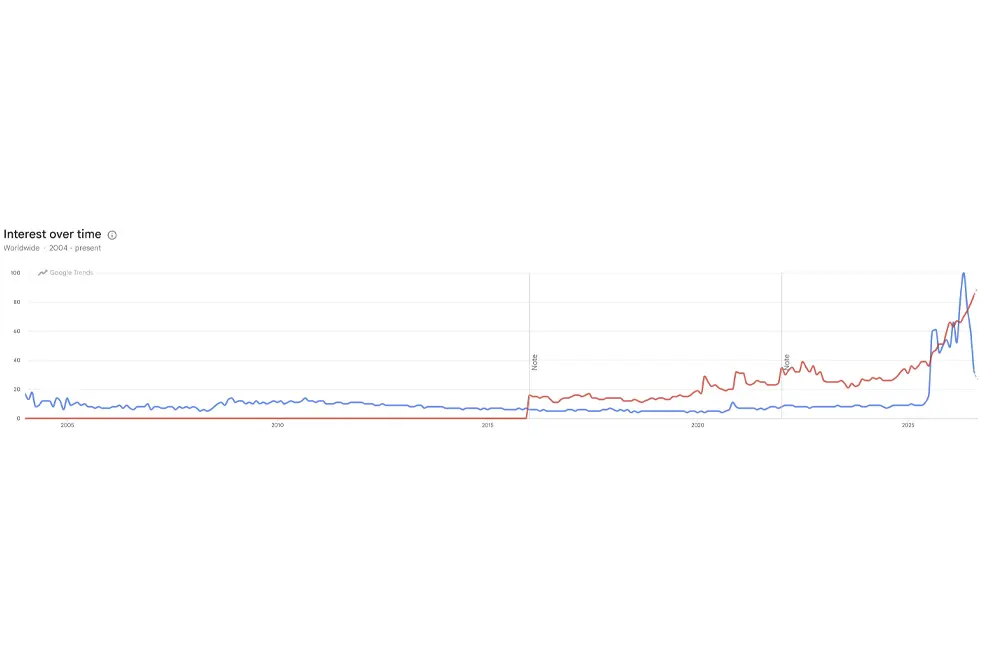
Google Trends searches for "music recognition” (blue) and “what's that song” (red) between 2004 and 2026.
Music Recognition Services
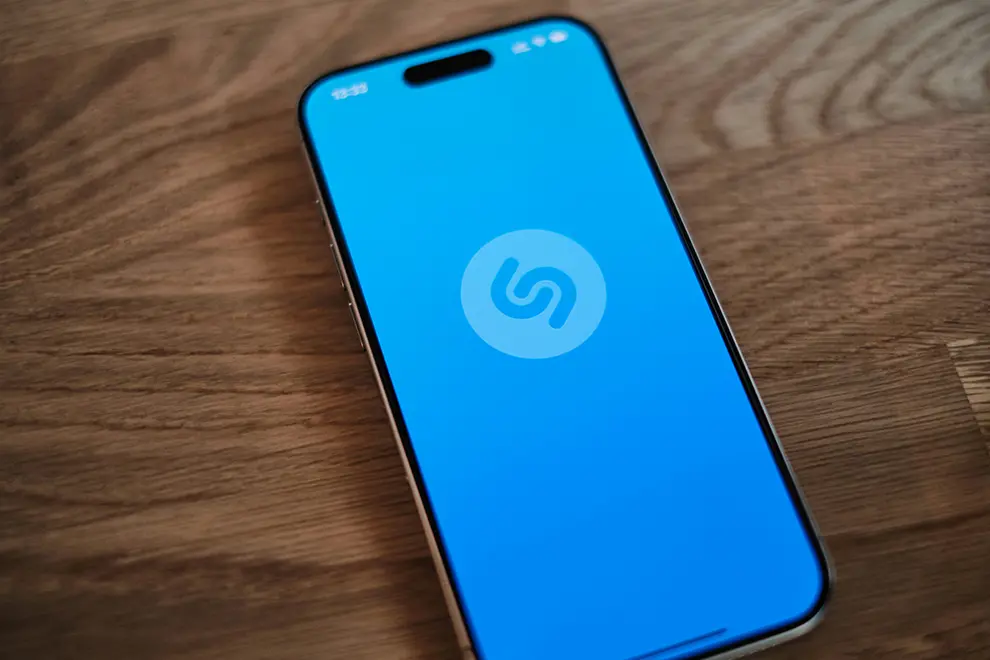
It's somewhat interesting that Google's searches can be traced back to 2004, because that's around the time that the now-ubiquitous service known as Shazam made its US debut.
In 2002, Shazam launched a phone-based service where users would call from their mobile devices (the number was the simple 2580 – the middle digits on one's keypad), hold the phone up to the audio, and then have the answer texted to them.
Two years later, it launched in the US and by 2006, it had become an application for those with phone devices which could handle the technology.
As time has gone on, Shazam has undoubtedly become the industry leader, and in 2017, it was acquired by Apple – three years after it was announced the service had recognised more than 15 billion songs.
Fast-forward to 2024, and that number exploded to 100 billion. At the time, the most Shazamed song was Tones And I's Dance Monkey, but given the track's divisive nature, it's hard to say whether that was out of curiosity or simply a case of knowing your enemy.
Looking at searches for the app since 2022, we can see moderate activity in its formative years, before it made a jump to 11 in July 2008, around the time that the likes of the iPhone were becoming more commonplace.
It would grow constantly over the years, hitting a high of 77 exactly ten years later (just prior to its Apple Acquisition), and would eventually hit a peak of 100 in March 2023.
Since then, it's remained moderately consistent around the 50 mark, indicating that it's still the most popular recognition services out there.
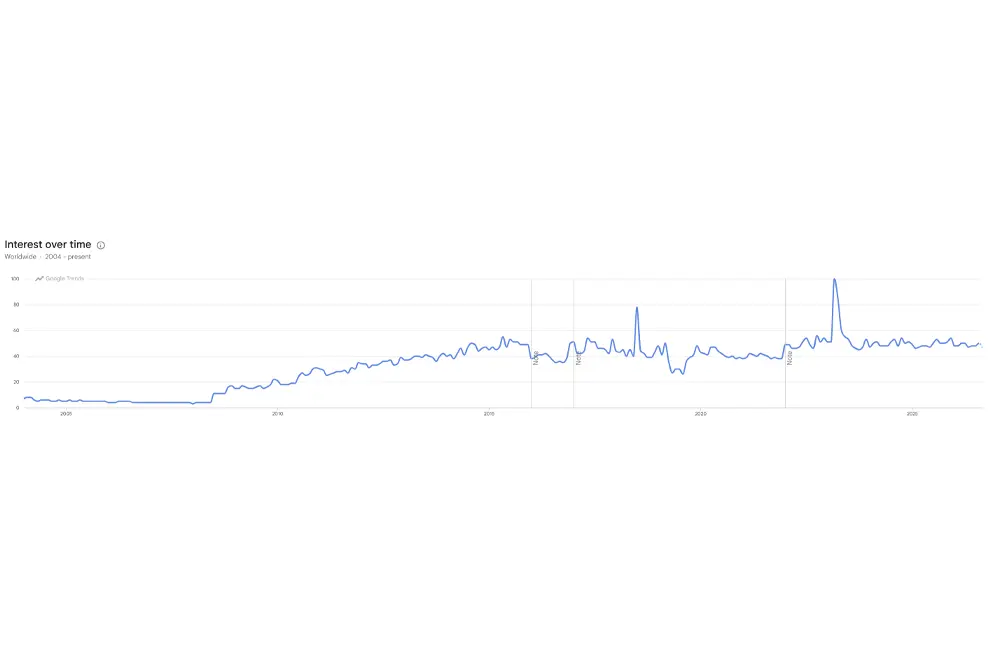
Google Trends searches for "Shazam” between 2004 and 2026.
One of Shazam's earliest rivals, however, came by way of SoundHound, which launched in 2005 as Melodis as a competitor to the more famous service. It would rebrand its app to SoundHound in 2009 and had largely remained something of an underdog – if you'll excuse the pun – ever since.
It became the default music recognition app in some Hyundai and Kia models in 2015, and it's managed to score a number of acquisitions and expansions over the years.
However, if we compare SoundHound and Shazam, we can see that searches for the former term and the latter app indicates that Shazam has always been the more popular one, despite a rise to 8 compared to Shazam's 36 in August 2012.
In recent years though, SoundHound has rallied while Shazam has remained consistent. In December 2024, Shazam was at 51 while SoundHound was at 22, a far cry from March of the previous year when Shazam was at 100 and SoundHound was at 2.
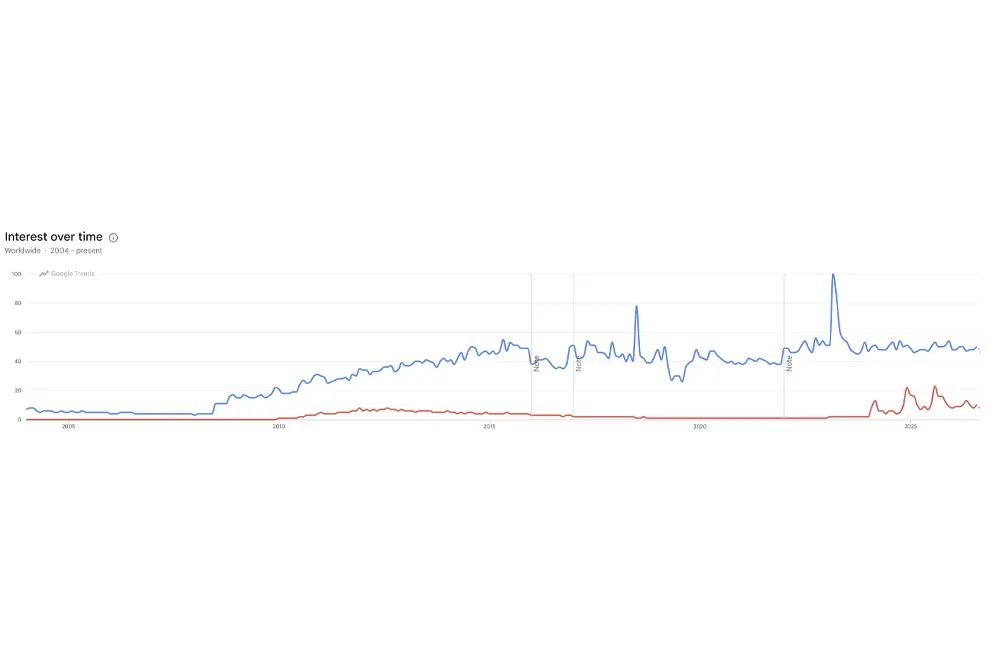
Google Trends searches for "Shazam” (blue) and “SoundHound” (red) between 2004 and 2026.
Around 2010, Microsoft also got in on the action, launching its Bing Audio software as a way to compete with the other services.
It never really made much of a splash in the grand scheme of things, and in fact, while it would hang around for some time, it seems to have been quietly discontinued since last year, though the company never actually made any statement regarding its demise.
It appears they never actually made any attempt at marketing it either, nor did it enter the discourse writ large.
Comparing it to Shazam on Google Trends, its official name of Bing Audio results in a plain flatline, while its more common name of Bing Music shows the faintest of movement in search terms over the years.
It appears to have reached a peak of 4 to Shazam's 31 alongside its launch, and the past decade has barely shown any life. In March 2023, Shazam was at 100 while Bing Music was at a paltry 1.
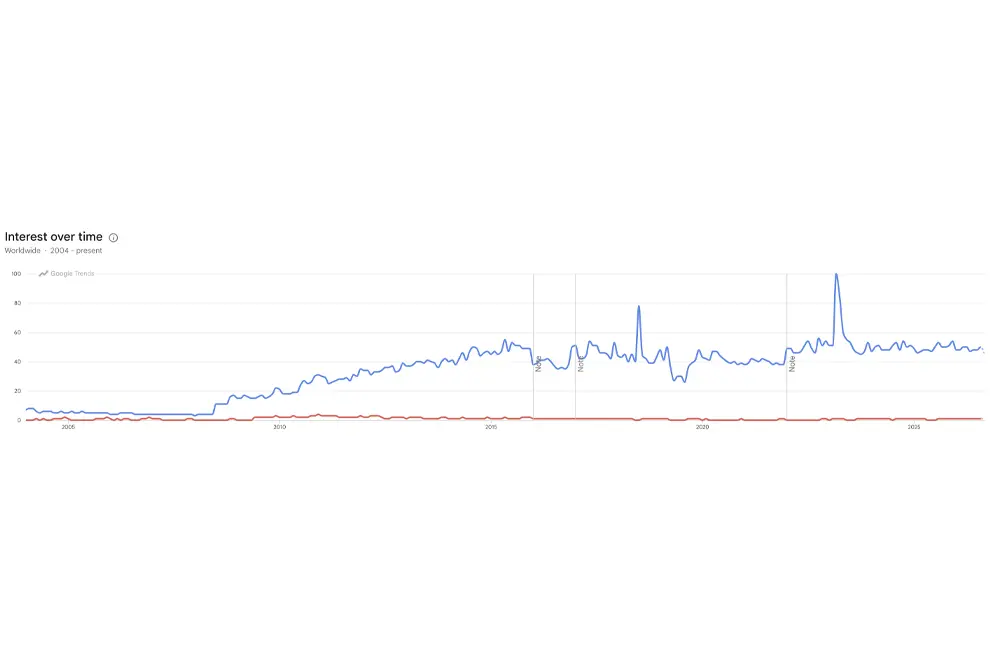
Google Trends searches for "Shazam” (blue) and “Bing Music” (red) between 2004 and 2026.
It's a similar story for the likes of Singaporean company ACRCloud, which launched around the middle of the '10s and despite working with companies such as Deezer, Musicxmatch, and Genius, had barely made a dent in the overall discussion.
Much like Bing Audio, searches for ACRCloud when compared to Shazam result in little more than a flat line, indicating it's never particularly made a massive dent.
The Rise Of Lost Media
While Shazam has enjoyed a steady rise in searches in recent years, this has also coincided with the rise in interest regarding lost media.
As the name may indicate, lost media refers to any sort of media – be it movies, songs, books, television programs – which are deemed as lost. This doesn't simply mean the likes of an album which has gone out of print, or a film not released on DVD, but the likes of songs which are unidentified or inaccessible or films which have had their only known surviving copies destroyed.
A famous example is the likes of television shows like Doctor Who, whose early episodes were wiped by the BBC in a cost-cutting measure. 60 years later, searches for the famous lost episodes are still ongoing. 93 episodes are still missing, so maybe check under the couch when you get a sec.
If we look at the rise in searches for 'lost media' in the past five years, we can see a 300% increase, with the term having peaked at 100 in May 2026.
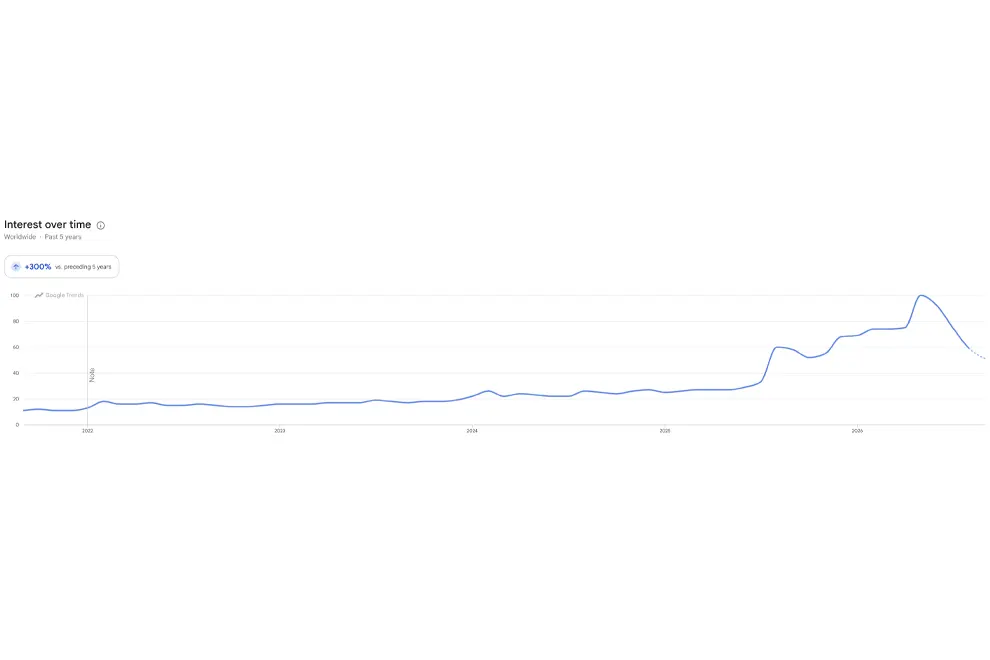
Google Trends searches for "lost media" between 2021 and 2026.
If we overlay searches for Shazam on top of that, we can see that while the service reached its peak of 100 in March 2023, it vastly overshadows the searches for 'lost media' which sit at a paltry 1.
However, while lost media has largely found itself referring to films and TV, it has a strong presence in the world of music. Famously, a search for 'The Most Mysterious Song On The Internet' was solved in 2024 when a 40-year-old song was identified as Subways Of Your Mind by West German outfit Fex.
In almost every case of a lost song, you'll see searchers admitting that they've checked out services such as Shazam to no avail, so even now, it's a massively useful tool.
There's also plenty of Australian-focused lost media searches, too. Most notably, there's an ongoing search for a song featured on a 1997 documentary about the Chatswood Youth Centre.
That search has been underway for seven years now, and the Lost Media Wiki website specifically notes that it could not be identified "via common methods like Shazam or searching up the lyrics."
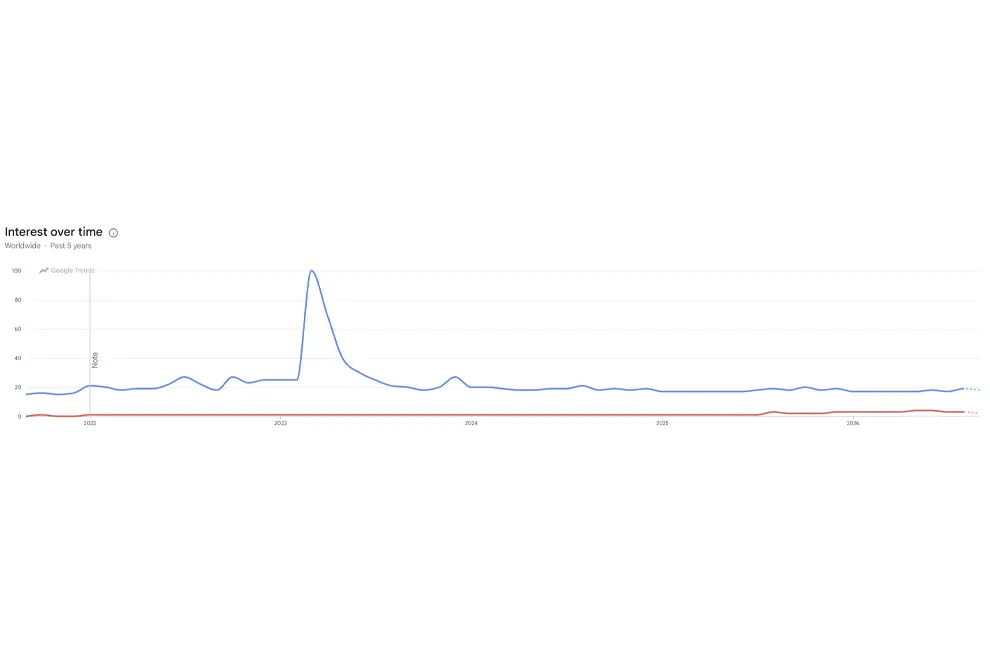
Google Trends searches for "Shazam” (blue) and “lost media” (red) between 2021 and 2026.
As a bit of a fun closer, let's compare searches for 'lost media' with the 'Mandela effect'. In the case of the latter, that's the psychological occurrence of false memories, wherein large amounts of people remember events which did not occur, such as South African anti-apartheid leader and President Nelson Mandela prematurely dying in prison.
Other examples include the Berenstain Bears being spelled 'Berenstein', Looney Tunes being spelled 'Looney Toons', and – most importantly – US comedian Sinbad appearing in a non-existent film about a genie dubbed Shazaam.
Apparently, it didn't exist, and folks appear to be confusing their memories with a real movie from 1996 starring Shaquille O'Neal called Kazaam. Frankly, that feels bizarre, because we have vivid memories of Sinbad appearing in a film called SoundHound.
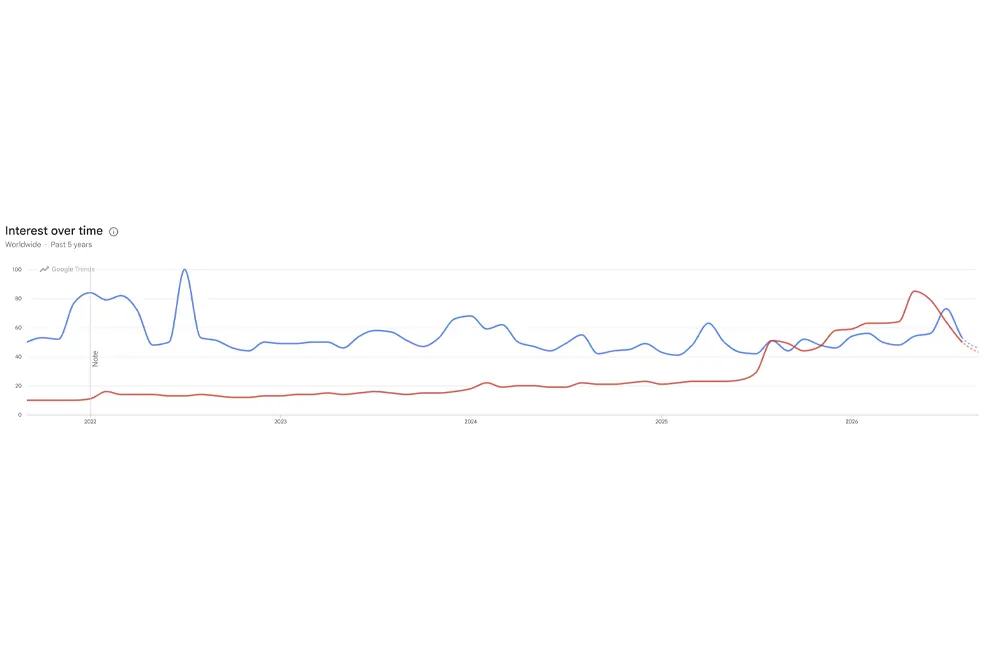
Google Trends searches for "mandela effect” (blue) and “lost media” (red) between 2021 and 2026.
That said, it appears that even when you compare searches for 'Shazaam' with 'Kazaam' over the years, 'Shazaam' wins out once again – proving that whether it's music recognition or movies that didn't exist, you know what your first choice is going to be.
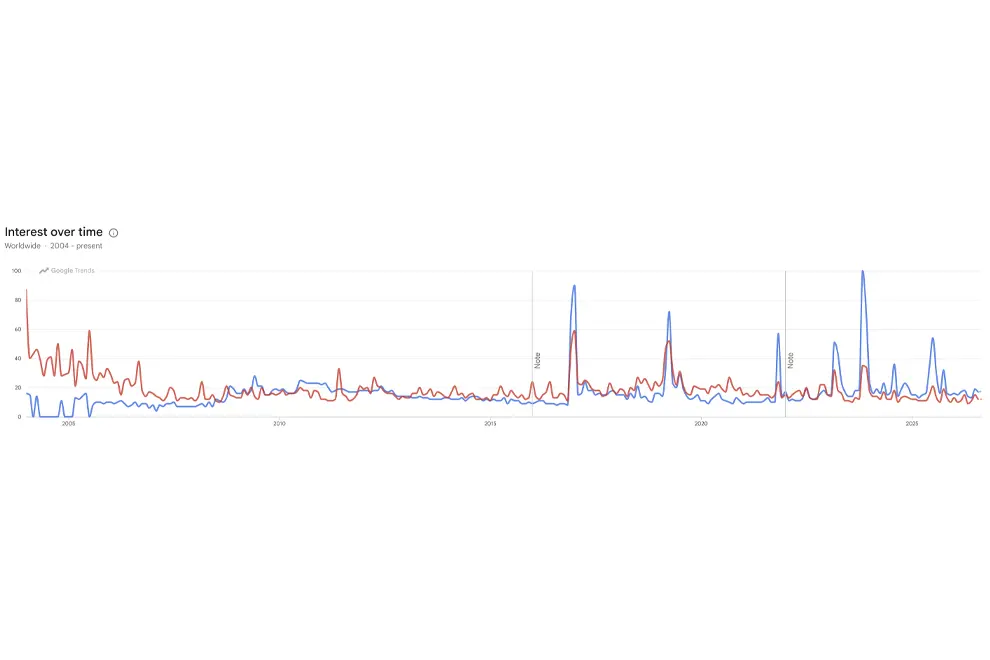
Google Trends searches for "Shazaam” (blue) and “Kazaam” (red) between 2004 and 2026.