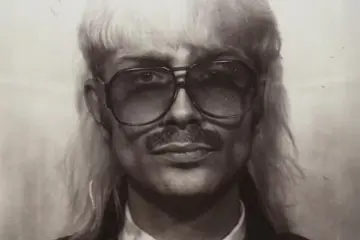
Playing violin at three, in youth orchestras at seven, Thomas Köner was being pushed towards a classical musical career. But he was drawn towards a different kind of sound.
“Playing music at such an early age really attunes your skill of listening,” says Köner. “And, as a child, I always loved the sound of the freight cargo trains in the distance, in the night, when they were passing. It’s a very grey noise, with a very soft envelope and a very long fade in; this opaque, granular, cloud-like sonic quality. And then there was the very long fade out, an end that was imperceptible. It was impossible to say when it faded wholly into the background, joined into the sounds of the cityscape. This is something that, still, years later, plays out in my compositions, these envelopes of sound where you can’t tell when something starts and when it ends.”
Köner’s approach to music-making, in turn, was always experimental. His debut album, 1990’s Nunatak Gongamur, was entirely composed from recordings of gongs, which were then electronically treated. Whilst working as a film sound designer and editor, Köner would turn out a run of ambient and experimental records.
But Köner’s most prolific output is scoring old silent films. After performing the collaborative piece, Alchemie, with film artist Jürgen Reble at the Louvre in 1994, Köner struck up a relationship with curator Philippe-Alain Michaud, and since being solicited for his first score (for Murnau’s Nosferatu), not a year has passed without a new commission, having performed alongside 28 films in 21 years. As part of this year’s Festival of German Films Köner will play a live score at screenings of Murnau’s 1926 film, Faust.
“My hope is always to make the movie relevant again for a 21st-century audience. So much time has passed [that] it can be hard to get beyond the change of viewing habits, of narrative, of visual storytelling, of technology. During the set, you have to navigate the expectation of an audience, your own desires as a composer presenting something in a concert-like setting and, then, the film itself needs to shine; everything needs to come together.”
Köner feels his scores are more personal, more revealing. “You’re much more stuck with your history, and your personal biography, than if you were just stuck in front of a blank canvas. With this silent film presentation we are doing, it’s a one hundred-year-old movie, it’s considered a masterpiece of this and that, there is so much context that you can really see the difference between it and what you are doing. What you are bringing to bear becomes so much clearer.”