“I’m in it for the long game” – these lyrics from the title track of marigolden’s debut EP double as her mission statement.
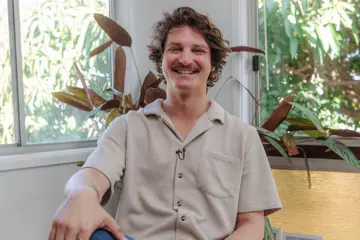
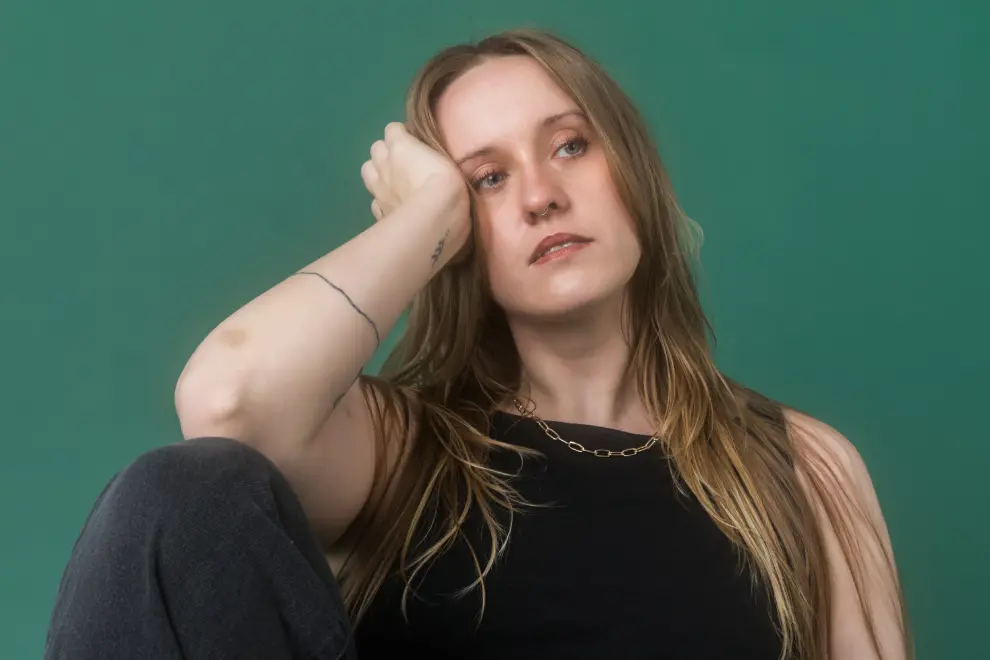
Raised in Lutruwita/Tasmania and now Naarm/Melbourne-based, Mel O’Neill (aka Marigolden) Zooms from a “little back room” at her home in the outer western region. In the background, we spot a guitar hanging on the wall behind her alongside a framed poster of rocket ships circling a red planet that reads “Marigolden – Exploration”.
For camera-on Zoom interviews, there’s an expectation to be well-presented – from the waist up, at least. “I've got a blanket on my lap!” O’Neill announces, presenting a bright purple, floral throw to the camera. “But you can't see that,” she adds, laughing, “So, you know…”
We discuss how dudes probably wouldn’t think twice about jumping on a Zoom straight from a workout or something (“Yeah, no, not at all”). Yet tinted moisturiser, mascara, brushed hair and a considered outfit seem like the bare minimum for us non-males (“Oh my gosh, so true!”).
Testing out this theory – and suspecting O’Neill wouldn’t give a shit (“One hundred per cent!”) – I just cleaned my face with a fancy wipe and brushed my teeth ahead of our chat.
“Yeah, same!” O’Neill beams. “I brushed my teeth, and I put glasses on to cover the tired eyes, hahaha.”
We’ve put in equal effort in terms of our appearance, which immediately puts us at ease. “I think it should be chill, cozy, comfortable,” O’Neill agrees, her septum ring catching the light.
“I could’ve been an amazing jazz saxophonist”
“My dad's a musician – he's a classical pipe organist – so I grew up with music all around. He would play; he would teach me keyboard and piano and stuff when I was really little.
“I don't know when I first picked up an instrument. The first instrument I got lessons in was clarinet, when I was eight or nine, but I lost interest in that. I wanted to play the saxophone, but they said that my lungs were too little. It’s so sad, because I could’ve been an amazing jazz saxophonist – who knows?
“Also, I always really wanted to sing. Singing was what I really loved. So I kind of started singing and got a guitar around the same time, and started writing songs on my guitar at home. Then at school, I was doing classical voice, so it was really different. And, at uni, I did classical voice, and then I did jazz.”
Fun fact: O’Neill’s dad plays piano on the Long Game EP.
“I always just wanted to write my own stuff”
“But I always just wanted to write my own stuff. My dad is a composer as well, really.
“I think I went through a bad breakup. I had someone tell me one time that the music you return to when you're heartbroken is the music that really speaks to you, and, for me, that was songwriter-based stuff.
“I find it really fascinating, but also just, like, comforting.
“Even though I'm a singer, first and foremost I see myself as a songwriter – that's what I really love doing and where I feel really comfortable. And I love listening to songs and hearing what the writer has done, and the way that they've achieved something. Or being like, ‘Oh, that's not what I was expecting’.
Does that mean you listen to music differently, ‘cause you’re dissecting songs to find out why they’re so awesome?
“Yeah, I think so. I think that's a bittersweet kind of thing. Because listening to music now – and I think any musician will say this – you can't necessarily completely switch off. There's always that thing of being like, “Ooh, that was interesting,’ or, ‘Oh, I don't like that because of this,’ or even being a bit judgmental. And I find that especially with certain genres of music, now. But, at the same time, it's like the more you know, the less you know.
“I also think listening to different styles of music is helpful, because even if you are really confident in one style, you can go to a different style and then not know anything [laughs].”
“My natural, folksy style comes through more on guitar”
A 2025 Music Victoria "Uncovering Talent" recipient, O’Neill has previously written songs on both piano and guitar.
“I mainly write on guitar,” she reveals, “just because I don't have a great keyboard set-up. And I'm more proficient on guitar. I think my natural, folksy style comes through more on guitar. But if I ever wanna get really quiet and intimate with a song, then it'll happen on keys, probably.”
Great Ocean Road: “I definitely wanted it to feel like a road trip”
The EP’s opener, Great Ocean Road, hoons down the titular scenic attraction, a mate who just got his licence – wide-eyed and hopped-up on Red Bulls – behind the wheel.
When told that her song Great Ocean Road feels like freedom – especially the soaring high notes (“Coo-oo-oo-oo-oo-l”), which sound like a stoked bird riding the wind – O’Neill chuckles, “Oh, that’s so nice! Yeah, I definitely wanted it to feel like a road trip. So that's the goal of the song.”
Great Ocean Road lyrics: “How to keep your cool as the months keep getting warmer/ How to be a confident underperformer/ How to play your part without breaking your heart or rip your soul apart.
“How to tell the difference between nerves and excitement/ How to feel it all without getting too heightened/ How to play the game, make yourself a name, and not go insane/ How to keep your… Cool.”
“How to be a confident underperformer”
“I think that line particularly, as well – it's almost like I was going through a period of figuring out that I don't have to give 110% all the time to be doing enough. And I think the last few years there has been a lot of unlearning productivity as worth, and realising that actually, sometimes being quiet is the best thing you can do. And listening to others. And trying to be the expert in the room doesn't always necessarily mean you are the expert in the room. One of my mottos for this year actually has been ‘lower the stakes’, because I get really caught up in minute details.
“And the narrower things become, the more overwhelmed I become. And so if I'm doing the album art or something, and I'm like, ‘I dunno where this text should go.’ I can get really, like, ‘This is ‘make or break’, when it's not.’
“I just have been saying to myself, ‘lower the stakes and then step away, zoom out.’ And that's been really helpful to just be like, ‘Yeah, this is good enough,’ kind of thing. It doesn't have to be perfect, ‘cause perfect doesn't necessarily exist.
“And so I think that thing of being a ‘confident underperformer’ kind of speaks to that a little bit, of being like, ‘I actually think I'm good enough. I don't have to, like, harm myself in terms of proving myself to you, kind of thing. Yeah.
“I think when we don't have a defined idea of what we're trying to achieve, it can be really scary to say that ‘this is finished’, or, like, ‘this is good, and this is what I want; I'm happy with it,’ ‘cause there's always an imagined ‘something better’. But I've been really trying to be happy with what I've got, lately.”
Steal Your Car: switching to acoustic changed the entire EP’s feel
“The one that's gonna be the focus track when the EP comes out, Steal Your Car, originally, my guitar was electric. And on the recording, it's now acoustic. And that's just because we were in the room and I was like, ‘Something doesn't sound right.’ And so Fi, the guitarist – she's a big advocate for rock’n’roll acoustic guitar – she's like, ‘Why don’t you play acoustic?’ And it changed the whole – ‘cause I think that the record now has a very folksy, country-leaning kind of feel.”
“And before it was gonna have more of a grungy kind of feel. And so I switched to acoustic, and now I'm just obsessed with playing acoustic guitar for every song ever. And it just gave it a really different feeling, a really kind of more relaxed, textural kind of feeling.
“But I think, again, being a woman with an acoustic guitar, there's a certain type of stereotype. So I think traditionally, I would always wanna play electric. And now I'm like – I will just take the acoustic everywhere because it's easier; it's gonna work in more environments. And I've kind of given up on that idea of having to prove myself.”
“I've had my fair share of sound engineers trying to tell me how to play my instrument”
“I've had my fair share of sound engineers coming up to me after a gig and trying to tell me how to play my instrument, for sure; I definitely have had that experience. If something's gone wrong with the sound, they've been like, ‘Oh, yeah, your guitar's probably doing this.’ And I'm like, ‘I don't think so. But yeah, cool.’
“But I think as you get older, and you keep playing, you get more confident being like, ‘Actually, that was your mistake.’ But when you're younger, it's a little bit harder to do that.
“So that's why I think I like working with women, and it's not even just women, it's people who are just kind and values-aligned. And actually respecting women, as well, is a big part of it.”
O’Neill worked with “lots of women” on her debut EP, “which is really cool”, she notes. “And helps me to be more comfortable as well, I think.
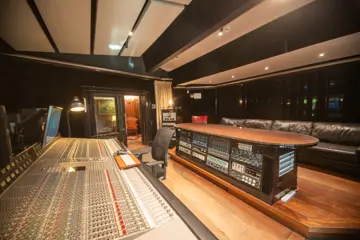
“One of the recording engineers, who’s also the mixing engineer and producer, is Natasha Newling. So she’s incredible; she's Sydney-based. And then my bass player, Loz Irwin-Ray – we went to uni together. The guitarist is Fi Steele – she's incredible; she was also classical and then kind of realised that folk is her world. And, yeah, Charlotte [Abroms, Hear Hear Group] helped me work on the EP; Tahlia [Rose-Coleman] mastered it.”
The incident that inspired Steal Your Car: “I was just a very confused teenager”
“It wasn't necessarily one incident [laughs], it was a few. No, I didn't have my [driver’s] licence or anything. I don't even know if I could be held – I don't know what the statute of limitations is on this. But, no, I was young, and I think when I talk about that song, I talk about – the song’s so lighthearted, but there was a lot of shame that I had not getting my license ‘til I was in my twenties, and some of the stuff I got up to when I was a teenager. But really, I was just a very confused teenager.
“So sometimes if my friends would wanna go out, I’d just take Mum's car and then drive it to their place, and then they would drive it for the rest of the night. And I was like – I was sure that Mum would’ve heard me leaving the house – I don't understand how she couldn't have heard me. And so I played her the song when it was first recorded, and she was just bopping along. And I was like, ‘Do you know what this song is about?’ And she was like, ‘What?’ And I told her she had absolutely no idea! So I probably could’ve gotten away with it even further.
“But there was one particular night where I drove it to my friend's house. And then we drove out to New Norfolk, which is a little town in Tassie, and there was an old asylum there that was abandoned. I think now you can actually do tours, and it's all fixed up, but we used to just go in there and hang out and paint stuff and, you know, just be kids.
“And, yeah, thinking back, I caused my parents a lot of stress, and I felt so badly about that for so long. And now I'm kind of like, ‘Oh, I think I was actually just a kid, and I was pushing the limits, and I was just figuring myself out. And everyone's okay. And everyone's safe now. And it's all good.’ And it's kind of nice letting my parents in on that stuff, in a way – now that I'm a grown-up.”
If either one of her parents were larrikins when they were growing up, they might have felt a sense of pride that she was taking after them…
“So true! Yeah, and that would be my mum, for sure.”
Long Game’s Billy Joel hat-tip
“If Vienna waits for me it must be quite the sight to see…” – Long Game nods to Billy Joel’s Vienna.
“I love Billy Joel, yeah… I think I came to Billy Joel later in life. When I was younger, it would be, like, the classic Piano Man – my dad would play that on piano and stuff, and we would all sing along. And then when I got older, I started listening to more of his stuff. And yeah, then Vienna became just like a really important song to me.”
“It's that style of songwriting. Something about the ‘70s and songwriting and rock’n’roll – I dunno, it was just very story-led, I think. And I really like story-led stuff.
Joel leans into lyrical specificity…
“Not too poetic, necessarily – in that flowery sense – but poetic in a really kind of everyday sense. And I love people that can make the mundane beautiful like that.”
Stepping off the algorithm: “it was overtaking the music”
O’Neill pays a friend to manage the marigolden socials, which ensures actually making music remains the priority.
“For a long time, my personal social media use has been pretty limited in terms of sharing stuff and using it as an actual social platform. I would doom scroll and all that stuff. But I think predominantly this choice was about using it as a musician. And I feel like I tried so many different ways to use it, as well.
“Like, if you go through my social media, it's pretty cringey [laughs]. There were periods of trying to do the little soundbites and stuff like that, and trying to make the funny stuff work. And then there's the earnest oversharing and, you know, trying to see if that felt good. I tried out a bunch of things, and I think eventually it just felt like it was overtaking the music, in terms of how much I thought about it.
“I took a trip to Japan for a few weeks, and I decided to just go off socials for a little while. Because, also, everything becomes a social media opportunity when you feel that pressure to be posting a lot. And I just wanted to experience travelling and not think about, ‘Will this be a good photo for social media?’ or whatever. And when I got back, I really didn't want to go back on; I really felt an aversion to going back on. But I also had this feeling – while I was in Japan – where I was like, ‘Why haven't I travelled for so long? I'm really enjoying travelling.’ And I realised that all of my spare time, all of my spare energy and money, was going towards music.
“And so I just had this moment of being a little bit confronted with: have I been kind of missing out on other things in my life because I've been so focused on music? So when I got back, I was like, ‘I think I really need to shift the way I'm doing this, because it's not necessarily healthy. It's a bit obsessive.’
“So I got back, and luckily I was working with people by that point, including Charlotte Abroms, who is just really values-aligned and was like, ‘Well, let’s just make that the campaign. Let’s do it that way, then. And if that’s what feels good to you, let’s just do it like that.’ And I think I've worked with so many people in the past who would’ve said, ‘That's not the way the industry works,’ but she was like, ‘Just try it’. And so that was kind of game-changing to have someone who I really respect in the industry give me that permission to explore.”
“I have so much more capacity to be the person I wanna be”
“[Outsourcing social media management] has been a really weird experience. I don't think I'll ever go back on – I'd love to never have to manage my own social media. I still make the content, but I pay a friend to post, because that's how much I value not being on social media.
“It's, like, I'm willing to pay someone else to do that part where they are on the actual platform. So even still making the content – I don't love it, but at least now I have the space to be able to shape it how I want to. And I don't have to engage with the actual platform; I don't have to read the comments – it just sucks you in so quickly.
“In a landscape where there's so much music online, and there's so much competition, I guess – in music and in independent music, especially – a lot of the time you're comparing yourself against your friends and things like that. And I think one of the greatest things about being off social media – and this is what I was hoping and working towards – is I found myself feeling really bitter when I would see my friends achieving great things. And I was like, ‘This is so not the person that I wanna be’.”
Was O’Neill thinking, ‘When's that [insert career highlight] gonna happen for me?’
“Totally, yeah. You think you're doing something wrong, and that feeling of self-pity and lack of self-worth overtakes the joy and the happiness you feel for them. And I know how hard they work, as well.
“And now, if I see a friend has achieved something, I genuinely feel the good feeling first. And I'm like, ‘Oh!’ – it just feels so much better. It feels like I have so much more capacity to be the person I wanna be. So, yeah, it's also been really challenging, but it's been the right decision for me.
“I'm where I wanna be, but it’s hard to know what you're working towards when you’re an independent musician, I think. There’s just so many different people saying different things, and you can lose focus really quickly.”
Social media: “it's for sales, not for connection”
“Since I've been off of social media – as a person, not even just as an artist – I've realised how ingrained it is in our lives. Even if I'm planning events and stuff, and doing research for that – a lot of people's social media is their website now, like, when you're looking for venues or artists or vendors or whatever, you kind of can't like just rely on Google or other search engines; sometimes you have to go onto Instagram or Facebook or whatever, and that's where people's websites and stuff are. So it's really tricky.
“And, you know, my family chat’s on Facebook Messenger. It's so ingrained in our lives. So I don't necessarily think it needs to be like, ‘Everyone needs to get off of social media,’ but if we can find a little bit more balance where there's other ways that artists can communicate with their audience.
“‘Cause I think that's the whole goal of social media, and that's why we were so excited about it in the first place was, like, connection: listeners being able to have that direct line to an artist – that had never happened before, and that's really cool. But now it's a really inauthentic connection. And I think something needs to change there.
“But there’s also not a lot of support. Like, artists are being expected to do this whole other workload of content creation without a lot of support. If you're an independent artist, you obviously don't have that support unless you kind of find someone to support you. But even if you’re with a record label, or a more high-profile artist, there’s still not a lot of support that’s offered for you to create content and manage social media and stuff. So there’s a lot of expectation on artists. But, yeah, it's for sales, not for connection. So I feel like finding some other way to be able to break out of that mold is really important.
E-newsletters: “artists finding different ways to connect with their audiences”
“I don't know what the answer is. But, for me, I love newsletters, and that's probably how I hear the most industry news now. I really love artists’ newsletters, because often they are written by the artist and it’s like a little letter. I just think that's so cute, and often they're not edited.”
Sometimes they even have spelling mistakes, which is a bit adorable.
“Totally! Or sometimes it’ll be a follow-up, like, ‘Oops, didn’t send the link!’ And it’s just so nice.
“Nick Cave has The Red Hand Files – so things like this, where artists are finding different ways to connect with their audiences; I don’t know if that’ll ever be mainstream, but I love finding the pockets of it, yeah.”
“I wanna make music for a really, really long time”
“The meaning of the EP in general is longevity and sustainability, and realising that the short spark – the quick, short fuse – yeah, it burns bright, but then what happens after it’s out? kinda thing. And so when you’re chasing that short fuse, it doesn't feel as meaningful when you get there, I guess. And I wanna make music for a really, really long time.
“So even if something were to blow up on – I mean, I don't think, for me, it would blow up on TikTok [laughs]. But I know that I do have the songs and the musicianship to back that up.
“The amount of times I've heard a song on TikTok or whatever, and then I listened to the song and I'm like, ‘Oh, that's the only good part of the song!’
“I remember listening to a song called Teenage Love by Katie Gregson-MacLeod, and I was like, ‘Oh my God, the part that's not on social media is even better than the part that is on social media!’ And that was a shock, because you're so used to hearing the best bit on socials and then the rest is not as good.
“Lots of people do write for TikTok. It's just such a backwards way of writing; it’s really strange. I guess the previous one was writing for radio and now we've got writing for TikTok, and there's always gonna be that commercial element, but a good song’s a good song.”
Sync fantasy: dogs running free in a dog park, beaches and solo travel
When asked her thoughts on an ideal marigolden sync, O’Neill exclaims, “Oh my goodness!” before sharing, “I love when I hear Australian music in Australian shows; I mean, that's always really cool. And I remember hearing a Melbourne artist in a show that had been recorded in Melbourne, and I was like, ‘Oh, that's really cool.’
“Something with dogs, I guess. I’m a big dog fan. Maybe something like a promotion for a dog park where the dogs are just running free in the background and it's just long game-playing, or something like that. But also, I often think of beaches and freeways and times where we slow down. Maybe travel could be the one for me, yeah. I love a solo holiday – like going to the country – so maybe Airbnb can…”
Slide into your DMs for your friend to vet, then forward on?
“I would love that!”
Mack the black Lab: “very, very much a part of the marigolden brand”
“I have a black Labrador called Mac. He's in the other room. He's really, really sweet. And he's not the sharpest tool, but he's very, very sweet.”
He's been in a music video of mine before [for 2023’s Mars]. He's also on a T-shirt. So yeah, he's very, very much a part of the marigolden brand. And, yeah, I actually get a lot of song ideas when I'm walking. So he's been there for the start of a lot of songs.”
Marigolden’s Long Game EP is out now.
This piece of content has been assisted by the Australian Government through Music Australia and Creative Australia, its arts funding and advisory body