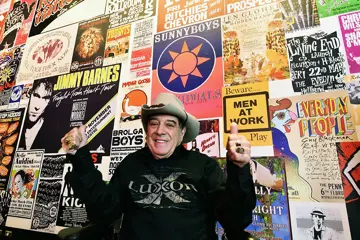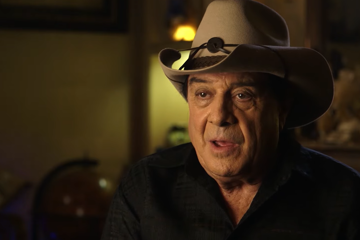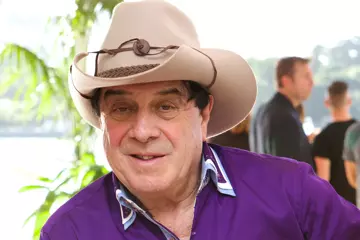
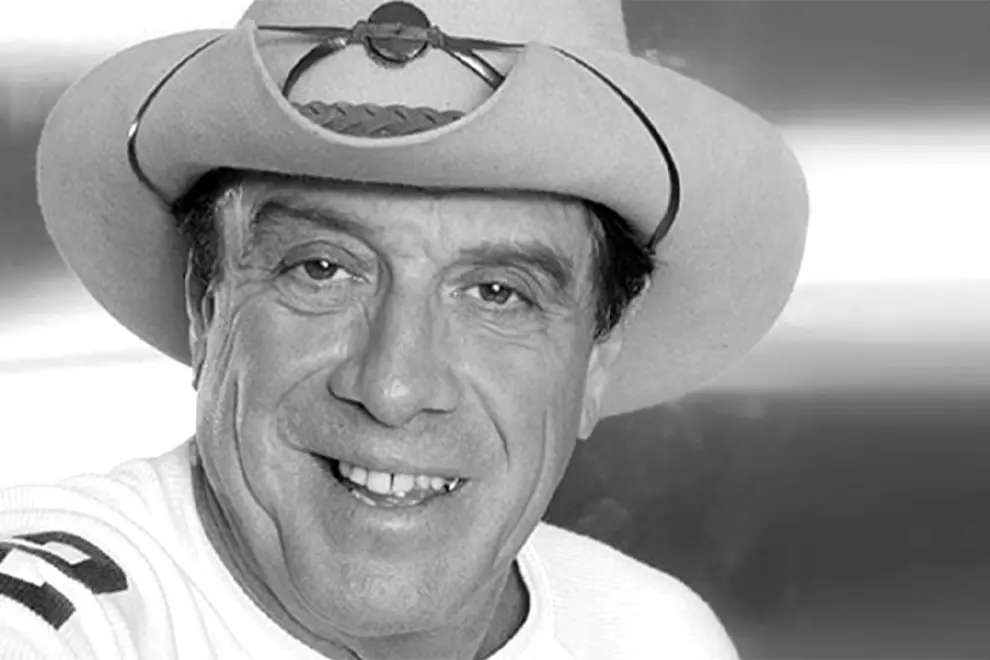
Ian “Molly” Meldrum didn’t just talk about music, he made it.
As a child, growing up in Quambatook in the Mallee, he dreamed of being a conductor. Mahler was his favourite composer.
Then he heard The Beatles and he wanted to be a record producer.
“It was like an explosion in my mind,” he said. “I’d go to sleep and hear these sounds in my head.”
Now, it should be stressed: Molly was not a technical producer. He didn’t really know one knob from another.
Melbourne music man Peter Sullivan – one-half of the Two-Man Band who had a massive hit with Up There Cazaly – tells a funny story:
“Molly was producing a band; I can’t remember who.
“‘It’s all wrong,’ he said as he listened to what was being recorded. ‘I need more space! I need more space!’
“The engineer got one of the faders and wrote ‘space’ on it.
“Molly came back from lunch, the engineer pushed the ‘space’ fader up, and Molly was happy.
“‘Yeah, that’s it, that’s it, that’s better!’”
Molly was a mentor to the late-great record producer Tony Cohen.
“I learned a lot from Molly,” Tony told me. “It was one of the best educations you could get, and I’m not just talking about recording. I found out about some things I didn’t even know were possible. I loved Molly’s unforced imagination. I think that school of producers is pretty much gone.
“He’s like a Phil Spector, where over-the-topness and the atmosphere are just so important.”
The late-great music critic Ed Nimmervoll also cited Phil Spector when he chatted to me about Molly.
“I wish Ian had produced more records,” Ed said. “He could have been the Phil Spector of Australia.
“I mention Phil Spector because if Phil Spector produced the record, it didn’t matter who the singer was, they’re Phil Spector records. With Ian, it would have been the same. It wouldn’t have mattered who recorded them, they would have been Ian Meldrum records.
“But all we really got was a litter of singles, which is a pity.”
In chronological order, here are Molly’s classic productions:
Somebody’s Image – Heat Wave (1967, In Records/W&G)
In January 1967, Molly went to the surf lifesaving club in Anglesea to see The Groop, a group he was keen to manage and produce. The support act was another Melbourne band, Somebody’s Image. Molly thought the singer had genuine star potential. His name was Russell Morris.
Russell recalls: “After seeing the reaction we got, Ian Meldrum approached us with, curiously, the same offer: ‘Can I manage you guys, produce your records, and get you a record deal?’
“We thought about it long and hard – for about a minute – and said, ‘Yes.’
“We were very naïve; who would do that? A complete stranger with no experience and no qualifications. And what are the odds he would turn out to be one of the greatest record producers this country has seen?”
The first Somebody’s Image single was a cover of a Martha And The Vandellas’ song, written by Holland-Dozier-Holland.
Somebody’s Image – Hush (1967, In Records/W&G)
“We had two [Somebody’s Image] singles, which Ian produced on very primitive equipment,” Russell Morris remembers. “And they still stand up today.”
Molly always referred to Hush as his first production, though Heat Wave was actually released before Hush, which was written by Joe South and first recorded by America’s Billy Joe Royal.
At the start of 1968, Molly was heading to England with The Groop, who had won Hoadley’s Battle of the Sounds. He called himself the band’s roadie, though Brian Cadd wryly notes, “I don’t think Ian carried anything except drinks.”
As the Castel Felice prepared to set sail from Station Pier in Port Melbourne, radio DJ Stan Rofe informed Molly that Hush had hit number two on the Melbourne charts.
“I was a successful record producer, and I was off to meet The Beatles,” Molly recalled. “As we sailed through the heads, I felt like leaping on the bow of the boat and bellowing, ‘I’m the king of the world!’”
The Masters Apprentices – Living In A Child’s Dream (1967, Astor)
“Ian took a shine to us,” Jim Keays told me. “He was very enthusiastic. He’s actually a groupie, to be quite honest.”
Molly produced the Masters’ third single, the psychedelic classic Living In A Child’s Dream, which hit the Top 10 in Melbourne and Sydney, and won Song of the Year in the Go-Set Pop Poll.
“Ian was quite different in the studio,” Jim explained. “He doesn’t know one knob from another.
“His production is something like, ‘Can you make it sound more purple?’ Somehow, miraculously, he would get what he wanted.”
Russell Morris – The Real Thing (1969, Columbia/EMI)
Molly returned from London to discover that Somebody’s Image were splitting, and Russell Morris was going solo.
He was furious.
“You ungrateful bastard!” he snapped. “We all built this band and now you’re deserting it.”
But when he calmed down, Molly started his search to find a song that would launch Russell’s solo career.
When he heard Johnny Young playing The Real Thing on an acoustic guitar in his dressing room at the Channel O music show Uptight, the search was over.
“John thought we were mad,” Russell remembers. “He said, ‘That’s not a solo artist’s song, you need something nice.’”
“John saw it as a version of Pictures of Matchstick Men by Status Quo. But Ian saw it as something completely different. And he turned it into his own, creating a psychedelic masterpiece, his from beginning to end.”
At a time when most artists would record entire albums in just a couple of days, Molly spent weeks in the studio working on the one song.
He got The Groop to provide the instrumental backing. Roger Hicks from Zoot provided the acoustic guitar intro. Brian Cadd provided a bizarre “rap”, reading the warranty on the tape box. Molly inserted some Hitler speeches and a German youth choir, and he impersonated Winston Churchill. And he finished the song with an atomic blast.
“This was the start of my descent into madness,” Molly smiled.
Amazingly, it was all recorded on an eight-track machine (testament to the genius of recording engineer John Sayers).
And when the guitarist Don Mudie was not in the studio, Molly did his best Hendrix impersonation to illustrate what the guitar would sound like.
Molly told me that would become his epitaph:
Ooh ma ma ma mow.
Russell Morris – Part Three Into Paper Walls (1969, Columbia/EMI)
Molly and Russell followed The Real Thing with another epic, Part Three Into Paper Walls, which Russell wrote with Johnny Young.
Russell Morris – The Girl That I Love (1969, Columbia/EMI)
After the mayhem and madness of The Real Thing and Part Three Into Paper Walls, The Girl That I Love was a conventional ballad, written by Johnny Young.
Molly grew frustrated in the studio, believing that Russell had not nailed the vocal. He slammed his finger into the talkback button … and missed, breaking his finger.
When Molly was out of the room, getting some treatment, Russell nailed the vocal.
Molly always hoped that Justin Bieber would cover The Girl That I Love.
Zoot – Monty And Me (1969, Columbia/EMI)
Molly wanted a whistling solo in Zoot’s Monty And Me, which was written by Hans Poulsen and The Seekers’ Bruce Woodley.
But singer Darryl Cotton couldn’t get the whistle right, so Molly got Johnny Farnham to do it. As well as the whistle, Farnham sang the harmonies with Zoot’s Beeb Birtles.
Released in June 1969, Monty reached number one in Brisbane but stalled at number 33 in Melbourne.
Wickedy Wak – Billie’s Bikie Boys (1969, Sunshine/Festival)
Though it was written by Johnny Young, this single was not a hit. And chances are you have never heard of Wickedy Wak. But the singer became a superstar.
“I will never be more excited about a recording session than I am for this very first one,” Rick Springfield recalled in his brilliant memoir Late, Late At Night.
“Everything is happening so fast. Johnny Young and Molly both want me to sing lead vocal on the song, and I’m euphoric. Paul, the bass player – and the other singer in Wickedy Wak – is not nearly as euphoric as I am about this decision. In fact, he’s so pissed off that he won’t even play on the session, so we bring in a bass-playing ringer named Beeb Birtles.”
Soon after, Rick would join Beeb in Zoot.
The Gathering – Lovely Loretta (1969, Festival)
When I mentioned this single to Molly – a cover of a song by UK duo The Merseys – he couldn’t actually remember it. But the label clearly lists him as the producer.
Molly’s connection to The Gathering was probably via the drummer, John “Hank” Wallis, who had been in The Flies, the band fronted by Molly’s housemate Ronnie Burns.
Lovely Loretta reached number 22 on the Melbourne charts and 49 on Go-Set’s national chart.
Ronnie Burns – Smiley (1970, Spin, distributed by Festival)
Johnny Young called Ronnie Burns at midnight on his 23rd birthday. “I’ve got a birthday present – I just wrote a song for you. Can I come over?”
At 1am, they called John Farrar – from Melbourne band The Strangers, who would later become Olivia Newton-John’s producer and songwriter – to see if he would do the vocal and orchestral arrangement. The following afternoon, they were recording the song with Molly.
Johnny had written Smiley after Australia’s King of Pop Normie Rowe was drafted to Vietnam.
“Smiley, you’re off to the Asian war/And we won’t see you smile no more.”
“It was exactly what I wanted to do,” Ronnie says. “I wanted to make a social statement with my music and not just sing about boy meets girl. I’d done that. I wanted to do something that had a social impact.”
Smiley soared to number two on the Australian charts, kept out of top spot by Johnny Farnham’s cover of Raindrops Keep Fallin’ On My Head.
King Harvest – Jumping Jack Flash Parts 1 & 2 (1971, RCA)
AC/DC’s manager Michael Browning called Leo De Castro “probably the most electrifying vocalist I’ve ever heard. But he was also big trouble … [though] it was hard to stay angry at a guy who could do Little Richard almost better than the guy himself.”
Leo, a Kiwi who relocated to Australia in 1969, was the singer in King Harvest, who released just two singles – covers of Wichita Lineman and Jumping Jack Flash.
Molly produced the heavy prog rock take on the Stones classic, a six-and-a-half-minute psychedelic freak-out.
Fun fact: Leo was also the singer in Friends, whose cover of Little Richard’s Lucille was Mushroom Records’ first single, alongside Madder Lake’s Goodbye Lollipop.
Colleen Hewett – Day By Day (1971, Festival)
“The song was called Day By Day, but it was really a long year,” smiles Colleen Hewett, recalling her stint in the studio with Molly.
“I remember Kevin Lewis, from Lewis-Young Productions, was coming over to hear what we’d recorded. He was expecting to hear an entire album, but all we had was one song that hadn’t even been mixed.”
Colleen also experienced some conflict with her producer, with Molly telling her to “sing it properly!”
“What do you mean?” Colleen asked.
“Just sing it!”
The singer snapped. “I’m singing it the way I’m feeling it!” Then she grabbed Molly by the throat and threw him up against the wall.
He started to cry.
“When we left, I found Ian sitting in the little sandpit outside the studio, still sobbing.”
Day By Day was a smash hit, the biggest Australian single of 1972. And somehow, Molly also managed to produce the Godspell soundtrack.
Supernaut – I Like It Both Ways (1976, Polydor)
Supernaut’s debut single was a song that summed up the swinging ’70s, a glorious glam rock anthem with a provocative lyric.
“We met Molly in Perth at one of our shows,” recalls singer Gary Twinn.
“He encouraged us to head for Melbourne, and he produced our first single.”
Molly enjoyed his return to recording. “Being in the studio was a wonderful release from the pressures of dealing with record company reps who all wanted their artists on Countdown.”
The recording engineer for the Supernaut session was a young Tony Cohen.
“Recording Supernaut was a funny time,” Tony remembered. “They were a pretty bad band, they couldn’t get in time or anything like that. In fact, on the take that was finally used, take number 90 or something, you can still hear the drums slowing down in certain sections.
“During another take, the phone rang in the studio, and Molly decided to leave it on the released version of I Like It Both Ways.”
The Ferrets – Don’t Fall In Love (1977, Mushroom)
At the start of 1976, Molly’s friends Frank Howson and Tony Cohen introduced him to a young band named The Ferrets.
“That was the beginning of the end for the Ferrets,” Tony said. “It was also the beginning of the start for them.”
Molly called his mate Michael Gudinski and convinced him to sign the band to Mushroom Records.
And the band’s lead singer Billy Miller asked Molly to produce their album. “He [Billy] knew I was a huge fan of his favourite band, The Beatles; I’d produced one of his favourite recordings, The Real Thing, and, just as importantly, I barracked for St Kilda.”
Molly instantly loved the band, also becoming their manager.
“They were just so talented. Billy was a great singer and they were excellent songwriters.
“And I thought it was a great combination of different musical influences, everything from The Beatles to the Eagles and Steely Dan. I thought we could combine all of that and do everything from really simplistic songs to rock opera-type pieces.
“I also suggested bringing Billy’s two sisters – Pam and Jane – into the band, which caused a bit of friction. Blondie was breaking at the time, and I just thought the climate was right; females were being accepted in rock ’n’ roll bands.”
Eighteen months later, Molly, The Ferrets and Billy’s three-legged dog Django were still in the studio.
“Oh my God, The Ferrets … a remarkable time,” remarked Brian de Courcy, Molly’s manager at the time when I mentioned the band.
“I remember one night in the studio, Ian [Molly] fired the orchestra string section because they were reading the paper. But they were reading the paper because they were waiting for something to do!”
Tony Cohen recalled: “When we were making The Ferrets album, Molly was screaming about ‘separation’ – ‘we need more separation!’
“I was at my wit’s end; I didn’t know what to do. So I called Roger Savage, the head engineer, and got him to come in. He winked at me and said, ‘Okay, I’ll plug it into the separator.’ Totally deadpan, he fiddled with a few leads and then we had a listen. Molly said, ‘Ah, that’s much better.’”
Tony also remembered one of the “production meetings” at Molly’s house.
“When we’d arrive, he’d usually still be in bed. He’d get up, wrap a towel around himself and pour a Scotch & Coke. As the Scotch kicked in, the meetings would get more and more outrageous.
“One day he was telling us how to produce records and he wanted to play us The Real Thing, but he couldn’t find a copy. So he took the gold one off the wall, smashed the glass and played us the gold record.”
The band initially thought that Don’t Fall In Love would be a B-side, but Molly said, “That’s the single.”
It ended up topping the Melbourne charts and going to number three nationally.
Its success led to the album, Dreams Of A Love, being “rush-released” – in a plain white sleeve with just the band’s name and the title stencilled on it because the real artwork had not been finished. Buyers were told to return the cover for the proper cover a few weeks later.
Molly was credited on the album as “Willie Everfinish”.
Stencilled in the groove on the record was the message: “Well, Williever Finish Finally Finished Hope You Liked It. Luv Molly X.”
Cheetah – Walking In The Rain (1978, EMI)/Deeper Than Love (1979)
Molly’s manager Brian de Courcy also managed Cheetah, featuring the singing sisters Lyndsay and Chrissie Hammond.
Brian asked Molly to produce a Cheetah single, a cover of The Ronettes’ Walking In The Rain.
“I don’t think there was a time when all four of us were in the studio together because there was always a fight going on,” Brian recalled.
After one dispute, Molly pulled up in his green Celica outside Lyndsay’s place on Toorak Road in South Yarra. “He jumped out and started yelling at me – stopping the traffic and the trams. Then he said, ‘All right, I’m sorry – take these flowers!’”
Walking In The Rain was a hit in late 1978. The follow-up was Deeper Than Love.
“That recording session was an absolute nightmare,” Brian explained.
“We used up all the board at AAV in Melbourne. Ian had this idea that we could run a coaxial cable from Melbourne to the 301 studios in Sydney. We would have had something like 72 tracks. We went to Sydney, but the studios didn’t match.”
Deeper Than Love cost nearly $50,000 to produce. Brian was worried that the label would refuse to pay the bill, so he went to see EMI’s boss Stephen Shrimpton.
“Don’t worry,” Stephen said, “it’s a record company. Money is paper to be pushed around a desk. It can be absorbed very quickly. It’s not a problem.”
Stephen’s older brother, Michael Shrimpton – Molly’s boss at Countdown – was not so happy when Molly returned to the ABC studios.
“At the start of 1979, I had to fly back to Melbourne to host one of the summer shows with Shirley Strachan. Driving to the ABC from the airport, I had a car accident at the Flemington Road roundabout.”
With smoke billowing from his Celica, Molly finally arrived at the ABC, where he was summoned to Michael’s office.
“Your pay’s docked,” Michael informed him. “And Shirl’s hosting the show, you can go home.”
Explaining the situation, Michael said: “It was much more than Meldrum being late. He was absent without leave for a week and he was working for someone else, in this case my brother.
“I got on the phone to Stephen and said, ‘I hear a rumour you are employing Meldrum. Has it occurred to you that he’s my talent?’
“Stephen replied, ‘You are fucking welcome to him!’”
Deeper Than Love stalled at number 89 in Australia, but was a big hit in Germany, selling 100,000 copies.
Ross O’Donovan – I Want To Live In A House (1982, Mushroom)
Molly was involved with the soundtrack for Gillian Armstrong’s 1982 movie musical, which was written by his old Go-Set colleague Stephen MacLean.
Molly produced the song I Want To Live In A House, which was written by Billy Miller and sung by actor Ross O’Donovan, who played Angus in the movie.
Spaniards – God Is A Shield (1984, I.C. Records)
Molly reunited with Billy Miller when he produced the debut single for the Spaniards, a supergroup that also featured Stars singer Mick Pealing and Rusty Brown (who later fronted Electric Mary).
Molly produced the band’s debut single and biggest hit, 1984’s God Is A Shield.
Kids In The Kitchen – Something That You Said (1985, Mushroom)
Molly produced the third Kids In The Kitchen single, Something That You Said, which was a Top 20 hit.
The band’s bass player Craig Harnath, who went on to become a noted producer himself, remembers: “We were at the Sebel in Sydney and Molly kept playing me the Sheila E song The Belle Of St Mark.
“It had been written and produced by Prince, and Molly absolutely loved Prince. They’d put a bell line behind her vocal all the way through the song, and Molly was now insisting we had to have it on our record, which was just so inappropriate. It just couldn’t fit. The melody for Something That You Said was really slow and this would have sounded stupid.
“But there was no telling Molly.
“We got into a taxi to go to the studio and he raved about it for 20 minutes. And then . . . it was never mentioned again.”
Craig reflects, “Now I realise he was trying to tell us that our song needed to be more ‘up’. What he’s talking about is inevitably different to what he’s actually saying. You’ve got to try to work out what he feels and not listen to the example he gives.
“It can be a hell ride.”
The Incredible Penguins – Happy Xmas (War Is Over) (1985, Mushroom)
In 1985, Molly was back in the studio with Jim Keays, his old buddy from The Masters Apprentices.
Jim asked if Molly would produce a version of John Lennon’s Happy Xmas (War Is Over) for a band called The Incredible Penguins, who wanted to raise money to protect Australia’s fairy penguins.
“This recording is a book in itself,” Jim told me. “At first, he wasn’t going to do it. But when I told him we were going to do a John Lennon song, he went, ‘Great, we’ll do it.’
“The recording became a monster.”
The single ended up featuring 18 voices – including John Farnham, Bob Geldof, Colin Hay, Brian Mannix, Brian Canham, Colleen Hewett, Angry Anderson, Scott Carne and Jim Keays – plus The Peninsula Boys Choir and The Hare Krishna Chorus. And it incorporated the voices of world leaders, including Reagan, Thatcher, and Gorbachev.
“There was so much on it that it didn’t fit on 24 tracks,” Jim recalled. “We had to get two 24-track machines and run them in tandem. Not many studios could do it.
“One night, Molly wanted to do some phasing or something, like he’d done with The Real Thing. And the engineer said, ‘We can’t do that.’
“As soon as he said this, Molly went absolutely berserk. ‘Whadooya mean, you can’t do it? DJs at the fucking Chevron can do it!’”
Molly informed Jim that they were shifting to another studio.
“He ran to the machine and started to pull the two-inch tape off the machine – while the tape’s going around and around.
“The engineer was freaking out because it’s very expensive equipment. Molly finally got the tapes and threw them at me and said, ‘We’re outta here.’
“The only problem was there was no other studio in Melbourne that could do it. We had to go to Sydney. We filled the two 24-track machines and Molly wanted to go onto a third one. The problem was this was a Christmas record – we were running out of time!”
Mushroom Records ended up releasing the single two weeks before Christmas in 1985.
“It was big for a week, but then, of course, it was all over.”
Kate Alexa – Teardrops (2008, Liberation)
This was family for Molly.
Kate Gudinski, Molly’s goddaughter, had a stage name for her recording career: Kate Alexa.
Kate and Molly updated the Womack & Womack classic from 1988, the year Kate was born, adding a rap from American artist Baby Bash.
Teardrops hit number 26 to become Kate’s fifth and final Top 40 hit.
Green Edge Anthem – I Won’t Back Down (2012)
Molly was working on this song the day he fell from a ladder and landed in a coma in December 2011.
His dear friend Gerry Ryan asked him to produce this single – a cover of the Tom Petty classic – to create a theme song for his GreenEDGE cycling team.
The Real Thing segues into I Won’t Back Down, with Russell Morris and Vanessa Amorosi on vocals, and Brent DeBoer from The Dandy Warhols on guitar.
And on slide guitar? Yep, that’s Courtney Barnett.
Ben Hazlewood – Loveless (2014, Independent)
“Loveless was painless,” Molly said of producing the debut single for Ben Hazlewood, who emerged via The Voice in 2012. “Working with [co-producer] Ricki Rae was a joy, and Ben is such a fine singer and this is such a great song, we didn’t want to over-produce it.
“The song speaks for itself.”
Having said that, the song was a trademark Molly production, with a six-piece string section, and the National Boys Choir of Australia. Molly always loved a choir.
Sarah Rzek – This Town (2016, Liberation)
Molly’s place was like an episode of Murphy Brown – there was always a tradie there doing some work.
In 2016, one of the tradesmen asked if he could play the music guru some songs that his girlfriend had written.
Molly loved the songs and insisted on producing one of them.
He kept things simple for what was his final production, this folk pop gem by Melbourne artist Sarah Rzek.
This piece of content has been assisted by the Australian Government through Music Australia and Creative Australia, its arts funding and advisory body