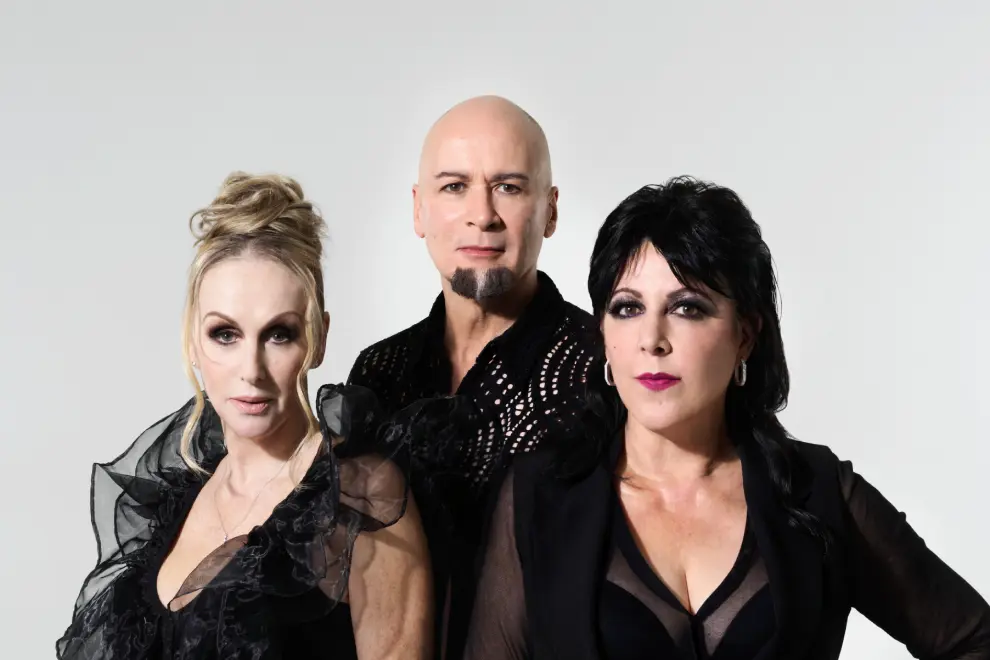
In 1980, a young Susan Ann Sulley was dancing like nobody was watching at Sheffield’s Crazy Daisy club. Except somebody did notice Sulley and her friend Joanne Catherall. That somebody was Phil Oakey, founding member of, at the time, underground electronic outfit The Human League. And thanks to Sulley and Catherall’s attention-grabbing dance moves, pop music was soon to experience a major shift.
In 1980, The Human League were a po-faced four-piece with two albums of anti-commercial electronica that included extremely radio-unfriendly-titled singles such as Circus Of Death, Empire State Human and Being Boiled (an unexpected top ten hit in parts of Europe). They took their art so seriously that one member was credited as “film technician”.
But tensions led to the band splitting in two (one-half becoming electro funksters Heaven 17), leaving Oakey and bandmate Philip Adrian Wright looking to take The Human League in a new success-friendly direction. Enter Sulley and Catherall, who Oakey had invited to join the band after that night out at Crazy Daisy.
The first single with the new line-up, Boys And Girls, featured the two new members on the cover but not on the actual recording. The song remains a stunning piece of brutalist electro, but at the time it scraped into the bottom of the top 50 before quickly disappearing.
However, ahead of the band’s first album with the new line-up (Wright, now not only on design duties but also credited as one of four synth players), they released the first of a string of singles featuring Sulley and Catherall’s voices alongside Oakey’s lead vocal.
The contrast between Oakey’s deadpan delivery and Sulley and Catherall’s perky contributions gave The Human League their signature sound. It also gave them immediate success. The Sound Of The Crowd was a UK hit while Love Action (I Believe In Love) and Open Your Heart landed them two UK Top 10 hits in a row and broke them into the Australian Top 40.
Then, in late 1981, along came the band’s Dare album. Its bleeping synths and pounding basslines sounded as if sent from the future. Lifting a fourth single from the album, the band released the soaring Oakey/Sulley love duet Don’t You Want Me. It wasn’t the first new wave synth track to top the British charts (Gary Numan and Soft Cell got there ahead of them), but it had a longer stay at number one than any of their electro predecessors.
The song went global, topping charts around the world; the band even scored a US number one. Buoyed by the commercial crossover of the burgeoning post-new wave, New Romantic scene gripping London, The Human League spearheaded (alongside Duran Duran) what became known as the Second British Invasion era of pop music.
Dare dominated charts worldwide and is now considered one of the most influential electronic albums of all time. By 1982, it seemed to be in everyone’s record collections.
Sulley, still performing with Oakey and Catherall four decades later, remembers her reaction to the success at the time, “We all thought that it was gonna be a temporary thing.”
But far from being temporary, Sulley is still performing the songs of Dare for audiences around the globe, and Don’t You Want Me continues to be remixed and covered - most recently reworked into a club hit by Purple Disco Machine and just covered by Cat Power and Meshell Ndegeocello on the latter’s new Synonym album. The original Don’t You Want Me has racked up over a billion plays across Spotify and YouTube.
Sulley is on a break from touring when she jumps on the phone to discuss the band’s upcoming Australian tour. Having just come off a US tour with ‘80s contemporaries Marc Almond (Soft Cell) and Alison Moyet (Yazoo), Sulley is resting up before taking on a handful of festival appearances in the UK and Belgium.
She can’t believe The Human League is still enjoying this much interest, “Even when Dare came out, even when Don't You Want Me came out, I think we all thought it wouldn't last for very long and it would just be one of those, like sometimes how pop music is, that it would just be sort of fleeting. It strangely hasn't been like that; we've been incredibly lucky.”
Indeed, since Dare, The Human League have released six more albums, the most recent being the Credo album, produced by I Monster for the Wall Of Sound label. There was also a string of hit singles after Don’t You Want Me, including Mirror Man, (Keep Feeling) Fascination, The Lebanon, Louise, Human and Tell Me When.
“Suspect” Dance Moves
In the ‘80s, it wasn’t just the band’s sound that was influential, but also the band’s style. Fans not only copied Oakey’s iconic asymmetrical haircut (which itself had been influenced by 1940s Hollywood star Veronica Lake), but they also tried to dance and dress like Sulley and Catherall. Their look was vintage-inspired, and their moves were a sharp and stilted interpretation of these new precise, machine-driven rhythms.
Sulley laughs off any suggestion of ever being a style icon, “I don't think we were at all, not at all. I think we just dressed how we would dress when we went out in Sheffield. We danced like we would in any nightclub.
“And I think that's one of the reasons why a lot of the people had a little bit of affection for Joanne and I because we weren't supermodels or super fantastic-looking and we didn't have the most amazing designer clothes on or anything. Everything we bought… the clothes we wore came from Oxfam and secondhand thrift shops and things. And our dance moves were, well, I think they would still be classed as suspect now, but we’re still getting away with it after all these years.”
And the band never really went out of fashion. In the ‘90s they were embraced by the club scene, not surprising given that The Human League were not only pioneers of electronic music but also of remix culture, having allowed legendary new wave producer Martin Rushent to dubify their hits into the Love And Dancing album in 1982 and releasing it under the name The League Unlimited Orchestra - a set now considered a classic.
While many of their ‘80s contemporaries were overlooked during the ‘90s, The Human League were lucky enough to hit with the single Tell Me When. It not only got them back on UK radio (and into both the US and British charts) but also back into the clubs with remixes by big-name dance artists Red Jerry and Utah Saints.
In the ‘00s, the electroclash scene exploded into clubland and The Human League weren’t just embraced; they were deified - their influences could be heard everywhere from pop acts like Fischerspooner through to the more alternative songs from Ladytron and Miss Kittin. In 2003 Richard X mashed together The Human League’s Being Boiled with Chaka Khan’s Ain’t Nobody, as Being Nobody, and the band were back in the charts around the world (even making the Australian Top 40).
Sulley says that she never really saw the band in the context of out-surviving other ‘80s acts, “I just think that we thought we were incredibly lucky to still be able to make music and that people were still buying it.
“We never thought about the other people that were around when we were making music. I don't think we ever think like that. I don't think that's ever been a part of our thought process. When we're making music it's just… it is what it is, and we're lucky that we've got a record company that is supporting us. And that we can make music that we want to.”
When pressed on the influence the band then had on music this century, Sulley is politely dismissive: “When other people say that we've influenced them, I never think about stuff like that.”
Given that synth-based music was often dismissed as a gimmick by mainstream music critics of the ‘80s (this followed hotly on the heels of the intense ’70s ‘death to disco’ movement), surely Sulley feels vindicated now that electronic music dominates popular culture?
Once again, Sulley responds modestly to any such suggestion, “I don't think of it like that. I think that there's always progression or there are cycles of music. And there’s always bits of progression, and also we have lived through a very big, massive technological age.
“Instrumentation was different when we started, and then obviously, as it's going on, we've got so much more. Now people can make the most sensational records in their bedroom, and they don't need to go to a recording studio anymore or anything like that. I think the landscape of music just changed, and we were there along the way when it changed. Synth music is a very different place now.”
Sulley experienced some of those changes when recording 2011’s Credo. Produced by I Monster, the band found themselves collaborating with a younger duo from the same hometown (Sheffield) who had grown up being influenced by the likes of The Human League (they also cite Blancmange and Fad Gadget). “It was a very different way of working,” recalls Sulley.
“We didn't sit in the studio all the time. That's not what happened. They did loads of work at home on their computers and then would send it down the line sort of thing, and we didn't see them that much. It was a very different way because that's how music works now, and so that's what we did. It was just very different but sort of still enjoyable.”
The Record Store Theory
One of the biggest changes Sulley has witnessed firsthand during her music career is the shift from physical sales to streaming. She credits streaming as aiding the longevity of The Human League’s appeal and reaching a new generation of listeners.
“I think one of the great things that's happened in music,” muses Sulley, “and I know that a lot of people think it's a bad thing from a financial point of view, but streaming has brought so many other young people to listen to our music. I think it's why, when we were in America, we were so surprised by how many young people were in the audience.
“I think what places like Spotify and Apple Music and all those streaming platforms do is, you as a punter, you say ‘Oh, I want to listen to Adele,’ but then along the way the actual AI [algorithm] behind Spotify starts picking up another artist Adele was influenced by, etc. So before you know it, you're listening to people like Geno Washington and things like that.
“And so people that like electronic sort of music, along the way they're gonna get a Human League record thrown in there and then they might think, ‘God, I really like this.’ ‘Alexa!’ - or whoever it is - ‘Play a Human League album.’ And they get to listen to it. And so I think, from our point of view, the streaming thing has been positive, maybe not so financially… from that point of view. It's made people listen to our music that ordinarily wouldn't have, and so I think that's a good thing.”
Sulley laughs when she reports that she’s witnessed people online mistaking them as a new act, “All these people saying, ‘Ooh, you know this group? You've never heard of this group? Ooh, listen to this music.’ Actually, it's 45 years old. It's really, really old, but they're listening to it for the first time with fresh ears, and that's wonderful and the fact that they're coming to concerts to actually listen and see the music performed, that's amazing.”
Australia remains a big territory for the band too. The country ranks high amongst The Human League’s Spotify streaming data, alongside Latin American markets and London. They first toured here in 1982 and were most recently here in 2024. Next year’s Generations: The Greatest Hits Tour will be their sixth visit here.
Sulley admits she’s not really sure why the band have built up such a special relationship with Australian audiences, “Do you know what? I have no idea. I think about the people that come to see us and how pleased I am that they've made the effort and spent the money in supporting us after all these years, but I never know what the relationship is like.
“I think that there's something about having a song or a group in your heart at a certain time when you're growing up. I think it's important [that] back in the day… music was something. That really we didn't have everything that people have now, there’s so much to keep one’s brain occupied now you don't need to even do anything.
“You can sit on your sofa all day and just look at your phone and do nothing, you know, watch TikTok. You now listen to streaming music, watch a video, whatever. There's so many things you can do. Whereas when we were younger, when we first came out in music, there was really only music and film and TV - maybe even the TV in those days wasn't that great like it is now - and I think that keeps a special spot in people's hearts. And also I think that actually physically having to go to a record store to buy a record that's how you got music and I think that stays with people.”
The Human League are returning to Australia and New Zealand in January and February 2027. Tickets are now available.