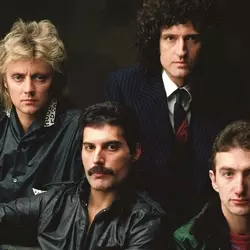
 Queen Profile
Forty years ago this November, Queen’s 1970s creative glut culminated with the release of Jazz, their seventh LP in five years. If the band showed no signs of weariness, their critics certainly did. This, after all, was the album that prompted Rolling Stone’s Dave Marsh to hazard that Queen “may be the first truly fascist rock band”. Mitchell Cohen at Creem was even more excoriating: Jazz was “absurdly dull... filled with dumb ideas and imitative posturing”.
Perspective is everything. In 2016 Rolling Stone sort-of disowned Marsh’s comments, while three of the album’s singles — Fat Bottomed Girls, Bicycle Race and Don’t Stop Me Now — remain among the most enduring and beloved of Queen’s hits. Don’t Stop Me Now, which Cohen in 1978 called “flaccid cock-rock”, is an undisputed anthem, from being deployed to comedic perfection in 2004’s Shaun Of The Dead, to conquering Top Gear’s 2005 list of the best driving songs.
From their prog/metal roots, Queen in the ‘70s had been trending towards a more radio-friendly sound. On Jazz they are on the cusp, looking back to their heavier origins and ahead to the straightforwardly pop-rock band they would become. But there is a jokey self-awareness that distinguishes Jazz from other Queen records. From the title down, Jazz is marked by a sense of both levity and irony that results in 13 of Queen’s most exuberant and enjoyable songs.
In part, it’s this self-awareness that gives Jazz its staying power. Take Fat Bottomed Girls. The track, and the naked-women-on-bikes stunt used to promote it and Bicycle Race, rightly outraged women’s lib groups at the time. Yet modern audiences seem to take the song as the sassy, infectious singalong it is intended to be. Its joyful appropriation by Lena Dunham during her 2015 lip-sync battle with Jimmy Fallon was a natural progression.
One bugbear for critics in 1978 was a purported cultural elitism in Queen’s music. But elements deemed as pretentious or condescending then are, in hindsight, not only palatable but endearing. The informed modern listener can appreciate that the Middle Eastern-flavoured opener Mustapha — derided by Cohen as an “earsore” and by Marsh as “a parody of a muezzin’s shriek” — is a nod to Freddie Mercury’s Farsi heritage, besides being a deliriously good tune.
The piano- and guitar-driven Let Me Entertain You is arguably the definitive track here. With lines like, “I can show you some good merchandise… To thrill you I’ll use any device,” and, “We’ll breakfast at Tiffany’s/We’ll sing to you in Japanese,” it is Mercury’s gleeful piss-take on the manipulation and commodification of popular music. To be fair, the joke might have been funnier to Marsh and his ilk had Queen not been so obscenely wealthy by the time Jazz landed.
Let Me Entertain You may also be among the songs Muse frontman Matt Bellamy had in mind when, in a 2005 interview with Keyboard, he referred to “the clash between guitar and piano” in Queen’s songwriting. Seven years later Muse would release The 2nd Law, which bears comparison to Jazz in terms of its savvy but accessible interrogations of diverse genres. In 2005 Bellamy admitted: “In my heart, I want to do more hard-rock music, but... I’m much more attracted to the piano.”
Jazz is proof you can have it both ways, and more. Let Me Entertain You lands between John Deacon’s If You Can’t Beat Them and Brian May’s (literally) thunderous Dead On Time. These are among Queen’s heaviest songs, with some of May’s most bravura guitar work. Yet they sit happily alongside the woozy, bluesy Dreamer's Ball, Roger Taylor’s disco-flecked Fun It, and Mercury’s Jealousy, which bombed as a single but remains hands-down one of Queen’s best ballads.
In 1975 Bohemian Rhapsody was a de facto curtain call to Queen’s masterpiece A Night At The Opera. More Of That Jazz, a Taylor hard rocker, mimics this effect at the end of Jazz with a glitchy callback to several earlier tracks. This encapsulates Jazz perfectly: it is Queen parodying Queen-as-product. It doesn’t reach the levels of ingenuity on Opera (they’d rarely be so inventive again) but in terms of vision and cogency, it comes close. Most importantly, it is a joy to listen to.