
One of the most infamous incidents of the UK punk era is the 1977 fight between Paul Weller and Sid Vicious in London’s The Speakeasy (Weller felt that Sex Pistols’ Holiday In The Sun ripped off his band The Jam’s In The City). The details are fuzzy: some recall a headbutt, others say punches or slaps were swung but few mention what band was playing at the venue that night.
“In the history of punk, people write about that [fight], but what they don't know is that it was a Fischer-Z gig. It's a great punk story,” exclaims John Watts, founding member of the band playing the night of the Weller/Vicious scuffle.
Now five decades deep into a music career, Watts and Fischer-Z first came to Australian audiences attention in 1980 when their sublime slow burn, new wave classic So Long became a massive radio and music TV hit - the song breaking out here bigger than it did in the their UK homeland.
What followed was a string of albums more popular in Australia than in Britain (1980’s Going Deaf For A Living, 1981’s Red Skies Over Paradise, 1987’s Reveal and 1989’s Fish’s Head), plus another hit here in 1987 with The Perfect Day.
Despite that early success, 2026 will be the first time that Fischer-Z make it to Australia. What took so long? “I think it’s a very simple answer in some ways; it’s a long, long, long way away,” laughs Watts. “I mean we thought, ‘We maybe come out and play a couple of little clubs, see what’s going on.’ But, [now] there’s interest in not just the [50th] anniversary but also the new stuff. I think the answer is - a different level of interest from your end, that’s what’s made it possible.”
With So Long reaching ‘golden oldie’ status in Australia, it is the band’s most streamed song on Spotify and various fan-cuts, vintage TV performances and live footage of the song have clocked up over a million views on YouTube.
Although the song was also a hit in parts of Europe, Watts is aware of our attachment to the song. “If we play in London,” explains Watts, “there’s always a large Australian contingent and they recognise that song and other songs, like The Perfect Day for instance. So I realise there's an interest.”
In the era before streaming homogenised the global charts, artists often found themselves with songs gaining more recognition in one territory than another. For Fischer-Z, that meant in some countries they are best known for the reggae-influenced pop punk cut The Worker (1979), elsewhere it’s the punchy Marliese (1981).
And, in the past decade another of their ‘80s tracks, Berlin, found renewed interest after being featured in Deutschland, the hit German TV spy franchise. Watts says that in the Netherlands both So Long and Marliese are considered evergreens, “Every year they vote their top a thousand songs, and they play them all at Christmas and New Year, and there's always [our] two [songs].”
BEING AROUND FOR SO LONG
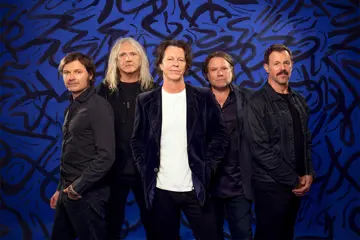
Watts’ put together the first line-up of Fischer-Z in 1976 with the band having gone through multiple line-up changes since. The latest edition of the band will commemorate Fischer-Z’s 50th anniversary with a tour travelling through Europe from August and landing in Australia for dates in November and December.
Watts has a theory as to what has given his Fischer-Z project such longevity, “As long as you're interested in the way the world is and the way you feel, your view of the world will change as you grow. And so therefore, you know, as long as you're interested in people and you're interested in events, you've always got something to write about. So the thing about art is you want to be individual, which is great. You put forward something you believe fully, with all of your heart… So it's a unique thing.
“If you're very lucky, other people appreciate it. And it gains a sort of universality. But for me, the thing is being part of something bigger than just one particular musical genre or being, you know, not high art, but being part of the art world. Also, the ability to change. I mean, I've had 160 people in my band since I started.”
At 71, Watts has not only been lucky enough to keep Fischer-Z productive (last year’s Punkt set was the fourteenth studio foray under that moniker) but has also explored other artistic endeavours. Not only has he released albums under various other names, including The Cry and JM Watts, he’s also kept busy podcasting, writing poetry and short stories and has even written and performed a multi-media one-man play, The Last Picasso.
“I always regarded us as art punks, not punks, but art punks,” explains Watts about Fischer-Z’s genre-melding, “Like the Talking Heads and Gang of Four and things like that.”
He looks at Fischer-Z as outsiders, “We were on the edge of the punk thing… we got very, very successful in continental Europe. And the punk scene was centred primarily in London… and New York, and then obviously spread. But everything mutated very quickly. You know, it went into punk then new wave, we were called a new wave band.
“But as I say, [I preferred] the term art punk… My heroes were the beat poets and people who make really original stuff, you know, the original people, the Velvet Undergrounds, Andy Warhol. So I saw a big connection. I saw a massive connection between Warhol and punk.
“The punk era was something we were part of, on the fringes of, because we started 50 years ago. So we were doing shows, obviously, at the same time as the first The Clash and Pistols shows. But for me, I've been mucking about with instruments - I play drums, I did God knows what. But the idea, when punk arrived, I just loved the energy of it. And so the influence for us was, we have the energy of a punk band, but we also had quite a lot more melody, which enabled us to transmit our stuff everywhere. It wasn't so anglocentric.”
In fact, Watts believes that punk scenesters at the time looked down on his band, “When we started, for instance, performing, you had to be energetic and cool. You didn't speak. And essentially… I'm an entertainer and I talk and I do humour and you couldn't do that in the beginning. If you're doing that in 1977, they just think you're a total tosser.”
Watts feels that his style of performance is now welcomed by music fans. “I just love change,” he says. “It's played right into my hands because now the performer part of it is incredibly important. Essentially, you're making bespoke art…paintings and also music and films.
“You're not selling lots of it. You are doing limited numbers nicely. And that promotes your live performance. And the thing about live performance that I adore - everything, everything's always different. If you have the same people in the same room, and I did the same set which, of course, I never do. If I did that the next day, the whole experience is a totally, totally different thing.
“And I like chaos, and I like things that go wrong. When the punk era was there, it was pretty chaotic and I enjoyed that and you worked off it. Then you went through, like as you got into the ‘80s and everything, and you got very smooth and [into the] ‘90s and people would spend three weeks to get the bass sounds… in the studio in the ‘90s. And now, it's got back to the purest thing of people being able to go out and transmit their music to people.”
‘MY CONTEMPORARIES ARE RICHER THAN ME’
Watts appreciates Fischer-Z being one of very few bands to have experienced continued success across the decades from the ‘70s punk and new wave scenes, “I mean the people I started with, the contemporaries, a few of us [are] still going. Well, I mean, Robert [Smith] with The Cure and Jim [Kerr] I saw about four years ago with Simple Minds.” But he adds with a chuckle, “Most of my contemporaries, most of them are richer than me.”
Having seen many changes in the music industry since the ‘70s, Watts cites the loss of support for artists as the most unsettling shift he’s witnessed. “The biggest difference in the business is… there was investment,” laments Watts. “Although people were ripped off - artists, quite often in the early stages - there were record companies, there were publishers, there were management that would invest in art and music and young people and allow them to develop.
“My big regret about music business doesn't affect me because I've had my nose over the parapet enough to be taken some notice of. I believe there's more talent in the young generation in music than ever. But, unless they're really adroit with social media, they're fucked. Because there's no one supporting young people music. And that's the biggest change. It was supported, although it was a bit exploitative, it was a supported industry. And the vast [majority of] people had the value of music, I'm not talking about money. The value of music and the role of music in people's lives was different. I mean, the end of the era of music when we started… music was the leading youth culture. And now, it's just one other thing that people can get on their phone.”
Watts isn’t just mouthing platitudes about young artists, he actively pursues new music on a regular basis - flying in the face of reports that “most people” stop seeking out new music in their early thirties (according to Spotify data released in 2015). “Every month I listen to all the new indie singles that come out because I don't need to listen to music that’s part of my heritage and my era. We've already been through that. There's so much out there.
“If you do a Spotify search, the indie singles that came out this month - the top 100, I mean some of it's shite but at least ten of them are marvellous. And then you go to their account and there's a track that's had two million listeners. And then you try and find out who they are and they're a tiny little band somewhere. It's amazing.”
(NEW) STRINGS ATTACHED
With a new album, X-Ray Serenade, set to drop in September, Fischer-Z have also recently released a new single Strings. The single is a pared back recording, Watts delivering his trademark haunting tenor vocal - which now also shifts into gruffer tones, to an acoustic strum as he imparts a simple plea for honesty. The song can be interpreted as personal or political. Watts’ songs have often revealed a political sting, and it saddens him that some of his older songs still hold relevance today.
“I mean we do a song from ’91, the Further From Love song from Destination Paradise - we made it at Peter Gabriel’s studio, Peter's singing is leading the choir on that song. So that song, Further From Love, ‘people die, statistics lie/a waste of life’ that was ’91. So that's 35 years ago, it's sad but that's still there. And also songs like Battalions Of Strangers [from 1981] which applies equally now to Ukraine or to Palestine as it did then.
“But the shame was when those songs were written, they were written almost in theory there wasn't as much of it in practise, I was writing about the possibility of people being bombed, the possibility of nuclear conflict, the possibility of lots of children dying because of war. And the scale now… the scale is ten times as bad but the subjects are exactly the same.”
Watts adds, “From an artist's point of view it's quite gratifying if [an old political song] feels irrelevant.”
So it’s a rich songbook Watts is arming himself with to bring to Australia. Watts will draw from fifty years of hits, political musings and his art punk experiences. And finally being able to visit Australia will fulfil a childhood dream. “As a kid,” Watts reminisces, “I either wanted to play music or play cricket for England. So I thought one day I’d get to Australia but I thought it was more likely to be playing cricket.”
Fischer-Z will tour Australia for the first time in November and December. Tickets are now available.