 Amy Winehouse Profile
On 27 October 2006, the British neo-soul icon Amy Winehouse presented her magnum opus, Back To Black – catching the Zeitgeist. It's still the very definition of a 'no skips' record.
Back To Black would be a huge commercial success. It sold 20 million copies globally – and, already reaching the ARIA Top 5 Albums Chart, is now certified diamond in Australia. Back To Black was also met with universal acclaim. It was hailed as one of the year's strongest releases.
At the 2008 Grammy Awards, Winehouse won five trophies, including the marquee 'Best New Artist' (over Taylor Swift), plus 'Record Of The Year', 'Song Of The Year' and 'Best Female Pop Vocal Performance' with Rehab. Back To Black was awarded 'Best Pop Vocal Album'.
Winehouse tragically passed in 2011 at the age of 27 from accidental alcohol poisoning but, as a generational artist, she bestowed a significant cultural heritage. The sensationalised tabloid narrative around the soul revivalist fixated on her troubled relationships or personal struggles with celebrity, substance use disorder and mental health, as she was besieged by paparazzi.
But, in recent years, following documentaries like Asif Kapadia's Amy and the Sam Taylor-Johnson-directed biopic Back To Black, the focus on Winehouse's artistry has been restored. She has a committed online fandom.
The singer/songwriter, based in the melting pot of Camden Town, London, had affinities with hip hop and neo-soul. An authentic confessional act, Winehouse was a transgressor when the entertainment industry favoured reality television music contestants. Her vulnerable, satirical and rebellious songs resonated.
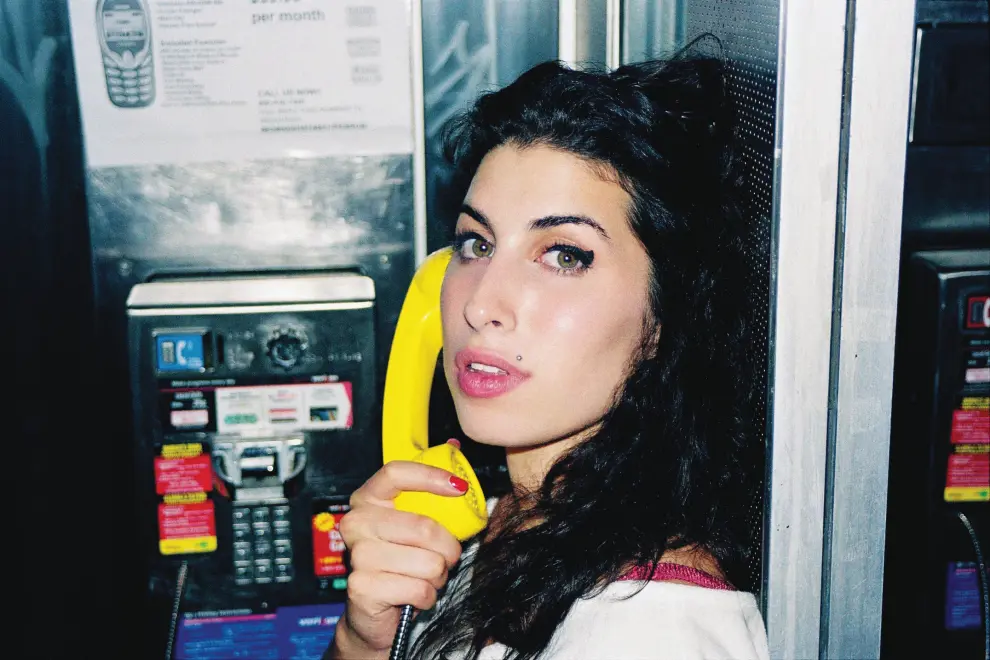
Winehouse influenced fashion, too, with an instantly recognisable image – '60s beehive, winged eyeliner and garb from Fred Perry, the sporty UK brand long popular in the mod subculture.
Inspired by '60s soul, Back To Black is a break-up album – Winehouse having (temporarily) split from boyfriend Blake Fielder-Civil. There are melodramatic numbers such as the title track and poignant ballad Love Is A Losing Game. But Winehouse also expressed her comic flair on the classic lead single, Rehab, and Me & Mr Jones – the latter referencing Billy Paul's 1972 Me And Mrs Jones and her friend, the rap GOAT Nasir "Nas" Jones.
Dale Davis was part of Winehouse's world from the early days as her Music Director, bass player and confidant (he was her "favourite person to go anywhere with"). He'd accompany Winehouse for many key shows.
Today Davis is conducting interviews as Universal Music Australia rolls out a lavish 20th anniversary edition of Back To Black with unearthed demos, rarities and a live recording from Paradiso in Amsterdam. The seasoned musician is determined to keep Winehouse's memory alive.
"The moment she passed, my instinct was, 'I'm gonna have to talk about her' – and that was literally what happened," Davis says over Zoom. He even served as music consultant to the Back To Black movie. A natural storyteller, the humble Brit apologises for being "waffly" (he isn't).
In fact, Davis has visited Australia several times as a sideman. The first occasion was in early 1997 with Tina Turner's Wildest Dreams Tour. Davis returned to play 2006's Good Vibrations with The Cuban Brothers, James Brown headlining, and then again in 2011 when Mark Ronson's The Business INTL were billed at the Future Music Festival.
JUST FRIENDS
Winehouse grew up in a Jewish family of jazz performers. No traditionalist, she developed her own retro-nuevo mode with hip hop soul influences and subversive contemporary lyrics. As a tween, Winehouse was in a rap duo, Sweet 'n' Sour, with childhood pal Juliette Ashby, channelling Salt-N-Pepa. Intrigued, Island Records A&R executive Darcus Beese signed Winehouse as a soloist amid a brewing bidding war, and she linked with Salaam Remi in Miami for her 2003 debut, Frank, chronicling a young romance.
Coming up in New York, Remi had played keyboards in the studio for Kurtis Blow and soon joined the Fugees' fold. He styled himself as a hip hop and R&B producer, drawing on reggae.
Frank established Winehouse's credibility. The lead single, Stronger Than Me, won an Ivor Novello Award ('Best Contemporary Song'). Winehouse likewise received BRIT nominations, and Frank was shortlisted for the Mercury Prize. Yet the perfectionist wasn't wholly satisfied with the project.
The older Davis entered Winehouse's orbit in 2003, as she wrapped Frank. "If I analyse my whole story, it's not by luck that I've ended up working with Amy," he starts. The singer was progressing from booking small venues to V Festival.
Davis had moved from his hometown of Reading in South East England to London in 1986. Here, he witnessed the explosion of the rave scene – "that blew my mind, and that's where I really came into my own." Davis' "break" arrived when he was recruited by Brighton's Norman Cook, today known as the mythic UK DJ/producer Fatboy Slim ("a great character"), to be his guitarist and bassist.
Cook, formerly in the indie outfit The Housemartins, had launched the collective Beats International – their SOS Band-derived Dub Be Good To Me topping the UK charts in 1990. Beats International evolved into Freak Power and aligned themselves with Island as Beese was ascending from intern to powerbroker. An esteemed sessionist and touring musician, Davis next backed Northern Soul-type Paul Young in the mid-'90s.
Davis encountered Winehouse serendipitously. "I first saw Amy in a club when I was playing bass. She was young, and she came in with [her companions] Lauren [Gilbert] and Juliette. And the thing I remember about Amy was, when she looked at me, there was like a flash of light came out – her eyes were so bright. I know it sounds a bit hippy-dippy, but that's what happened."
Meanwhile, Davis was invited to audition for the newcomer's band. "I got asked by a friend saying, 'Would you want to work with a girl called Amy Winehouse? She's going on tour with Annie Lennox.' I said, 'Yeah, of course.'" Ironically, "the tour never happened", and Davis wasn't hired, anyway, "'cause [Winehouse] liked the bass player before me – better looking, taller, et cetera," he quips.
Davis subsequently spotted her hanging out. Then his fortunes changed – and he took a call. "The other bass player, he worked with George Michael, Cliff Richard, and he was on more money; she was a new artist, and they couldn't afford to use him. So they got the uglier, cheaper version in – which was me."
BACK TO BLACK
Though Davis "predominantly" liaised professionally with Winehouse live, he was privy to her recording – and her mindset.
When Winehouse cut the raw Back To Black, she had separated from Fielder-Civil – and was grieving the loss of her beloved "Nan", Cynthia.
The creative had been vibing to the "jukebox music" she heard playing pool in local pubs. But Winehouse was especially enamoured of '60s girl groups like Motown's The Supremes, The Ronettes and The Shangri-Las. Either way, Back To Black signalled a departure from Frank as she embraced vintage R&B.
Winehouse reunited with Remi in his private Instrumental Zoo Studios. She'd also connect with NY DJ/producer Mark Ronson via her publishing company.
Ronson had enjoyed kudos for his work with Nikka Costa on 2001's Everybody Got Their Something and, two years later, dropped a buzz debut, Here Comes The Fuzz, featuring Aussie Daniel Merriweather. In his Allido Studios, Ronson acquainted Winehouse with The Dap-Kings – the in-house soul and funk band at Daptone Records. Moreover, Ronson emulated Phil Spector's Wall Of Sound aesthetic, prominent on the title-track. (He'd score 'Producer Of The Year' at the Grammys.)
"I was aware of what direction Amy was going down because I used to try and ring her, or when we'd try and speak, and she'd always have girl groups music on her voice message; on the answer phone," Davis recalls. "Also she had ska going on at the time as well – and the two things were quite linked when we first started to do Back To Black.
"But we started playing Addicted [produced by Remi], the song which is on the album, towards the end of the Frank era – and I think Tears [Dry On Their Own] [again produced by Remi and interpolating the 1967 Marvin Gaye/Tammi Terrell duet Ain't No Mountain High Enough] might have been written around then as well. So I think, with Salaam and the direction that she was moving in, it was going that way, anyway.
"When I congratulated Amy on the success, she said she knew what she was doing – and she didn't say it in an arrogant way; she just had a vision of what she could do. I always thought Amy was gonna be a massive star, but not so quickly. I think, because she was so intelligent, and deceptively intelligent, she saw the process with Frank, how to record, and then she saw the process once and then got everything right with Back To Black."
Remi and Ronson each brought a distinct perspective – Remi being an instrumentalist and Ronson a DJ/curator. "Salaam's productions were different from Mark's but, once they put the orchestra on these things and then they mixed and mastered it, it all sounded like one thing." Ultimately, Back To Black feels unified. "Amy's strength was she could make anything sound like herself," Davis notes.
He stresses Winehouse's particularity. "She was an artist in the pure sense, you know – very musically talented, as musically talented a person [as] I've ever seen, even though she wasn't necessarily the most technical. When I look at someone like Jimi Hendrix, my idol – no technique necessarily, not a technical musician, but all feel and all soul. So Amy was very much like that – and it's an innate thing. She was obviously gifted from birth and she was obviously here to make her mark."
HE CAN ONLY HOLD HER
Winehouse astonished Davis with her instincts. "In the beginning, she surprised me all the time. Firstly, I did a gig with her at Notting Hill Carnival [in Powis Square, 2003], which was not necessarily the most ideal place for a young 19-year-old girl. But, by the end of the Carnival, when we played the gig, everyone was there and I thought, 'You actually didn't need a band there, you were so powerful.' She was almost like a Bob Dylan character where she could have just stayed there with a guitar and sang and everyone would have watched it."
Davis recollects another instance in a hotel room, where Winehouse put on Busta Rhymes' I Know What You Want with The Flipmode Squad and improvised Mariah Carey's lines.
"When people come to sing like Mariah Carey, they try and sound like Mariah Carey," he says. "But, when Mariah Carey's part came on, Amy just sang it like herself. I thought, 'That is just as good as Mariah Carey' and that was like two or three months into working with her – and that's when you realise what a gifted talent she is."
While belonging to different generations, the pair shared music tastes. "She was never mainstream," Davis remarks of Winehouse. She was opinionated, too. "The things that I'd wanna say, she'd say out loud for me!," he laughs.
They rarely diverged. "I remember once when we first started playing Back To Black [live] and we were out in an evening and she was playing all this Motown stuff and I said, 'Amy, come on!' – 'cause I was that much older than her and I'd been around and heard it first time 'round. I said, 'Can we change the music?' She went 'No!' And I thought to myself, 'Of course – it's all new to you.' [But then] sometimes, if I'd put on Diana Ross or Joni Mitchell, she'd go and switch it off. I never questioned why, but she obviously had her own things."
REHAB
Winehouse herself was "surprised" that Island selected the gospelly album opener Rehab to be the first single from Back To Black – the track helmed by Ronson. Startlingly autobiographical, Rehab riffed off conversations the star had with her management team and father Mitch. But, Davis relates, Rehab wasn't her favourite – despite it eventually winning another Ivor Novello. "She was excited about Rehab, but I think she genuinely liked Wake Up Alone."
Winehouse had laid down the ballad with Paul O'Duffy – renowned for producing Swing Out Sister's Breakout – and ad-libbed. (The demo can be found on the posthumous compilation Lioness: Hidden Treasures.) "He said he had Amy in [the studio] for a month and they weren't getting much done but, then, all of a sudden, she had this song written out, went in to sing the song and didn't sing pretty much what was on her lyrics sheet – and that became the original recording after that."
In June 2007, Winehouse performed Rehab at the MTV Movie Awards in California, introduced by an appreciative Bruce Willis, and that summer hit festivals like Glastonbury (where she'd premiered in 2004). Alas, the star, struggling, cancelled European dates after Tuborg GreenFest in Belgrade, Serbia.
YOU KNOW I'M NO GOOD
Winehouse was indebted to the '90s' neo-soul movement epitomised by Lauryn Hill. Yet Davis believes that Macy Gray was a precursor with 1999's debut On How Life Is (he's gigged with the American). Still, Winehouse was intrinsically British – to the extent that The Rolling Stones put their stamp on You Know I'm No Good for Foreign Tongues (she'd joined them on stage at 2007's Isle Of Wight Festival).
Crucially, as a white vocalist, Winehouse impressed a Black audience, similarly to Teena Marie. In some ways, her rise led to a trans-Atlantic reappraisal of the UK's soul canon – from Dusty Springfield to Sade to Lisa Stansfield to Soul II Soul.
And Winehouse's music continues to reverberate. With Back To Black the best-selling album of 2007 in the UK, she in turn paved the road for a fresh wave of Brit soulsters – among them Adele and latterly RAYE and Olivia Dean. In 2017 Dua Lipa covered Tears Dry On Their Own with Gallant.
Davis admired Winehouse's sass. "I'm not a big fan of the Spice Girls, [but] I always say that, 'At the beginning of the last century, you had the suffragettes and then, four years before the end of this century, you had the Spice Girls' – and I'm saying, 'Is that progress?,"' he asks. "They were considered 'girl power,' but Amy was real girl power, in my opinion.
"She was just a force of nature, really. Lyrically, she was so funny. You could hear all the action in her voice and everything, the humour, and she had a great imagination. She could take a simple thing and make it hit you."
WAKE UP ALONE
Winehouse's passing affected Davis deeply. He regrets that she felt stress from all the accolades – and scrutiny. "I always wanted to say, 'Look, you don't need the pressure of writing something as big as Back To Black' – because trying to follow that would have been an impossible thing."
At the time, Winehouse was contemplating album three. Her final song was a Grammy-winning duet with American legend Tony Bennett – the jazz standard Body And Soul.
Where does Davis imagine Winehouse may have gone creatively post-Back To Black? "I think Amy always had a classic approach to writing music. So it would be not necessarily electronically classic now – or she would do something in a way that would make it sound classic. So whatever Amy touched, or would have got into, would have been brilliant." He reckons she'd have "been a character like a Barbra Streisand or a Bette Midler," venturing into acting.
TEARS DRY ON THEIR OWN
In 2015 Davis instituted The Amy Winehouse Band with Winehouse's other original side musicians, adding Bristol vocalist Bronte Shande. They performed at the Secret Cinema X screening of the Amy doco at Koko nightclub (previously Camden Palace). The group have just marked their 10th anniversary. It's another way to honour – and sustain – Winehouse's legacy given how social media has fractured narratives and fragmented monoculturalism.
"At first, I didn't wanna do it," Davis admits. "I was reluctant to do it." He fretted that Winehouse might have disapproved. "I thought Amy was gonna strike me down with lightning!" The bassist expects that she would be "embarrassed." "She'd say, 'Dale, what are you doing that for?,'" he speculates. "But, deep down, she knew that she could touch people's lives."
And that's what persuaded Davis. "People kept saying, 'If anyone's gonna do it, you should do it,'" he proceeds. "I never push these things, it's just a demand – so there was a demand for it." Davis has observed a new demographic of fans since the Back To Black biopic. "Amy was never gonna go quietly – she had a massive impact while she was here and the impact's still going."
Davis' fave song of Winehouse's to revisit is either her cover of Eddie Jefferson's evergreen '50s lounge Moody's Mood For Love off Frank or Me & Mr Jones (originally entitled Fuckery) with its "great rock 'n' roll swing."
However, he's unsure whether playing Winehouse's songbook has been healing for him personally. "I don't think you can ever process the whole thing, because sometimes I feel guilty that I didn't do enough to help her," Davis ponders. "It's very cathartic because, the band, we've always been together and we all still get on, that's the thing, and [we] still enjoy doing it after all these years. So she obviously left us in a good way. And the band operates in the same way as it did when she was around."
Winehouse never travelled to Australia, but is there any possibility of The Amy Winehouse Band touring? "There is talk, but I think there's always talk," Davis teases.
As for penning a book? "No, because it'll be the most boring book in the world, it'll last about 30 seconds, and I think it's probably easier if I go to my grave with all this," Davis jokes. "Also it's trying to be balanced… I mean, I could be very honest and very balanced, but it's just sometimes you don't need to mention those things, really. It's nice to have a lot of special memories that you don't have to worry about talking to people about." That's something Winehouse would say.
The Back To Black 20th anniversary editions are out now via Universal Music Australia.