
 David Bowie Profile
22 years after he last played Australia, David Bowie is returning to appear in arenas as part of a world tour.
He will be seen with his former crack band from his Isolar II – The 1978 World Tour, including guitarists Adrian Belew and Carlos Alomar. That was the first of his four Australian tours.
Bowie died from liver cancer in January 2016.
But the new concert-format production – called Stage or by the full name of The David Bowie Stage Show – is based around a raw unseen 35mm from a three-night run at London’s Earls Court on June 29, June 30, and July 1, 1978.
Shot by British actor and film maker David Hemmings, it was shelved by Bowie at that time.
The footage is now embellished with next-generation lighting, visuals and audio. Producers say the technology will make it so realistic fans will believe it’s Bowie and band up on the stage.
“The show is designed for scale and staged in auditoriums and venues with capacities starting at 5,000, enveloping audiences in the atmosphere of a full-scale rock concert for an unprecedented live experience,” said the media release.
“It has taken five decades for technology to develop enough to bring his vision to life with cutting-edge spatial audio and visual tech. The production blurs the line between cinema and a live concert. Fans will achieve the sensations of attending an authentic David Bowie show.”
To that end, the “concert” will be shown on multi-screens.
Sound-wise there is immersive audio mapping, mixed by Oscar-winning sound engineer Paul Massey, best known for the Queen biopic Bohemian Rhapsody, the James Bond movie No Time To Die, and the 2022 Grammy-winning Bowie documentary Moonage Daydream.
Audio is integrated into a Clair Global audio setup using advanced DSP algorithms and a spread-out flown array system to deliver pristine 7.1 surround sound to every seat in the venue.
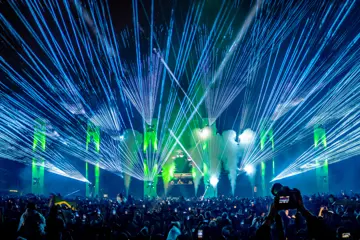
The visuals use full-range transparent LED screens (70 times 40 displays) provided by Unilumin/Roe.
The integrated lighting is by world-renowned lighting designer Patrick Woodroffe who works across music, dance, fashion, and architecture.
His lighting was used by The Rolling Stones since 1982, Michael Jackson’s This Is It, Elton John, Paul McCartney, AC/DC, and Lady Gaga.
Bowie, who predicted the era of the internet, himself sang in Word On A Wing:
“In this age of grand delusion/You walked into my life out of my dreams/Sweet name, you’re born once again for me/Sweet name, you’re born once again for me”
Concept
The concept of Stage got its start in 2018 when director, film maker Brett Morgen, found the Earls Court footage ten years ago while working on the Moonage Daydream documentary.
In fact, “Heroes” from Earls Court was used on the doco.
Ironically Bowie originally conceived the Earls Court film to be shown in music venues so he could avoid having to go on tour.
But he got distracted and, after releasing the double live album Stage in September – recorded at the tour’s stops in Philadelphia, Boston, and Providence in April and May – he moved on to other projects.
The Stage album reached No. 14 in Australia on the Kent Music Report, No. 5 in the UK, No. 44 in the US, No. 1 in New Zealand and charted through Europe.
In 2001 the star told Uncut: “I simply didn’t like the way [Hemmings’ footage] had been shot. Now, of course, it looks pretty good and I would suspect that it would make it out some time in the future.”
What was significant was that Hemmings shot the footage almost uninterrupted of the star, which made it easier for the concept to work.
Morgen began talks with the Bowie estate about rejigging the material to create a full arena concert. He then spent almost a decade colour grading and hand-painting it, and configuring it for multiple screens.
The Bowie band, aside from Belew and Alomar, included George Murray (bass), Dennis Davis (drums), Roger Powell (keyboards/synthesizer), Sean Mayes, (piano), and Simon House (electric violin).
Songs included Ziggy Stardust, Rebel Rebel, Suffragette City, Fame, The Jean Genie, and “Heroes” alongside tracks from the Low and “Heroes” albums which he was promoting on that tour.
In 2024, things started to move when former AEG Live President of International, Rob Hallett, joined with his company Wonderworld.
Hallett says: “David Bowie has bestowed upon us an extraordinary treasure – an unprecedented concert experience that has yet to be witnessed.
“Working hand-in-hand with David Bowie’s estate and Brett Morgen, we are ensuring this experience is 100% faithful to his legacy while making his genius accessible to global fans and a new generation.
Stage has its world premiere on February 14, 2027 at the Berlin International Film Festival (Berlinale), playing the Uber Arena.
Hallett revealed: “After the Berlin show, The David Bowie Stage Show will embark on a landmark global tour, taking Bowie’s music, vision and theatricality to the live markets of Asia, the Middle East, Africa, and Latin America, some of which, never saw him perform.
“The production will introduce a new generation of fans to his extraordinary catalogue, also returning to the countries that embraced him throughout his career, including the UK, Europe, North America, Japan, and Australia.”
Younger
Bowie has after his death been drawing a younger audience. In Britain alone, he’s sold five million albums and singles tracks. Figures are not available for Australian posthumous data.
A year after his death, his tracks had generated one billion streams. Spotify says that Australia is the sixth largest Bowie market on its platform. “Heroes” is the most streamed cut, both in Australia and globally.
Younger audiences are fascinated with his fashion, style, art, theatre, and music.
Billboard claimed Bowie “influenced more musical genres than any other rock star.” This included glam, folk, space-folk, theatrical hard rock, electronica and synth-pop.
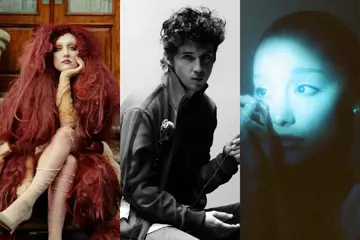
A new generation of stars including Lady Gaga, Charli xcx, Janelle Monáe, and Harry Styles sing his praises and his influence on their art.”
Each generation continues to find solace in the early glam-rock songs, which effectively send the message, “It’s OK to be different”.
Chart Toppers
In Australia The Thin White Duke only had two chart toppers – Sorrow in 1974, and the 1985 duet with Mick Jagger on Dancing In The Street. 1983’s Let’s Dance peaked at No. 2.
Making it into the Top 10 were Space Oddity and the Queen collab Under Pressure.
Fifteen albums went into the Top 10, with Scary Monsters And Super Creeps (1980) Let’s Dance (1983), and posthumously Blackstar (2016) reaching pole position.
In the UK, he had 68 tracks that made it into the Top 75, with 25 going into the Top 10, and five reaching top spot. Eleven albums made it to No. 1.
The star long had a special bond with Australia. It had started in his early teens and see it as an exotic location as he grew up in the dowdy London suburb of Brixton.
In a 2004 interview, he recalled, “The first time I had seen Ayers Rock (Uluru) was as on the cover of a (Russian classical musician) Stravinsky album.
“And I bought that particular one — I was only about 12 — because of the picture on the front and I thought — what a fantastic looking mountain or whatever that is.
“It looked really exciting and subsequently when I read the sleeve notes, I realised it was this place in Australia and I always wanted to see it because of that.”
On that first tour of Australia in 1978, in between shows, he’d drive out to explore the bush.
He developed a strong connection and affection for First Australian people and culture, and in global interviews, called out the racism and poverty that befell them.
“As much as I love this country,” he told Rolling Stone in 1983, “it’s probably one of the most racially intolerant in the world, well in line with South Africa. I mean, in the north, there’s unbelievable intolerance.
“The Aborigines can’t even buy their drinks in the same bars-they have to go round the back and get them through what’s called a ‘dog hatch.”
He got an apartment in Sydney’s Elizabeth Bay. It became a sanctuary from the media intrusion in his life in the UK. In Sydney, he told this writer, he could walk around and pop into pubs to see young acts without being hassled.
He used the Elizabeth Bay pad as his base, holidaying here often, and trekking off to First Nation communities or taking in the Daintree forests and the Great Barrier Reef.
Parts of his second Tin Machine album were recorded in Sydney.
So were the videos for Let’s Dance and China Girl, incorporating many First Nation themes.
He sold the Sydney property in 1992 after his marriage to Iman, as her supermodel career kept the two of them busy in the northern hemisphere.
Aside from that debut 1978 tour, Bowie also brought the Serious Moonlight (1983) and Glass Spider (1987) treks, with the final one being A Reality Tour in 2004.
In the next 18 months, Stage will make it his fifth.