When my parents started going to gigs, there was no such thing as knowing what songs their favourite bands would play, let alone what time they’d hit the stage.
You’d rock up when doors opened or make a calculated guess of when it was safe to arrive without missing anything. Unless you had contacts in the know about the show, traded bootlegs with fellow fans, or maintained an archive of live music, chances are, you wouldn’t know what songs were played when, in each city.
In 2026, the world of attending concerts couldn’t look more different. A large chunk of it is down to mobile phones and social media, for sure, but one can’t look past the impact of the internet, blogs, community websites, and the rise of setlist.fm.
These days, people are really into setlists. They want to know which “surprise songs” Taylor Swift brought out during her Eras Tour. They want to know if Metallica swapped out Nothing Else Matters for a deep cut. They follow Radiohead on tour, whether it’s physically or via a string of fan-recorded shows, to see which rarities will return to the set. When Beyoncé launched into her Renaissance and Cowboy Carter tours, videos and setlist teasers were all over the internet.
But the impact of finding and knowing setlists goes beyond major artists and their tours. It extends to people ensuring that they have a toilet break mid-set, leaving early to avoid traffic or catch the last train home, and attending multiple shows interstate to hear their favourite songs.
The question is: when did the rise in caring about setlists begin? When did punters’ attitudes begin to change?
Examining the figures shown on Google Trends, it’s clear that Australians’ interest in setlists is a recent phenomenon.
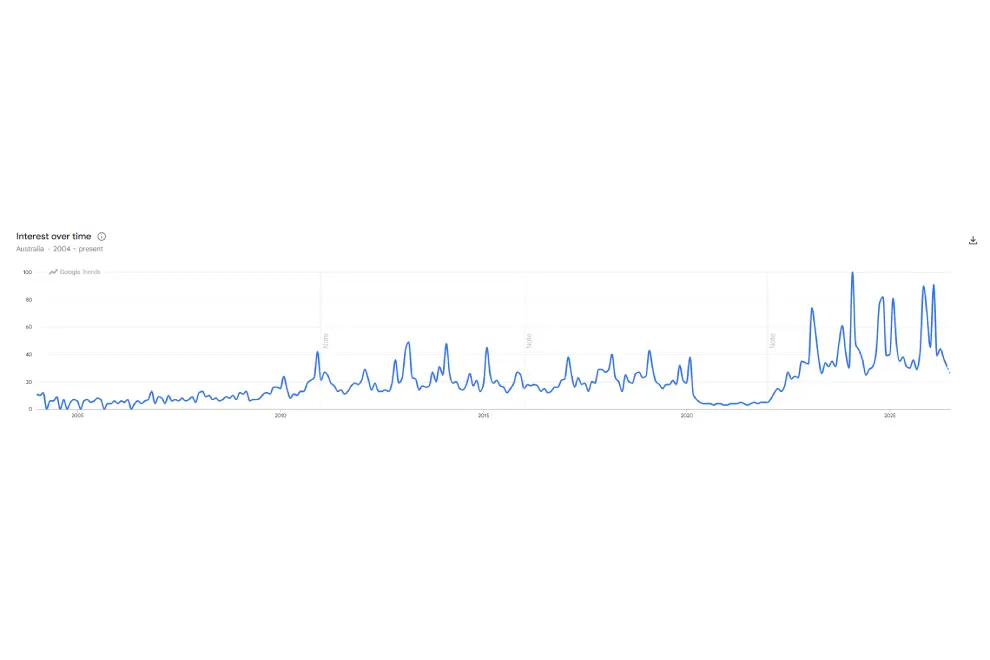
Google Trends - Interest over time graph
In a graph showing the interest in setlists over time, Google Trends displays search interest on a “relative scale” from 0 to 100. Of course, 100 signifies the peak interest for the time period of the chart; a value of 50 indicates half the popularity, and 0 suggests insufficient data.
In 2004, Google would account for an interest amounting to 12 for setlists, tops. More often, the numbers would hover around five to seven searches. The story is the same until 2010, when there’s an uptick in searches for setlists (24) in February of that year. In December, that number spiked to 42 despite most of the year hovering around the twenties range.
In March 2013, the number rose to 49. The story was the same in February 2014. And in February 2015. Searches typically remained lower throughout the winter months, before rising again in summer. The pattern repeats year on year, the numbers remaining relatively consistent until February 2020.
Looking at the months with peak interest, it’s fair to assume that travelling summer festivals such as Big Day Out, Soundwave, and Stereosonic contributed to people’s interest in setlists, while major tours like Coldplay’s Mylo Xyloto run in November 2012 would again increase interest.
The data dramatically changes from March 2020 until April 2022, when the numbers slowly begin to increase again. As the COVID-19 pandemic took hold in Australia and live music events such as gigs and festivals were cancelled and social gatherings were policed, Australians didn’t go looking for concert setlists.
However, once live music returned to our lives, so did interest in the humble setlist – with a vengeance. In February 2023, the number spiked to 74, following 34 in December 2022. The figures coincide with Ed Sheeran’s mammoth stadium tour of Australia and the announcement of Foo Fighters’ stadium tour later that year.
In February 2024, the number reached 100. The reason? Taylor Swift’s enormous Eras Tour, taking place at Melbourne’s MCG and Sydney’s Accor Stadium that month. Anticipation for her tour and finding out which songs she played on each date – three nights in Melbourne and four in Sydney – hit fever pitch.
In the 2020s, the numbers dramatically dip in the winter months, particularly June, as major artists tend to perform internationally during the Northern Hemisphere’s summer months.
By November 2024, the number rose again to 82 following a quiet couple of months of setlist searches. Artists who toured Australia in late 2024 included The Kid LAROI, Olivia Rodrigo, Kim Wilde, Travis Scott, Thom Yorke, Coldplay, and Take That – Olivia Rodrigo made her Australian debut, while Thom Yorke returned to our shores for the first time in over a decade.
From there, the trend is clear: massive upticks in the summer months, particularly February and November, while there are major dips when the weather cools down (and so does the touring schedule).
February 2025 saw Billie Eilish bring her HIT ME HARD AND SOFT tour to Australia, while country star Chris Stapleton showcased his All-American Roadshow and Knotfest Australia, and Green Day returned a month later.
Last October and November, major acts such as Oasis, Metallica, AC/DC, Sam Fender and David Gray returned to Australia, with the first three artists back for the first time in many years.
In February 2026, the number sat at 91, as Chappell Roan headlined Laneway Festival (where the buzzed-about Geese also performed), CMAT played her largest shows in the country to date, Ed Sheeran returned to stadiums, Lorde headlined arenas, and Halsey brought her BADLANDS tenth anniversary tour to our shores.
The numbers are backed by searches for setlist.fm, Taylor Swift, Ed Sheeran, Metallica, Coldplay, and Foo Fighters setlists.
Of course, one can’t examine setlists’ increase in popularity without looking at setlist.fm. Founded in 2008, setlist.fm has changed everything for concertgoers, as The New York Times examined last year.
You can find setlists from the ‘80s or from yesterday. At the time of publication, the website is home to over 10.3 million setlists by 463,601 artists at 448,103 venues, plus sets from over 228,000 festivals. It’s easy to find a set, and almost as easy to upload one.
When a particularly devoted punter posts on the website, you can even find out set times from the night before. Perhaps what boosted its popularity even further was its 2010 acquisition by Live Nation, which provided the service with more resources to develop its presence, especially on social media.
This year, setlist.fm has hugely boosted its presence on Instagram.
Yes, there are carousel posts where you can swipe and read setlists from big-name artists, but the service also shares video interviews with artists, tour announcements, photo galleries, and perhaps most essentially, lets followers know when an act with a rabid fanbase has premiered a new song or brought back a deep cut, further contributing to today’s culture surrounding setlists.
In early 2024, The Music’s Ben Lamb asked: is there such a thing as a perfect setlist? In the feature, Lamb argued that, of course, artists will always perform new songs, but the skill for performers is curating a setlist—especially in an age when people’s attention spans have decreased, and a new generation of punters haven’t been taught concert etiquette.
Lamb dug into touring artists’ setlists at the time, such as Matchbox Twenty, and how they opened with a new track before performing a classic.
“Other performers (like recent visitors blink-182 and Pink) litter the first section of their shows with classics before chucking in a track off their latest release,” Lamb wrote. “This allows them to build up a bit of momentum and rapport with the crowd, before potentially losing a bit of it when a new song hits.”
Lamb added that now, songs have a life of their own, whether it’s All The Small Things by blink-182 or Shake It Off by Taylor Swift, leading to fans connecting music with significant parts of their lives. Of course they want those songs represented in a live context, and seek them out on Google.
“These tracks can never be ignored in a setlist,” Lamb wrote. “They’re the reason fans come, the reason you can go viral for a night, and the thing that can take a show from great to unforgettable. That’s why you’ll often see the last 20 to 30 minutes of a set dedicated to these classic tracks – if a set lost you with the new tracks, it’ll always win with a string of songs you know every word to.”