 Sampa The Great Profile
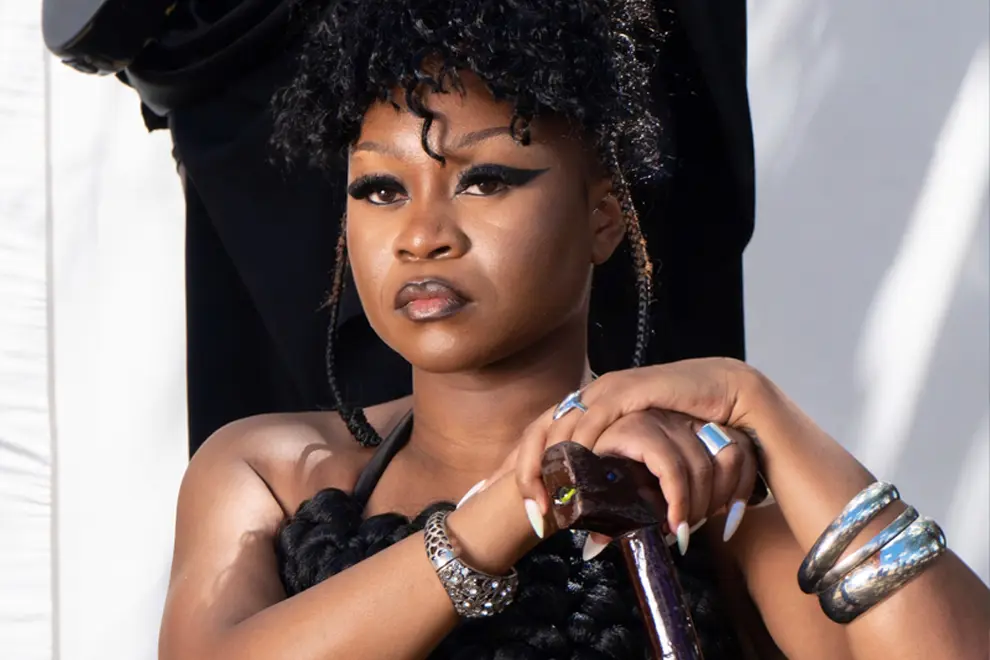
Sampa The Great (aka Sampa Tembo) was exposed to Zambian rock legends WITCH by chance when she caught an episode of HBO's superhero series Watchmen that synced their song Living In The Past for the end credits.
It led to the prodigy learning that her blood uncle George "Groovy Joe" Kunda co-founded the mythic Zamrock band.
Now she's contemporising the 1970s style – a radical and liberating fusion of traditional African rhythms and Western psych-rock – for Nu Zamrock, with Kunda as narrator. And her third album is both a celebration of lineage and a vibe.
"There's no simple way to say, 'Hey, I discovered that my uncle was a musician and it was kind of destiny because I never knew this before,'" Tembo laughs.
The Zambian star is Zooming from Botswana, Southern Africa, where she was raised and her parents currently reside. Soon, Tembo will head to Lusaka, Zambia's vibrant capital, to host a Sunday listening party for Nu Zamrock.
"I just love that I can fully now be a creative at home – because my career started outside of home, that kind of felt distant, but now feels like a memory. That feels like so long ago."
Tembo's life has been unusually mobile. She attended college in California prior to moving to Eora/Sydney and then Naarm/Melbourne to pursue music. Today Tembo lives all over.
"It's sort of that trifecta of being in Zambia, being in Australia at times with my sister [the alt-R&B vocalist Mwanjé, based in Naarm/Melbourne] and then being in London working."
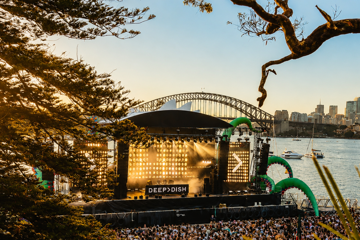
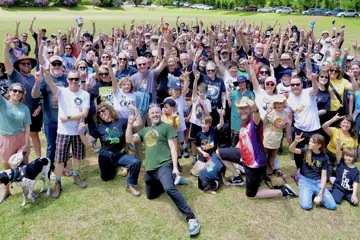
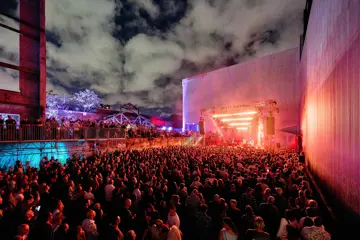
Tembo was in Australia in early October with her Zamrock Band for the lowkey new "community festival" Move My Way in Eora/Sydney and Naarm/Melbourne, billed alongside British jazz quintet Ezra Collective – the MC notably gracing their 2023 Mercury Prize-winning Where I'm Meant To Be.
Here, she previewed Nu Zamrock with the lead single Can't Hold Us, anthemic Afro-rock featuring Mwanjé and boasting fuzzy garage guitars, percussive Simon Says, a critique of industry dictates, and Location.
"We didn't play the full thing," Tembo admits. "Hopefully we can play the actual full album when everything comes out. You kind of wanna tease enough."
Tembo was "surprised" by the crowd interaction during Simon Says. "You're like, 'Whoa, this is so cool that everyone was able to get the lyrics that quick.'"
The poet, rapper, singer, composer and visual artist has established an international profile with successive conceptual projects. Her 2017 breakthrough mixtape Birds And The BEE9, released via Ninja Tune's Big Dada imprint, traversed gospel, neo-soul, reggae, hip hop, and Afrobeat. It won the Australian Music Prize (AMP).
Tembo followed with 2019's empowering debut proper, The Return, exploring diasporic dynamics and reclaiming her cultural identity, having been misrepresented as 'Australian hip hop'.
It peaked at #12 on the ARIA Albums chart and secured the musician a historic second AMP.
Tembo would also be the first woman of colour to score the ARIA for 'Best Hip Hop Release' with the single Final Form (the next year she received three more gongs, including 'Best Female Artist').
Signed to the US Loma Vista Recordings, Tembo last ventured out in 2022 with As Above, So Below, months after becoming the inaugural Zambian act to play Coachella (as she was at Glastonbury in 2019).
Back in Australia, Tembo joined pop superstar Billie Eilish's Happier Than Ever tour (alternating with Dora Jar).
Tembo is heralding another "new era" with Nu Zamrock – and, fulfilling a trinity, it may be her most grassroots foray. Reinventing Zamrock, the album is intergenerational yet evolutionary rather than nostalgic – Tembo ever the Afro-futurist.
In many respects, the genesis of Nu Zamrock predates As Above, So Below – Tembo experiencing a gradual epiphany.
"It's such a whirlwind of a story," she says. "Whenever I tell it, even I'm just like, 'I can't believe that this is how things kind of came together.'"
In 2020, as the COVID-19 pandemic closed borders, Tembo had "relocated back to Botswana; to Zambia." She was reacquainted with her heritage – and consciously cultivated community.
"My career did take off in Australia, but a lot of my musical inspirations, and the beginning of my music, started back here in Africa," Tembo stresses.
"So I took the opportunity to reconnect with people whose music I've loved." She bunkered down with buzzy local producer Mag44 (Magnus Mando).
"When we were working on As Above, So Below, my sister and I were watching the Watchmen series that has Regina King in it," Tembo recollects.
"I remember a particular episode had a song by WITCH [Living In The Past from their 1974 album In The Past] and it played and Twitter went off and [everyone] was like, 'Oh my gosh, a Zambian band, this is on this big HBO series – that's so huge.' And I was just like, 'Who is this, who is this band?' I was so intrigued."
A WITCH aficionado, Mando filled her in. "I was like, 'Oh, I have to learn more about this music, I have to know who they are, this is so cool – like this is what, African rock? This is crazy.'
"So I started doing my homework on just Zamrock music and being like, 'Why haven't I come across this in my career?'"
Mando proposed they seek out WITCH's frontman Emmanuel "Jagari" Chanda for a studio session, resulting in the album track Can I Live? (Tembo likewise composed the kalindula-flavoured Never Forget as her "ode to Zamrock").
The star subsequently materialised on WITCH's epic Avalanche Of Love off 2023's triumphant comeback Zango. The septuagenarian Chanda is now a mentor.
Tembo fathomed the origins of Zamrock from Chanda. "And, in those sort of queries, it was revealed that my actual uncle, George Kunda, was not only the person who brought together the band WITCH, but also a pioneer of the genre Zamrock – and I was so floored.
"I was like, 'Wait, you're telling me that someone in my family was a pioneer of this genre?' And he was like, 'Yeah, go and ask your family, go ask your dad.'
"I remember coming back home and being like, 'Dad, this is what Uncle Jagari is saying, what is this – like this has been in our family?' And my dad's so nonchalant. He says, 'Oh, yeah, Zamrock, oh, yeah, your Uncle George…' I'm like, 'Dad, you can't keep these things – this is so important, this is so huge!'
“We kind of had this history lesson about Uncle George and what he used to do back in the day and pioneering this genre called Zamrock and also just the realities of leaving it behind and being like, 'I don't think this thing is working out for me.'"
Zamrock emanated as Zambia was enjoying its new independence from British colonialism – President Kenneth Kaunda instituting a policy that radio stations program primarily domestic music.
WITCH (standing for 'We Intend To Cause Havoc') formed in Kitwe, the hub of Zambia's Copperbelt mining region, with the charismatic Chanda their lead singer – his alias a cheeky play on the name Mick Jagger.
They were the most popular band in a conservative country, famed for explosive live performances.
Yet WITCH's fortunes were intertwined with Zambia's. The country, reliant on copper exports, sustained social and economic upheaval as the price of the metal slumped worldwide and, coupled with autocratic government and conflicts in neighbouring countries, Zamrock lost momentum.
Five albums in, Chanda quit WITCH – and, although the collective endured into the '80s with different vocalists (deviating into a disco direction), members tragically succumbed to the AIDS epidemic. Zamrock was largely forgotten at home.
In the 2010s, Zamrock had a rebirth in the West, and online, owing to vinyl collectors – WITCH's catalogue reissued by Los Angeles' Now-Again Records, launched as an archival subsidiary of Stones Throw. Inevitably, the band was sampled.
Chanda reformed WITCH and, their rise chronicled in the documentary We Intend To Cause Havoc, they delivered the aforementioned Zango – Chanda's first LP in nearly 50 years.
WITCH even toured Australia in 2024, headlining the Sydney Opera House (they returned the following year).
The saga struck a chord with Tembo. "It just blew me away." And it seemed fateful. "What are the odds of watching the Watchmen and listening to a song and that happens to be Zamrock," she ponders, "and then finding out this huge chunk of family history that was sort of just brushed to the side?"
The revelation was validating professionally for Tembo, too – and she related to how WITCH attracted a global audience.
"It was so powerful to me because I think, 'til that point, there was no one in my immediate family who had done music as a career. It was always like, 'This hobby that she does that she's not stopping…'
“[But] to actually have someone who came before you, who did music as a career, it felt like this made sense: 'Oh, that's why there is a hunger to do this, because it's something that's in our blood. It's not something that has just come out from nowhere.'
"It was so healing for myself and my younger sister to talk to Uncle George about our feelings on music, our doubts, our fears, why we love doing it and just have someone who resonates with that; [someone] who's done it before.
"I think the deeper story for me was him probably feeling like he didn't get the fruits of his labour or maybe [that] he missed out on something – which was probably why the family story was sort of just shrugged to the side… [But] just his encouragement on my own music and how far I can push the music really inspired me to do my own take on Zamrock and expand the genre forward."
Tembo's bond with Kunda is such that she now values cross-generational exchange more. "He always says, 'I'm passing the baton to you.'" And she involved him in what is a circuitous project. "It really felt like Zamrock was our way to connect with our musical legacies – and Nu Zamrock was the way we did it."
Nu Zamrock has interludes with Kunda reconsidering his achievements and offering counsel. "I really wanted the listeners to feel like he was their uncle."
The seeds already sown, Tembo commenced Nu Zamrock with the team of beatmakers behind As Above, So Below – Mando and Solomon "Plate" Moyo, plus band.
"We're sort of trying to figure out the elements of Zamrock that we love, the elements of hip hop and soul and traditional folk music that we love, and how we can expand that forward into something new." They'd "create a foundation of an album."
Tembo then travelled to the US for "a bit of a LA studio run," spending a fortnight canvassing various producers. "We were like, 'Hey, this is the sound we're trying to polish and we want other ears to hear it.'"
In the process, she encountered "an amazing producer" in the West Londoner Cadenza (Oliver "Oli" Rodigan). The son of legendary Brit reggae DJ (and onetime Doctor Who actor) David Rodigan, MBE, Cadenza had made his own mark, albeit in the studio, leaning into bass – and Afrobeats.
Collaborating early with UK hip hop bluesman Rag'n'Bone Man, the younger Rodigan has clocked up credits on records by everyone from Jorja Smith (her biggest hit, Be Honest, featuring Burna Boy) to Lucky Daye, not to mention Ghanaian-American fusionist Amaarae, similarly active in a decentralised, multipolar pop movement.
However, he's best known for his contributions to Beyoncé's RENAISSANCE and COWBOY CARTER.
"He played me what we now know as Can't Hold Us and I heard that beat and I was just like, 'What is even going on with this sound?,'" Tembo raves. "It's so fresh, it's so new and it's so challenging and makes me excited.' And that's what you want as an artist."
Tembo decided to appoint him co-executive producer, enthusing, "The sound that was made was even just bigger, better, bolder than its inception."
Again "bigger, better, bolder" is the unexpected pop guest on the euphoric Supernova – Tarndanya/Adelaide singer/songwriter Sia. How did that happen?
"Man, I can't even – I don't know," Tembo chortles. "We were in the studio and we were kind of talking about vocal choruses and the way we sing differently in different parts of the world.
“One particular song, Let Me Be Great, that we did before [for As Above, So Below] had [Beninese avant-popster] Angélique Kidjo's voice and we were just talking about how she sings – like she was trained classically, but there's a way she sings, especially from her part of the continent that is just so intriguing. And [so] we just started naming names – this singer and this singer and this singer…
"Cadenza brings up Sia and we were like, 'Wow, that would be great' and he's like, 'Yeah, she's from your ends too – like you're based in Australia, she's from there…' Then the conversation kind of goes like, 'Wouldn't it be lovely if she was on the album?' And we all just laughed and we're like, 'Yeah.'
"It's like, 'Yo, what would it sound like if nu Zamrock met a voice like that?'"
Undeterred, Cadenza reached out to Sia's producer "on a whim" and submitted a demo that Tembo had cut with Mwanjé. Happily, the Chandelier vocalist was open to a collab.
"One of the things that is actually crazy is, not only does it land on Sia's lap, [but] it also lands on Madonna's lap because they happen to be in a studio session together," Tembo spills. "I'm just like, 'Is this world serious? What's happening right now? I'm not understanding what's happening right now.'
“They love the demo. They each wanna work on it differently. [But] Sia ends up doing vocals for it."
She was enthralled by Sia's input. "The thing that floors me is this is not like little vocals here or there and ad-libs – she's fully singing on this song, like fully belting, fully chorus, like actually collabing… And, when you meet artists who engage with you like this, especially when you feel like you're still emerging or still learning, you're just like, 'Wow, you're really engaging with me as your peer' – it really is so humbling. I'm so grateful that we were able to make this song.
"She sends back the demo and me and Mwanjé are just like tearing [up]… It's like, 'Oh my gosh, this is Sia!' And the beautiful thing about it is it didn't sound like two different worlds.
“I think the topic at hand and what we're speaking of – destiny and feeling like what you're doing is what you were meant to do and everything that comes with that – resonated so much with her and wherever she was in her life and wherever I was in my life. It ended up making a beautiful single."
As an artist in 2026, Tembo is "assured" – completing a circle or narrative arc. "I'd say As Above, So Below was sort of the real 'return', because it was the first project fully done at home.
"With this one, it was, 'Now we know the sounds of home, now we know the sound that we're trying to recreate but, even more, now we know the legacy that we're trying to push forward' – because really and truly Uncle George being introduced into my life changed a lot and gave me a permission that I'd thought I'd had before, but even more so now.
"This is the most confident I feel I have ever sounded – and this sound to me feels like the most 'me' I've ever sounded."
Even the Nu Zamrock visuals are emblematic – Tembo proud of her bespoke 'Zamrock jacket', designed by PrimeSlick as a nod to the Zambian flag with its blazing copper-orange.
Additionally, the instinctive storyteller conceived "a prelude" to the album in the short film Ukwamba: (To Start) that "shows me engaging with my uncle and him telling me parables about how he discovered music and how he wants it to be passed down."
Tembo shot Ukwamba (To Start) in Lusaka "with a crew of young Zambian creatives, like 21-year-old directors and stylists and designers," recognising that she's in a position to boost any compatriots without platforms.
After all, Tembo reasons, "This is a Zambian story." Coincidentally, the child actor Shupe Kile Tembo cast on location as "Little Sampa" shares her surname – "so trippy, so, so wild." Indeed, Tembo is ushering in a fresh wave.
Nu Zamrock is reverberating for Kunda himself. "Oh, he loves it," Tembo affirms. "The more rock the song sounds, he's like, 'Yeah!' He loves when there's so much energy 'cause he's just like, 'Yeah, this is where I would have pushed it.' He's so, so encouraging. He's been so supportive of everything."
In November the nu Zamrocker will stage dual shows at the feted Blue Note London, but she intends to revisit Oz – causing her own havoc. "I need to perform the full album," Tembo says.
"I have to do that globally, but I have to do that in Australia as well. So definitely [there are] plans to tour next year."
Sampa The Great’s Nu Zamrock is out now.
This piece of content has been assisted by the Australian Government through Music Australia and Creative Australia, its arts funding and advisory body