 AC/DC Profile
In 1970, Australia went through a massive change in liquor licence rules.
Pubs could stay open to 10pm instead of closing at 6pm. They had to offer dining and entertainment in the extended hours. The legal drinking age dropped to 18 from 21. Virtually overnight smart entrepreneurs were turning pubs into where teenagers consumed live music.
It was a goldmine for venues. The likes of Cold Chisel, The Angels, The Aztecs, Midnight Oil, and Chain were renowned for gigs where up to the modern equivalent of $200,000 were drunk at the bar.
To retain the attention of drunken crowds, bands had to play loud, with songs that were sing-alongs with strong hooks. They needed dynamic frontpersons to deliver the goods.
This was the start of the pub-rock that defined Australian rock for the world for another 40 years until the current EDM phenomenon.
But Australian rock was far more diverse. New rules allowed women into public bars for the first time rather than the “safety” of ladies lounges.
Pubs transformed into social hubs. More women musicians could hone their crafts here. The new rules also let gay clubs and discotheques become places for “different” kinds of music.
The boom in festivals coined an audience that encouraged musicians to stretch out their creativity. TV’s Happening ‘70, GTK, and Sounds Unlimited showcased what was happening out there. Publications such as the “heavier” Go-Set, Daily Planet, and Soundblast were devoured by the new audience.
Here we look at 18 local tracks between 1970 and 1975 that shaped Australian popular music.
Lobby Loyde & Coloured Balls – G.O.D. (1970)
Lobby Loyde was the first local to view volume and violence as an artform. It was something he introduced to The Aztecs and Coloured Balls.
Having stretched out the concept of the ultimate guitar hero in the 1960s with The Purple Hearts and Wild Cherries, he created a masterwork of fuzz, wah wah, and feedback on G.O.D. (Guitar Over Drive) that others tried to reach for much of the decade. At festivals, G.O.D. would be stretched out for at least 16 minutes.
At the Sunbury festival outside Melbourne, the sound turned off between midnight and 10am. Exhausted roadies had the time to recover, one had to be rushed off site because constant exposure to loud music saw his eardrums pop.
Loyde had other ideas. “It was 3am. Everyone was off their faces and no one was sleeping. I said, ‘Fuck it, let’s go out and play.’ Their sound engineer had the smarts to record it. As Loyde finished off G.O.D., dawn’s light started to break, and Loyde saw it as a sign from the universe.
Years later, punters remembered that joygasm where they experienced something they couldn’t put into words, “because they hadn’t heard it anywhere on this planet, except maybe [Jimi] Hendrix.”
Skyhooks – Carlton (Lygon Street Limbo) (1974)
Skyhooks members came from all over Melbourne. But their spirit was from Carlton, in the early ‘70s a creative counter-culture hub of theatre, radical art and music.
In fact the irony is that they were an art-theatre group sending themselves up as a glam-glitter band… and ended up becoming exactly that!
Carlton was where the ‘Hooks played their first gig, on April 16 at St. Jude’s Church Hall.
Bassist and main songwriter Greg Macainsh was fascinated with the bohemian nature, and Carlton was a nod to after dark glitterings: “pizza places and spaced out spaces”… “grey haired writers and drunken fighters” and ”night time junkies and long haired monkeys.”
Writers before Macainsh had been writing about Australian places and people. But the astounding success of the Hooks’ October 1974 debut album Living In The ‘70s – 16 weeks at #1 on the Kent Music Report, and sales of 226,000 at the time with latest figures nudging 400,000 – saw a complete and permanent turnaround.
What’s more, the Australian references were edgy. Apart from buying drugs in Carlton, the album had gay trendies in posh Toorak and influencer girlfriends in middle class Balwyn, and equating the 6.30 news with a horror movie while Smut (written by guitarist Red Symons) was about masturbating at the movies.
Macainsh wasn’t making a statement of writing about homegrown localities. “I knew those places, I’d never been to New York or London,” he shrugged.
The Dingoes – Way Out West (1973)
Guitarist and multi-instrumentalist Kerryn Tolhurst’s foray into country-rock began in the Country Radio, co-writing their Top 20 hit Gypsy Queen with singer Greg Quill. He was annoyed with how local country-rock bands were writing about US cities. “There were so many great things to write about what was going on in Australia,” he told The Music.
In early 1973 when he formed a new band with guitarist and songwriter Chris Stockley and blues belter Broderick Smith, he deliberately called it after an Australian animal. It paved the way for band names as Bandicoots and Goanna.
The Dingoes’ songs about the Australian experience gave other writers the confidence to do so. This was especially when their debut single Way Out West, written by Tolhurst, became a hit.
The song was about the real-life experience of a Melbourne musician who headed to WA to work for an oil-drilling company and enjoyed "living and a-working on the land".
Way Out West captured that universal sense of freedom and the simple life, which saw it covered in Australia (notably by James Reyne & James Blundell) and in the US.
Formidable on stage The Dingoes had the shazam for Rolling Stones manager Peter Rudge to sign them on and prep a US break-through via a major tour with Lynyrd Skynyrd. Alas, the tour was cancelled after a plane crash killed some of Lynyrd’s entourage.
Helen Reddy – I Am Woman (1971)
There were no dainty women in Helen Reddy’s family. Just strong ones who survived wars and depressions. When Reddy went looking for a rock song that lit the path for her to follow she found none. So she wrote one herself with Australian songwriter Ray Burton.
I Am Woman gave voice to generations of Australian and global women and songwriters. Her label EMI ticked off her manager for sabotaging her career with this “women’s lib crap”. But self-empowerment (“I am strong, I am invincible”) had legs. It was the first #1 hit in the US written, performed and produced by a woman and which won a Grammy.
Reddy stood on the Grammy podium and delivered a seminal line: “I want to thank God because She makes everything possible.” After that, there was no turning back.
Jeannie Lewis – Do Not Go Gentle (1973)
The daughter of a trade unionist, Jeannie Lewis was one of the fierce politically inspired female singer songwriters who gave a new generation of assertive women a voice.
She threw herself into anti-Vietnam and anti-apartheid rallies and First Nation struggles. Her best known song Red Dust from the 1980s was about her mum’s early life in Broken Hill in NSW and a metaphor for ageing It also let her reflect on how her grandfather worked as a miner to support his five children and contracted silicosis.
Her ‘70s shows melded dance, theatre, visual effects and spoken word. Her music flirted with South American sounds. Her critically acclaimed debut album Free Fall Through Fearless Flight stretched boundaries for a female artist. It got no airplay but won the Australian Radio Record Award for the Best Australian LP of 1974.
Do Not Go Gentle was a re-adaption (with guitarist Billy Green) of Welsh poet Dylan Thomas’ Do Not Go Gentle Into That Good Night. It was dedicated to his ageing father, to enjoy the wonderfulness of life even if fleeting.
Billy Thorpe & The Aztecs – Most People I Know (Think That I’m Crazy) & Believe It Just Like Me (Both 1972)
In Billy Thorpe’s memoirs, brawls, run-ins with the law, a brief jail stint for swearing onstage, hookers, playing to crowds of 200,000, hotel room smashing, drug binges, screaming mobs and being railroaded out of country towns by shotgun-toting locals were part and parcel of being a genuine A-List rock idol and larrikin.
But to understand what fuelled Most People I Know (Think That I’m Crazy) and Believe It Just Like Me, you had to appreciate the impact rock music had on him. When he came onstage, his entire demeanour changed and his eyes lit up.
This obsession was what he opened up about on Most People I Know (Think That I’m Crazy) which peaked at #2. According to Lobby Loyde, the song got its title when a music journalist used that phrase on Thorpe during an interview.
Believe It Just Like Me was Thorpe’s love song for Australian music and Australian musicians – and urged radio to support them more. Thorpe had his run-ins with critics as well. This writer and he had a 15-minute argument as to why any criticism of music could only be regarded as a negative.
Thorpe used his pulling power to force pubs and venues to treat their acts well rather than force them to change in grungy toilets.
AC/DC – High Voltage & It’s A Long Way To The Top (If You Wanna Rock And Roll) (Both 1975)
At one of their earliest gigs, Bon Scott fell off the stage. It was too high for him to jump back on. So he ran around to the backstage area to re-enter. The security guard refused to let him in, convinced he was an audience member.
That has always been the essence of AC/DC: they looked and thought like their crowd. They defined early ‘70s pub rock, most successfully taking it worldwide even while losing members on the way.
Years before AC/DC put High Voltage and It’s A Long Way To The Top on record in the mid-’70s, the songs had achieved legendary status from the live shows from relentless touring.
They spoke directly to their crowd. As they convey, there was nothing glamorous about being on the road. High Voltage, which started with Malcolm and Angus Young wanting to write a song utilising the chords A, C, D, and C. Bon took the narrative of high powered living.
It’s A Long Way, which came out of a jam session summed it up: “Getting robbed/getting stoned/getting beat up broken bones.”
Scott was asked on Countdown if they changed strategy for different countries. “There’s no need to change, we are what we are,” he replied.
Russell Morris – The Real Thing (1969)
The Real Thing was actually released in 1969. But its creative production, psychedelic sounds and OTT craziness was a huge seller that set the tone for the decade that followed. It also overturned the Australian cultural cringe.
Russell Morris wanted something “unique” that other solo singers of the time like Normie Rowe or Johnny Farnham would never record.
Producer Ian “Molly” Meldrum’s frequent forays overseas as lead writer for Go-Set magazine opened him up to the latest sounds that wouldn’t arrive in Australia for another 12 months. “You could smell the marijuana fumes,” Easybeats guitarist and co-producer Harry Vanda chuckled.
Daddy Cool – Eagle Rock (1971)
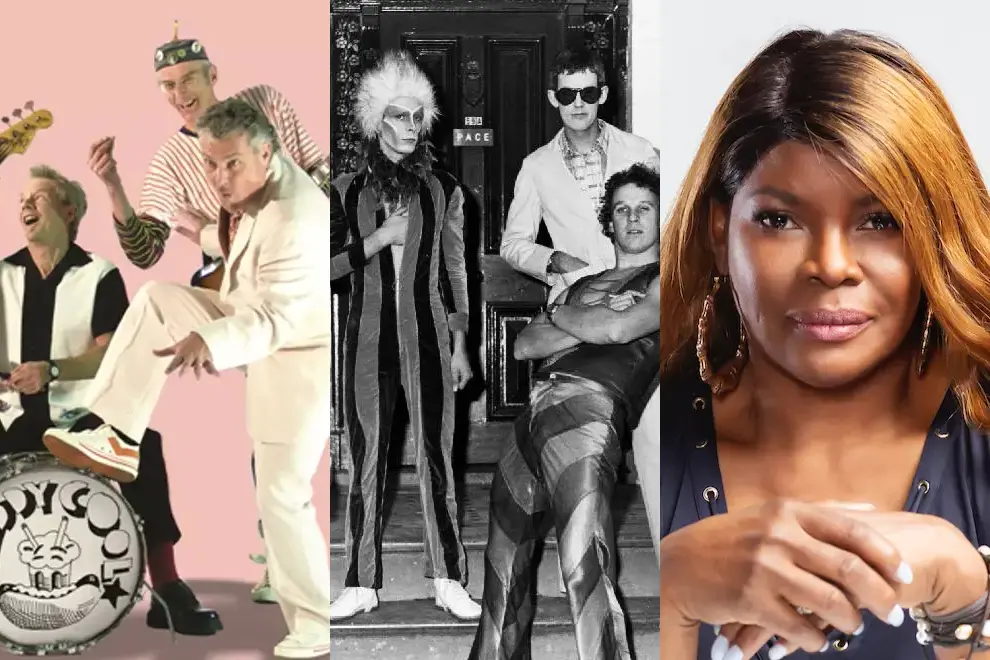
Formed in 1970, Daddy Cool were musically accomplished but they had a sense of goofiness married to ‘50s doo wop that helped loosen up Australian music. Eagle Rock (“now listen!”) with a killer riff stayed at top spot for 10 weeks on the Kent Report and 37 weeks throughout. “This is selling like a Beatles record!” gasped Go-Set.
Its success paved the way for musicians with a theatrical bent, like Captain Matchbox and Skyhooks. Audiences responded to the silliness with their own dance: The Eagle Drop started at a college at the University of Queensland and where trousers were dropped.
Marcia Hines – Fire And Rain (1975)
In her teens growing up in Boston, Marcia Hines attended the famous Woodstock festival and dropped acid. She and her bestie would sneak into the bedroom of the latter’s sister, future disco queen, Donna Summer, and nick her makeup.
Hines arrived in Sydney in 1973 aged 16 to feature in the hippie stage show Hair, and found herself pregnant. As her stomach grew, producers kept hiding her behind stage props.
From then on she became a trailblazer for women of colour, first across theatre and TV. She became the world’s first black Mary Magdalene in Jesus Christ Superstar, hosted her own TV show, became a TV judge, and got awarded an Order of Australia.
Becoming a household name opened up to a record deal. Her debut single was Fire And Rain, first a hit for its fellow-Bostonian writer James Taylor, and with a dose of hot buttered soul.
Her popularity was too huge for commercial radio to ignore, and Hines became the first local black female with a soul sound to get on heavy rotation play. When it became a Top 20 hit, record labels began to scout for other acts of colour.
On the music side, she released 49 singles and 15 albums, sold 2.6 million, was the first Australia-based female to go platinum, the first female to have seven consecutive Top 20 releases, and was inducted into the ARIA Hall of Fame in 2007.
During her acceptance speech after winning Queen Of Pop, Hines said, “I worked hard for it. Thank you for accepting me, as myself.”
Band Of Light – Destiny Song (1973)
Band Of Light was formed by La De Das guitarist Phil Keys, featuring slide maestro Norm Roue.
But they make this list because its songwriters were Keys and his wife Pam Keys, writing under the credit Wheels. They wrote about racial equality, social justice and spiritual harmony.
Debut single Destiny Song (WEA/Warner) encapsulated these themes, signalling radio would play a local spiritual song. It went Top 20 on the Go-Set Charts. Its parent album Total Union (1973), a Top 15 hit, also marked a milestone. It was the first original Australian rock album with a woman as a primary songwriter.
Spectrum – I’ll Be Gone & Trust Me (1971)
Pioneering prog rock/psychedelic group Spectrum were formed in Melbourne by guitarist and songwriter Mike Rudd and bassist Bill Putt. The Rudd-penned I’ll Be Gone was a “hippie” theme about the simple life and the endless journey.
It was a runaway hit that shocked the band when it peaked at #1 on the Go-Set Chart.
Rudd said, “It was a time of the [Gough] Whitlam era when there was great support for all things Australian, including music and musicians.”
The follow-up Trust Me, written by drummer Ray Arnott, was another breakthrough. It fused flute, finger-cymbals, atmospheric keyboard and sitar-themed guitar with a spiritual narrative about “He was there at the start of my search/I travelled so far…and when at the bridge his step I would see.”
Richard Clapton – Prussian Blue (1973)
Australia was traditionally a year behind overseas trends. But the advent of singer songwriters moving into personal and confessional particularly had an impact in Australia when 20-something Richard Clapton arrived back in 1972 from a three year sojourn in Europe and signed to Infinity/Festival.
He had a lot of anecdotes and insights from the trip. He went to London and played in various bands. One consisting of North American players got busted importing marijuana by mail and all of them – including Clapton – got deported.
He ended up in south Germany, living alone in a rambling old house. Prussian Blue, the title track of his debut album, took its name from a shade invented by accident in Germany in the 18th century. The song embraces film maker Luis Buñuel and US sax player Ornette Coleman.
Clapton showed a skill in evoking alienation, survival and environmentalism, creating a deep resonance with his listeners.
The alienation was from a left-curve life. He was born Terry Goh in Sydney to an Australian nurse and Australian-Chinese doctor who split up when he was two. His mother suffered from mental issues and often kept him in care until she committed suicide. Clapton met his father for the first time at her funeral.
He mental-bombed his personal feelings via Bob Dylan and Rolling Stones records. They taught him the art of dropping the listener into the middle of a story and trying to figure out the background. He changed his name legally in tribute to Keith Richards and Eric Clapton.
The Prussian Blue album struck a chord with many writers. It initially sold only 2,000 copies on first release. But through the years it was discovered by new artists and music fans as a masterclass in story telling.
The record company insisted he come up with something radio friendly. Girls On The Avenue (1975) was written in an hour, about three girls on a street called The Avenue in Rose Bay.
Then label hated it, rejecting it six times – “they called it a pile of rubbish, asking, Where the chorus?” – and grudgingly released it as a B-side to Travelling Down The Castlereagh.
But triple j and commercial radio flipped the disc, and Girls On The Avenue reached #4. It was adopted by hookers as their theme song. “My manager told me, ‘Don’t correct, let the urban myth stay; sex sells!’”
Chain – Black & Blue & Judgement (Both 1971)
While British bands such as Led Zeppelin and Blind Faith were updating American blues to the space age, local acts were putting it into an Australian reference.
The most effective was the 1971 Chain line-up of Matt Taylor (vocals, mouth harp), Phil Manning (guitars), Barry Sullivan (bass), and Barry Harvey (drums). Their working class stance and anti-Vietnam War stance saw them draw a huge following and in high-demand at festivals.
Behind this fervour, their debut album Towards The Blues (Infinity/Festival) went Top 10 and was certified gold. It had two hits.
Black & Blue was a traditional chain gang blues, but rewritten for Australia’s penal colony beginnings, and a capitalist system which enslaved its workers. It reached #12 on the Go-Set Charts. Judgement was more evocative and modernised, incorporating wah-wah effects.
Visiting US bluesmen B.B. King, Albert King, Freddie King, Muddy Waters, Buddy Guy, and Willie Dixon were awed by their sound – "You play the blues, but it ain’t like no blues I’ve ever heard in my life," Albert Collins told Taylor – while UK’s Manfred Mann’s Earth Band covered Black & Blue on their 1973 album Messin’.
Chain not only set up the sound of Aussie blues but opened up expectations for others. They were the first blues band to be on TV, first to tour nationally and first to become household names.
This piece of content has been assisted by the Australian Government through Music Australia and Creative Australia, its arts funding and advisory body