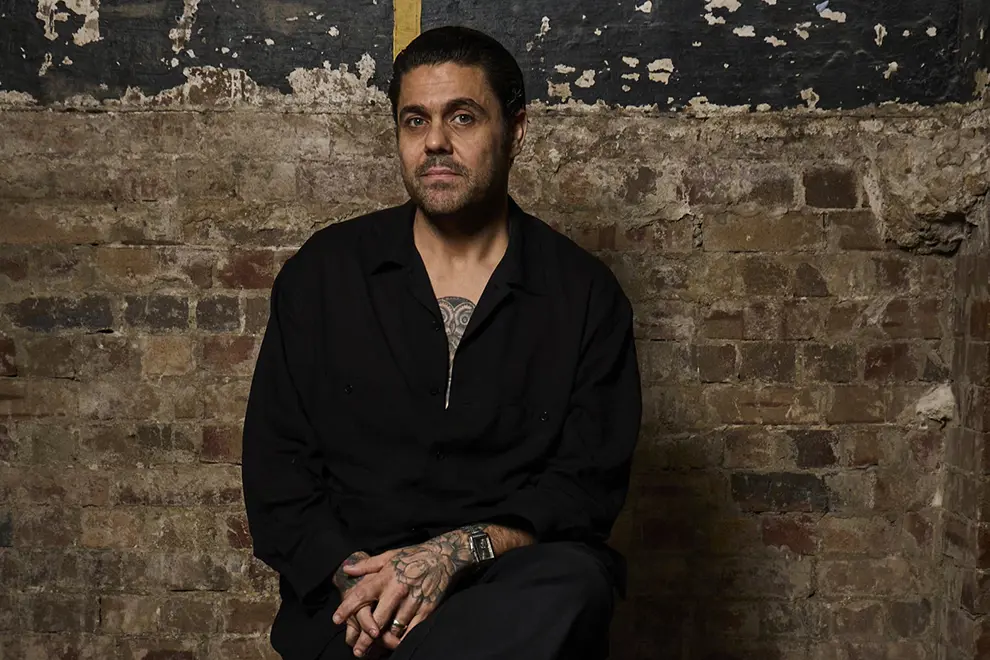
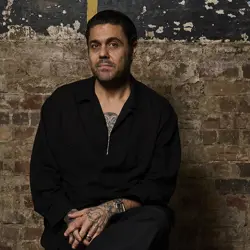
 Dan Sultan Profile
It's been said you have a lifetime to write your first album and three months to write your second. It's up to you whether you believe it, but Dan Sultan has seemingly taken this drastic shortening of time to its logical conclusion.
For his sixth mainline studio album Little Miracles, the Arrernte and Gurindji singer-songwriter wrote the whole thing in approximately 12 days last year – then proceeded to record the whole thing in roughly three weeks.
In an era of long gestation periods and extensive absences, there's an unexpected urgency when Sultan describes the creation of his newly-released album.
“I mean... I wouldn't recommend it,” he grins, almost choking on a cloud of vape smoke as he laughs from his balcony. “Normally, you've got a body of work that you're crafting a record from – you've written 20, you pick 14, it goes down to 12, whatever have you. This wasn't like that at all.
"I had a writing session in June with Guy, I went back in August and we finished it when I came back for a week in October. It was incredibly free-flowing and serendipitous. It was lightning in a bottle. At the end of it all, I mentioned to Guy how quickly it all came together.
"He replied, 'it was a time of little miracles'. He was the one that coined the phrase!”
Guy, for those of you playing at home, is acclaimed English producer and songwriter Guy Chambers. Best known as Robbie Williams' right-hand man through the early stages of his career – working on classics like Angels and Rock DJ – the unlikely pairing was originally forged through an even more unlikely connection: INXS.
Sultan provided vocals to a reworked version of the band's Just Keep Walking for the Original Sin album, which was produced by Chambers – although they didn't work together directly at the time.
“Guy's name was brought up back then as someone to maybe possibly work with on one of my own albums in the future,” Sultan recalls. “I don't think it ever came across his desk at the time, but it certainly came across mine. That didn't end up happening – and if I look back, it was the start of a pretty rocky time for me. I achieved a lot of success back home, but as far as that step into the big pond, it just never really happened.
"That was something that I regretted, and it's a difficult thing to be totally honest about. Cut to April last year: I had some work in Europe, and I put the word out to my publishers that I'd love to do some writing while I'm in London. I woke up to an email that we had a writing session with Guy. That was a really beautiful, full-circle moment.”
By the time Sultan was in the room with Chambers for the first time, writing what would become the song Atlas, he'd had another realisation:
At that exact moment, seven years prior, he'd hit rock bottom. Ongoing struggles with addiction and alcoholism came to a head during a solo performance at the Tanks Art Centre in Cairns, during which he collapsed on stage and engaged in what he later described as “inexcusable and disrespectful” behaviour.
“I touched my last drink a few days after that show,” says Sultan solemnly. “That was one of the most difficult nights of my life. I was really unwell, and it all ended in disaster. I went through a lot of disappointment, and a lot of feelings of unfulfilment with my artistic identity. I felt like I was never going to reach my full potential.
"Seven years, to the second I was on-stage in Cairns, I was sitting in Guy Chambers' studio. That was another little miracle. It became this life-affirming experience.”
Sultan unflinchingly refers to Little Miracles as the best album that he's ever made – and really, you're inclined to agree. It's an accomplished, fully-realised vision of pensive balladry, soaring choruses and classy flourishes of strings and horns for good measure.
“These are the best songs I've written,” he says.
“I love the way the music moves in Can't Be For Nothing – I can't believe I was able to write that. I think the bridge to Here For Love is so beautiful – the time signature change, the key change, that big '70s Delphonic vocal stack moment.
"I feel like my songwriting really levelled up in a big way on this record, and it was an incredible experience.”
Going through other highlights, Sultan turns to the jaunty One Star At A Time – which, to him, best reflected the transformative nature of working with Chambers and his ensemble of top UK session players.
Originally conceived as more of a ballad, the first few runs at the song were “not at the place they should have been,” per Sultan. That changed, surprisingly, thanks to some joggers going through London's Hyde Park.
“I was walking past the tennis courts, up to the rose garden, and they all went past me at pretty much the same tempo,” says Sultan. “It put that kind of piano-driven beat in my head – Mr. Blue Sky by ELO, or Paul [McCartney]'s verse in [The Beatles'] A Day In The Life.
"I started singing that ballady idea to that rhythm, and it ended up working really well. It's a very British sound, and it felt like the perfect opportunity to explore that sound that really resonated with me.”
In speaking of his own music and his own craft, Sultan never comes across as braggadocious or pretentious. Rather, he's proud. To him, this is the culmination of a journey that began exactly 20 years ago – when Sultan, all of 21 years old, released his debut album Homemade Biscuits.
Although you can start to hear the makings of Sultan's powerful vocals and heart-on-sleeve songwriting, it's not all the way there yet – and really, nor should it have been at that age.
When asked what's something he wishes he knew about making albums then that he knows now, Sultan pauses. “I'm not sure if there's anything I'd change,” he eventually replies.
“Really, I think the only thing I would do differently is to trust my instincts more. Back then, I might have been a bit more easily talked in or out of something – even when I was feeling the opposite to whatever it was. I'd dull myself down a bit.
"That's not really something that I allow anymore, and that's a big part of growing up and figuring out who you are as a person.”
So, 20 years in the game, who does Dan Sultan want to be?
“A provider for my kids,” he replies. “Fulfilling my artistic identity – as a writer, as a producer, as a composer, as a singer. I'm extremely fortunate in this life, and it's never lost on me, but it's hard out there, man.
"I've always known where I belonged, but it's only been after getting healthy have I been able to really confidently be in this kind of space. I've taken huge comfort in this process.”
Dan Sultan's Little Miracles is out now.
This piece of content has been assisted by the Australian Government through Music Australia and Creative Australia, its arts funding and advisory body