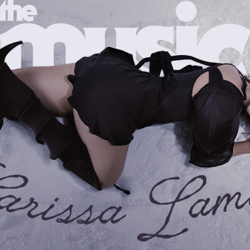
 Larissa Lambert Profile
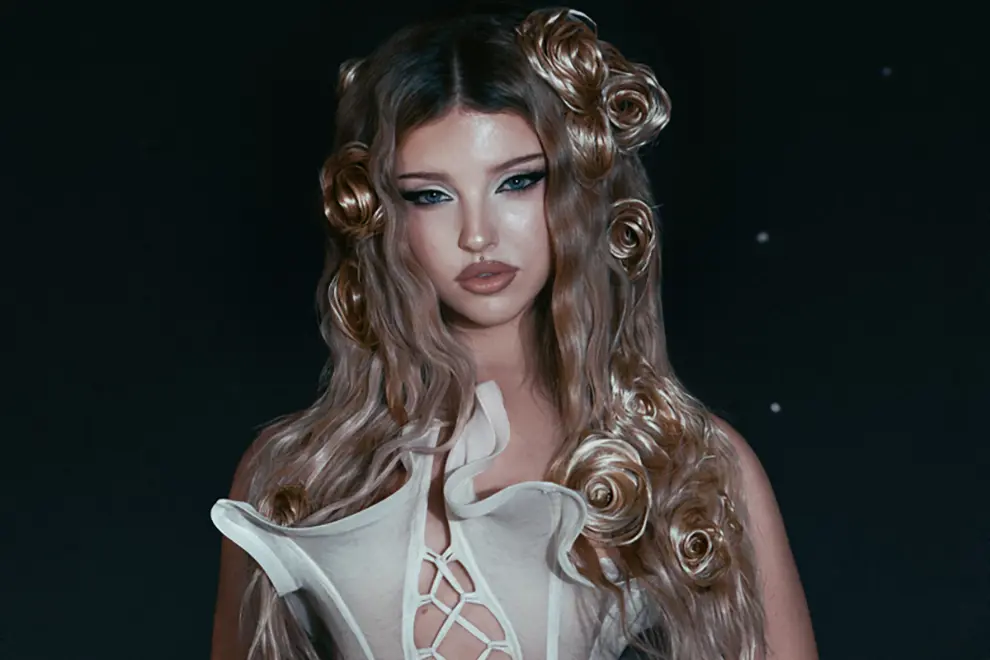
When Larissa Lambert was first entering the public eye, the rising R&B singer was worried about how she’d be perceived. “I thought that people would think my hobbies are a bit weird,” Lambert says. “Or, they’d think I’m a bit bogan.”
“I like metal detecting, going fossicking,” she continues. “I’m always camping. That’s what I do most weekends. I have very high interest in bugs and animals. Anything in nature. I love nature. But, at the moment, fossicking is my fixation. I found a fossil recently, a fossilised leaf in a rock, that was incredible.
“I haven’t found any gold yet, but I’m going to get a bunch of gold. I want that gold. It must be the Ballarat in me.”
With the release of her debut album, Yearning, Lambert is stepping onto an international stage. But, she’s very much a girl from Ballarat. “There’s a side of me that would just love to have a farm, to be in nature with a bunch of animals. Pop out some babies. Just disappear,” she laughs.
Growing up, she was “very adventurous”, all skinned knees and attitude. “I was always out exploring some abandoned house. Running around in some river, playing with bugs, getting dirty,” Lambert recalls. She wasn’t much for school (“I absolutely hated it”) and was raised in a dysfunctional family; where her father was in and out of prison, and her mother struggled with mental health problems.
“I grew up in a pretty dysfunctional household,” Lambert admits. “I didn’t have the best upbringing. I was never really taught how to manage my emotions. I think that’s how I ended up with an addictive personality, and falling into drug use at a pretty early age.”
Luckily, there was always music. “When I was a kid, that’s what kept me sane: other people’s music,” Lambert offers. “Music was, very early on, my therapy. Just belting a song, that emotional release. I would have so much emotion in me, and would have no idea what to do with it. So, I’d sing.”
She loved Aaliyah, Christina Aguilera, and Mariah Carey. “I always gravitated towards the sad, emo songs,” she recounts, “singing them in front of the mirror, pretending they were mine.”
Having discovered how to use singing as therapy, Lambert, in turn, wanted nothing more than to do that with her life. “I always wanted to be a singer. It’s cliché. But I’ve always known… I realised pretty young: ‘okay, this is what I’m good at’. The pull to do it as a job is just embedded in me. And I don’t really have a backup plan.”
As a teenager, she attended music camps, performed in a girl group, appeared on The X Factor, tried her best to make it. Her careers teacher told her not to bother finishing Year 12. Throughout those years, she worked to support herself and her dreams; she shouts out her time working for Rio Bravo Pizza in Ballarat as a key life stage.
“It definitely me a long time to quit the 9-5,” Lambert says. ”To quit the pizza shop jobs or the retail jobs. I’ve had so many of those jobs to keep the bills paid. I couldn’t even count it on both hands. It took me about eight years to make enough money that I didn’t have to do that anymore.”
Though she’d started posting videos on YouTube way back in 2012, it wasn’t until her 2021 cover of SWV’s 1992 single Weak blew up on algorithmic media that Lambert’s career really turned.
She suddenly had global attention, and initially felt like she should do more covers in a similar style. “I thought ‘this is what people want! I need to do this!’ I was thinking of other people, rather than [asking myself] ‘what do you want to do?’”
Trying to succeed in the public eye, Lambert reckons, “can be debilitating if you’re a severe people-pleaser.” Though she’s, by nature, very open as a person, as an artist, Lambert says, she “had [her] walls up.”
“I wasn’t allowing myself to truly be open, to be me,” she offers. “I felt like I was holding back. Fear of what other people would think was a big one. Fear of not releasing the right kind of music.
“Posting things where I was listening to the outside noise, and it not feeling right, not feeling good in my heart. What’s the point? If I’m releasing these songs that are ‘bangers’ and are going on the radio, but I fucking hate them, or I’m performing them and I can’t even figure out how to dance to them because I don’t like them, what am I doing?!
“That’s not what I signed up for. I’m a deep person, my artistry is very special to me. I can’t go against that. I’m not doing this to be famous, that’s unfortunately just something that comes with it. Being famous is a privacy sacrifice. I’m doing it to make music, for the love of music.”
The road from her Weak cover to this moment has found Lambert receiving public praise from SZA, Justin Bieber, and Craig David, found her sound through two EPs (2023’s I Love You And It’s Getting Worse and 2025’s Chronosick), and struck up an in-sync collaborative relationship with producer Khaled Rohaim, best known for his work with The Kid LAROI.
Now, Lambert feels, she’s finally ready for the release of her debut LP, Yearning. “The album is all about love in all forms. Self-love, toxic love, relationship love, friendship love. Then there’s the songs that make you want to fall in love,” Lambert enthuses.
It’s taken her a long time to get here — some of the songs have been worked on for six years — in part because she wanted it that way. “I held off on releasing a debut album for a long time because I didn’t feel like I was ready,” Lambert says.
“But I’m at a point where I just need to stop giving a fuck, and just be open. It’s about having no ego, no pride. Feel what you feel and put it out there.”
Evidence of this change is reflected, Lambert offers, in a song called Damaged Goods, which was given a radical reworking mid-way into its existence. “I initially wrote that about a person, a bad relationship back in the day,” she explains. “But, then I went through some experiences a few years later.
“I was going through a really messed-up mental challenge in my life. I was going through a psychosis, from a prescription drug withdrawal. And, I was losing my mind. For a good three months I was out of it completely. I was scared. I was in severe paranoia. My brain was just, like, flipping it.”
The reworked version, Lambert says, draws on those times, the difficulty of that period. “That song means so much to me, now, whereas the meaning [that it had] before, that doesn’t mean anything to me at all,” she says. “[The version now] is what I want to sing on stage. I don’t want to sing about some fucking loser I don’t even see anymore.”
Those days of withdrawal and its psychic fallout are in the past now. “I’m great now. I’m sober. Straighty one-eighty,” Lambert beams. “I feel at peace for once in my life. I used to get in my head real bad... [but] it’s so good to get it all out. Holding shit in is what causes mental health problems. That’s what causes personality problems, causes depression.”
Lambert is even learning to deal with the perceptions of others; something that will only be amplified with Yearning’s release. “Being perceived online is terrifying, it’s so terrifying,” she sighs.
“People don’t understand the weight of being perceived by millions of people. Because you’re going to have days where you’re perceived by the wrong type of people, that just don’t fuck with you. You definitely get people that just hate you, for no reason. It’s just inevitable on the internet.”
Lambert’s counter is to express more of herself, both in music and online. To let the Ballarat in her shine through. In part, she admits, to counter the hilariously misguided misassumptions that can be made about her, based solely on her looks.
“People perceive me as some rich white girl using daddy’s money. They don’t know that my dad’s in jail, they don’t know this side of me. From looking at me they just think I’m some entitled bitch. It’s so off. It’s so funny,” she says.
“So I’ve started to try and show people who I am a bit more. I’ve recently started to do more deep dives into my personal life and my personality. I try to be as authentic as I can. That’s my biggest goal in everything I do.”
Larissa Lambert’s Yearning releases September 18th.
This piece of content has been assisted by the Australian Government through Music Australia and Creative Australia, its arts funding and advisory body