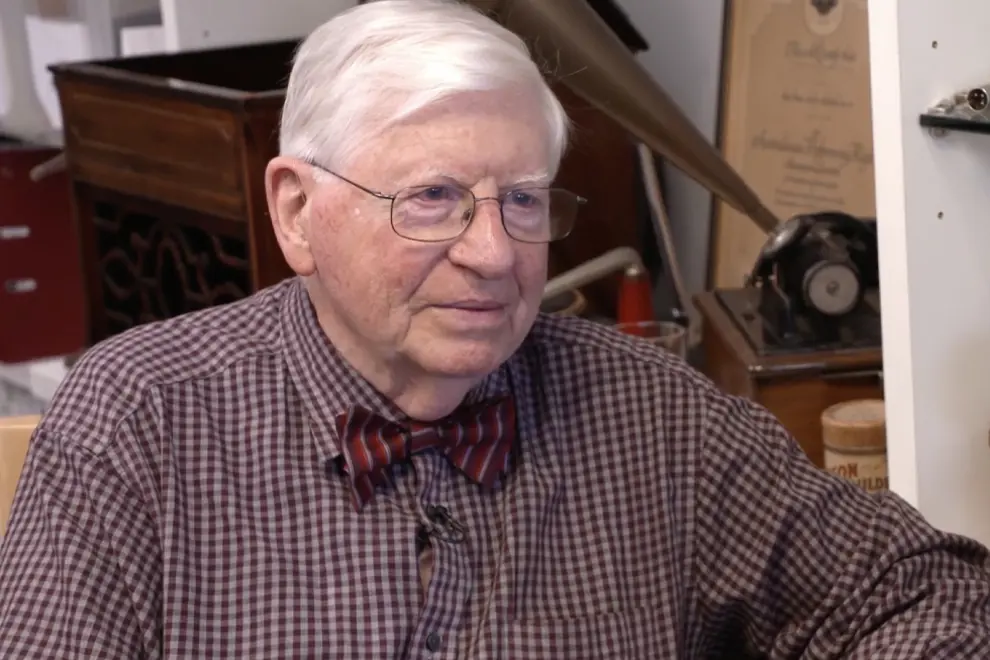
Plans are being amped up to create a permanent memorial for music, radio, mentor and audio pioneer Bill Armstrong AM after he passed away August 7th at the age of 97.
One is the Bill Armstrong Square in South Melbourne. The idea has been mooted for some years.
Bank Street, where the world famous Armstrong Studios was situated for decades, would be closed between Clarendon Street and the South Melbourne Town Hall to become a mall with an entertainment industry focus.
It embraces the importance of the entertainment industry in the area. It would include a Walk of Fame that would also honour late pioneers such as recording label founder Ron Tudor and music editor Ed Nimmervoll who worked at various stages of their careers in the area.
It is understood that some councillors including the mayor are in favour of the idea. It needs more public support, with supporters urged to email the Mayor of Port Phillip.
“We all looked up to him as our mentor,” producer and engineer Mark Opitz once told this writer. “He was totally untouchable in what he meant to us all as a figurehead.
“It’s hard to summarise his achievements. But Armstrong Studios was clearly one of them. It was the premier studio in Australia for a long time. Bill was obsessed with sounds and recording.
“Armstrong Studios was the first studio in the world to install an eight-track outside of America. Not even Abbey Road in London had that.”
Producer and engineer Ross Cockle, who worked at a time at Armstrong Studios posted, “He has affected so many people’s lives for the better, through his (and business partner Roger Savage) foresight in making it possible for many Australian music artists and composers to record with the best technology available at every stage from the ‘50s on.
“He did one of the first live recordings with the Pyro wire recorder…and he was responsible for the installation of the first PA at the MCG for the Melbourne Olympics (in 1956).
“So many more milestones. I feel very lucky and thankful for his and Roger’s guidance and all at Armstrong’s/AAV that were influenced by his vision and expertise.”
Another sector that hero-worshipped Armstrong were road crews, obviously through their sound engineering on the road. Many would further their skills learning under Armstrong.
“Bill was definitely a friend to the industry, his splendid legacy included road crew members,” Opitz asserted. “A couple of them were put on staff, in semi-managerial positions.”
“Crews and roadies put him on a pedestal,” confirmed Ian “Piggy” Peel, co-founder and former director of the Australian Road Crew Association.
“We regarded him as a truly unsung hero of the music industry, especially how he pioneered recording against all odds. He gave us his time and knowledge so we could learn.”
The appreciation was not one-way. In 2024, Armstrong donated 46 albums from his jazz labels Bilarm Music and Swaggie Records to ARCA. They were to be released on CD and vinyl through the association’s Black Box Records to raise funds for crews in crisis.
They summarised how the likes of pianist Graeme Bell, trumpet and cornet player Bob Barnard, multi-instrumentalist Don Burrows, trumpeter Frank Johnson, and banjo player Smacka Fitzgibbon built up the jazz scene.
ARCA in turn began negotiations with a major awards event to set up a Bill Armstrong category to honour those in the industry who worked in the back scenes. This week an ARCA director confirmed it was something still being pursued.
ARCA also had plans for government bodies to fund a Bill Armstrong bequest to give emerging studio producers and engineers a career boost.
Jazz
Bill Armstrong was born in Melbourne in June 1929. The Australian jazz scene was entering its golden period when Armstrong was in his teens, and he became hooked.
“There were jazz clubs offering a lot of work, and after World War II, a number of great local bands emerged,” he told this writer. “Graeme Bell, Bob Barnard, and Frank Johnson were friends of mine.”
The players had a problem: they had no idea how they sounded on stage. Cue their tech-mad friend with an obsession with sounds and latest devices.
Bill turned the family home at 100 Darling Street in East Malvern into a makeshift studio. The enclosed back veranda with a piano was the focal point. His bedroom was the control room.
His friends would make 78 rpm acetates and hear themselves on record for the first time.
“They could hear it back immediately,” Bill remembered. “Just the look on their faces listening to themselves made it all worthwhile.”
It was expected Bill would become a builder like his father and brothers. But he went to Caulfield Technical College to study electrical engineering.
A friend, Neil McRae, a technical engineer at microphone manufacturer Steans Sound Systems, taught him about audio technology and helped him build amps and a disc cutting machine by the age of 19.
Within 12 months, he bought a Pyrox wire recorder, which let him record at jazz gigs.
In the early 1950s he started releasing local jazz records through his record labels Paramount, Magnasound, and Danceland. He worked for ABC Radio producing broadcasts.
Between 1956 and 1960, he worked for W&G Records and set up its first recording studio, and recorded acts as Graeme Bell and The Seekers, and commercial jingles.
He’d long hankered to build his own recording studio.
At the time, making jingles was more lucrative than records. So Armstrong worked out that most of the ad agencies were on Albert Road in South Melbourne, and decided to set up shop in one of the terrace homes there.
He went on a reconnaissance mission, and spotted a man in a singlet mowing the lawn outside one. “Are any of these for rent?” he asked.
It turned out the man owned a number of properties. The first terrace house was rented for £18 on December 1st, 1965. As other houses became available, Armstrong Studios expanded to five more on the street and one behind. They were illegally inter-connected with wires and cables.
Armstrong’s interests were jazz, and he admitted he knew little about recording rock acts. That changed when Roger Savage migrated to Melbourne and became his partner in the venture.
Savage worked as a junior engineer at Olympic Studios in London, and had worked with The Rolling Stones on demos.
Armstrong Studios became a hit factory, accounting for recording 80% of the Australian music in the charts at the time. It was where Daddy Cool, Skyhooks, Russell Morris, and Normie Rowe cut discs.
A rumour was that John(ny) Farnham’s debut single Sadie (The Cleaning Lady) was written about the studio’s cleaning lady.
Armstrong Studios was also a hub for jingles. Bill allowed composers to write there for free, as long as their jingles were cut in the studio.
According to award-winning producer and engineer Ernie Rose: “One of Bill’s legacies was the way he introduced pop music to the advertising scene in Melbourne.
“Before Armstrongs, all the commercials were done in jingle houses with an in-house music director with jazzy dance band music from the 1950s.
Bill introduced contemporary singer songwriters like Hans Poulsen, Pete Best, Mike Brady, and Bruce Woodley into the jingles scene.
“He brought advertisers to pop musicians. It created a whole industry, there must have been 50 or 60 musicians who could live off the extra money they made from jingles while simultaneously also enjoying pop careers.
“This is significant: it not only made advertising hip and current but gave pop musicians the chance for a stable income.”
Mentored
Armstrong and Savage also discovered and mentored engineers and producers as Rose, John L Sayers, Graham Owens, David Mackay, Howard Gable, Peter Dawkins, Ted Albert, and Ian Meldrum.
Rose told The Music this week: “Bill was his own solar system, and planets revolved around him. He knew how to spot talent and encouraged it.
“They in turn were loyal and dedicated to him. Most people deal in the currency of money, Bill dealt in the currency of loyalty.”
Rose was speaking from experience. He was expected to become a builder like the rest of his family. For a year he rang up Bill every two days to wrangle a job in the studio.
Bill asked him to build a studio and equip it. He was so impressed with the results that Rose was given a staff job and equipped other studios.
Rose went on to produce or engineer for Little River Band, Spectrum, Billy Thorpe & The Aztecs, Farnham, Split Enz, KISS, Diesel, Tommy Emmanuel, Courtney Barnett, and Renee Geyer.
Armstrong said: “The main thing about the music industry is to somehow get your foot in the door.
“I was very lucky that everyone who came up through us was very enthusiastic about what they wanted, and keen to learn from people. We were very successful because of that.”
In 1972 Armstrong Studios moved to a new five-studio complex at 180 Bank St in South Melbourne, the site of an old butter factory.
Armstrong was part of the consortium that founded Australia’s first major FM radio station EON-FM (later rebranded Triple M) and was its first managing director.
In 1986 he sold the studios to the owners of The Melbourne Age "to get back into my love of recording jazz”. He set up Bilarm Music and bought Swaggie Records which pianist and composer Graeme Bell had founded in 1949.
Bill Armstrong was made a Member of the Order of Australia (AM) in 2015.
This piece of content has been assisted by the Australian Government through Music Australia and Creative Australia, its arts funding and advisory body